The identity of Jesus as the Son of David is not just a genealogical fact, but a profound declaration that God’s promises are trustworthy and intricately fulfilled. Matthew’s Gospel highlights the number 14 in Jesus’ genealogy, echoing the numerical value of David’s name in Hebrew, to show that Jesus is the long-awaited heir to David’s throne. This careful weaving of history and prophecy reminds us that God is always at work, even when His plans are not immediately clear to us.
Sometimes, it’s only in hindsight that we see how God has been moving in our lives and in the world. The story of Jesus’ lineage encourages us to trust that God’s faithfulness is not random or accidental, but intentional and purposeful. Even when we cannot see the full picture, we can rest in the assurance that God’s promises are being fulfilled in ways that may only become clear with time.
“Thus says the Lord: David shall never lack a man to sit on the throne of the house of Israel, and the Levitical priests shall never lack a man in my presence to offer burnt offerings, to burn grain offerings, and to make sacrifices forever.” (Jeremiah 33:17-18, ESV)
Reflection: Where in your life do you struggle to see God’s faithfulness? Take a moment to look back and identify one way God has kept a promise to you, even if it was only clear in hindsight.
God’s kingdom often emerges in the most unexpected places and through people the world might overlook. Jesus was born in obscurity, raised in a small town, and lived much of his life away from the centers of power. His ministry was marked by humility, suffering, and a willingness to embrace those on the margins. This pattern reveals a God who delights in working through weakness and humility rather than through worldly strength or status.
This challenges us to pay attention to the quiet, hidden ways God is at work in our own lives and communities. Instead of seeking God only in the spectacular or the obvious, we are invited to look for His presence in the ordinary moments and in people who might otherwise be ignored. God’s activity is often found in the places and people we least expect.
“He raises up the poor from the dust; he lifts the needy from the ash heap to make them sit with princes and inherit a seat of honor. For the pillars of the earth are the Lord’s, and on them he has set the world.” (1 Samuel 2:8, ESV)
Reflection: Who in your life or community might be overlooked or undervalued? How can you intentionally seek to notice and honor God’s work in and through them today?
The kingdom of God is both present and still to come—a reality that shapes the Christian life with hope and perseverance. Jesus inaugurated God’s reign through his life, death, and resurrection, but the fullness of that kingdom is still on the horizon. This “already and not yet” tension means we celebrate the glimpses of God’s reign we see now, while longing for the day when all things will be made new.
Living in this tension calls for both gratitude and patience. We are invited to rejoice in the ways God’s kingdom is breaking into our world—through acts of justice, healing, and love—while also holding onto hope for the ultimate restoration that is yet to come. This perspective helps us persevere through disappointment and suffering, knowing that God’s story is not yet finished.
“For here we have no lasting city, but we seek the city that is to come. Through him then let us continually offer up a sacrifice of praise to God, that is, the fruit of lips that acknowledge his name.” (Hebrews 13:14-15, ESV)
Reflection: What is one area of your life where you feel the tension between God’s promises and your current reality? How can you practice both gratitude and hope in that area today?
Recognizing Jesus as King is not a passive belief, but a call to active participation in his kingdom. Every act of healing, forgiveness, and love is a sign of God’s reign breaking into our world. We are invited to join in this ongoing work, even when the results are incomplete or unseen, trusting that our efforts matter in God’s unfolding story.
This means that our daily choices—how we treat others, how we respond to injustice, how we extend grace—are all opportunities to manifest the kingdom of God. We are not called to wait idly for Jesus’ return, but to be agents of his love and justice here and now, knowing that even small acts can have eternal significance.
“And let us not grow weary of doing good, for in due season we will reap, if we do not give up. So then, as we have opportunity, let us do good to everyone, and especially to those who are of the household of faith.” (Galatians 6:9-10, ESV)
Reflection: What is one practical way you can participate in God’s kingdom work today—through an act of kindness, forgiveness, or service—even if no one else notices?
The story of Jesus is ultimately a story of hope that outlasts suffering, injustice, and darkness. The promise of his return as King of Kings assures us that evil will not have the final word. Our faithfulness in the present is anchored in the certainty that Jesus will one day set all things right, and his kingdom will have no end.
This hope empowers us to persevere through hardship and to resist despair, knowing that God’s justice and love will prevail. Even when the world feels broken and our efforts seem small, we can trust that the true King is coming, and that our labor in the Lord is never in vain.
“For the Lord loves justice; he will not forsake his saints. They are preserved forever, but the children of the wicked shall be cut off. The righteous shall inherit the land and dwell upon it forever.” (Psalm 37:28-29, ESV)
Reflection: Where do you see suffering or injustice in your life or the world that feels overwhelming? How can the hope of Jesus’ ultimate victory shape your prayers and actions today?
In this sermon, we explored the question, "Who is Jesus?" by examining the Gospel of Matthew’s presentation of Jesus as the Messiah, the Son of David, and the rightful King of Israel. Drawing a parallel to Tolkien’s Aragorn, whose true identity is revealed through prophecy and lineage, we saw how Matthew uses genealogy, prophecy, and symbolism to establish Jesus’ royal credentials. The sermon highlighted the significance of Jesus’ humble beginnings, the fulfillment of Old Testament prophecies, and the paradox of God’s kingdom being both present and yet to be fully realized. We were challenged to recognize Jesus as King, to participate in the work of his kingdom now, and to live in hope for the day when his reign will be fully revealed.
Matthew’s genealogy isn’t just a list of names—it’s a declaration: DAVID, DAVID, DAVID! Matthew wants us to see that Jesus is the promised Son of David, the true King Israel had been waiting for.
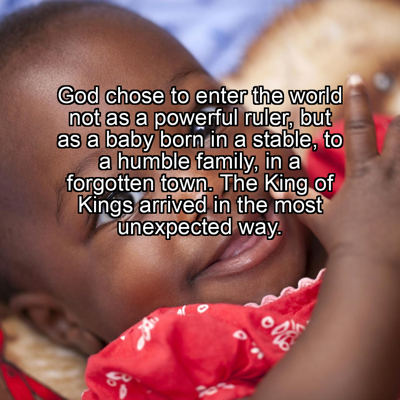
God chose to enter the world not as a powerful ruler, but as a baby born in a stable, to a humble family, in a forgotten town. The King of Kings arrived in the most unexpected way.
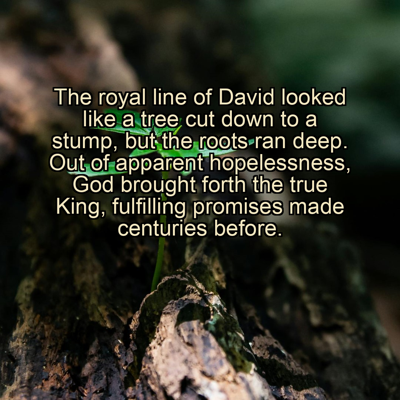
The royal line of David looked like a tree cut down to a stump, but the roots ran deep. Out of apparent hopelessness, God brought forth the true King, fulfilling promises made centuries before.
The birth of Jesus marks the advent of the Kingdom of Heaven. The long wait is over; God’s Kingdom has come! The King is here, and everything changes because of it.
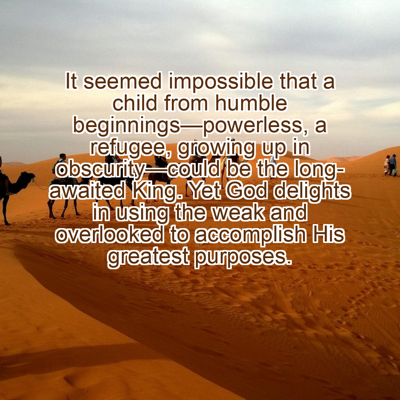
It seemed impossible that a child from humble beginnings—powerless, a refugee, growing up in obscurity—could be the long-awaited King. Yet God delights in using the weak and overlooked to accomplish His greatest purposes.
When we acknowledge Jesus as the one true King, the Kingdom of God becomes real in our lives. We are invited to spread hope, pray for healing, and sow seeds of love in a broken world.
God’s Kingdom is both “here” and “not yet.” We see glimpses of His reign, but also the brokenness of our world. Our calling is to keep doing the work of the Kingdom while looking forward to the return of the King.

The story of Jesus reminds us that true greatness often comes in unexpected forms. The world may overlook the humble, but God sees a King where others see only a carpenter’s son.
The visit of the Magi, bringing gifts fit for a king, was a foretaste of a day when all nations will recognize and honor the true King—Jesus, the Messiah.
Even when darkness seems to prevail, we live in hope, knowing that one day the King will return, defeat evil once and for all, and reign over the entire world.
Hi, I'm an AI assistant for the pastor that gave this sermon. What would you like to make from it?
Add this chatbot onto your site with the embed code below
<iframe frameborder="0" src="https://pastors.ai/sermonWidget/sermon/gospel-matthew-author" width="100%" height="100%" style="height:100vh;"></iframe>Copy