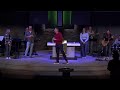
Baptism is a beautiful gift where God makes a lasting covenant with His children. It is a moment where He declares that everything Jesus has done is for you, and nothing can take that away. When life gets difficult and you fall down, you fall into His hands, which is the safest place to be. This sacrament marks you as one redeemed by Christ and welcomes you into a family that will pray for and support you. You are a child of God, and He will never let you go. [17:28]
“Go therefore and make disciples of all nations, baptizing them in the name of the Father and of the Son and of the Holy Spirit.” Matthew 28:19 (ESV)
Reflection: When you face moments of failure or doubt, how does the reality of being a "baptized child of God" change the way you view your worth and your future?
Scripture is described as "God-breathed," a combination of the words for God and spirit or breath. This means that when you engage with the Bible, the Holy Spirit is actively working to bring life into your soul. It is more than just ancient text; it is a tool for teaching, correcting, and training you in righteousness. In a world filled with anxiety and pressure, this word offers a foundation of hope and joy. By making a habit of being in the Word, you allow God to shape your heart and mind daily. [34:02]
“All Scripture is breathed out by God and profitable for teaching, for reproof, for correction, and for training in righteousness.” 2 Timothy 3:16 (ESV)
Reflection: When you consider the pace and pressure of your daily life, what spiritual practice could you adopt to create more space to recognize God's presence in His Word?
A rebuke is often a word that calls for a sharp turn, moving you from one direction back toward God. While the world may suggest you should live however you want, God loves you too much to let you stay stuck in sin. He uses His Word and the community of believers to hold you accountable to the life He has planned for you. These moments are not meant to tear you down but to lift you up and point you toward the cross. True love involves calling one another out of darkness and into the light of Christ. [41:28]
“And he turned and rebuked them. And they went on to another village.” Luke 9:55-56 (ESV)
Reflection: Is there an area of obedience you’ve been postponing or a habit you know is leading you away from God? What is one small, concrete action you can take this week to move toward faithful obedience?
Even in His weakest physical state, Jesus faced the temptations of the enemy by relying on the power of God’s Word. Each time He was challenged, He responded with the phrase, "It is written," showing that Scripture is our primary defense. You are called to follow this example, using the truth of the Bible to rebuke the lies and fears that the world throws your way. The Word has the power to calm storms, cast out darkness, and remind the enemy that you belong to Christ. By hiding these truths in your heart, you find the strength to overcome the trials of life. [48:51]
“But he answered, ‘It is written, “Man shall not live by bread alone, but by every word that comes from the mouth of God.”’” Matthew 4:4 (ESV)
Reflection: What specific "lie" or fear has been loud in your mind lately, and what specific promise from Scripture can you use to rebuke that thought today?
The cross of Jesus Christ stands as the greatest rebuke ever given, as it silenced the accusations of Satan and paid the debt for all sin. Through His death and resurrection, Jesus claimed you as His own and removed your transgressions as far as the east is from the west. This grace is not just a concept but a tangible gift offered to you in the meal of Communion. You are invited to lay your burdens at the foot of the cross and receive the strength to live differently. Because of His victory, you can walk in peace, knowing you are fully loved and completely forgiven. [52:09]
“He entered once for all into the holy places, not by means of the blood of goats and calves but by means of his own blood, thus securing an eternal redemption.” Hebrews 9:12 (ESV)
Reflection: Think of a relationship or a personal failure that feels heavy with guilt. How might God be inviting you to experience His "tangible grace" and reconciliation in that area this week?
Worship gathered around baptism and Scripture emphasizes a God who both saves and shapes. A child is baptized into the covenantal life of the family of faith, a visible sign that nothing can separate the baptized from God's claim of possession and love. That gift summons a congregation to sustain, pray for, and raise the child in faith, reminding all that baptism marks membership in a body committed to grace and formation.
The sermon then shifts to the heart of Christian formation: the Bible as Theopneustos—“God-breathed.” Scripture is presented not as mere moral advice but as living, Spirit-empowered speech that teaches, reproves, corrects, and trains sinners toward righteousness. Rebuke is reframed as an expression of divine love: God disciplines because God will not allow beloved ones to die in their sin nor to remain comfortable within it. Jesus’ own pattern is pivotal—he rebukes out of compassion, confronts demons and storms with authority, and counters temptation by citing “It is written.” Thus, faithful rebuke always points back to the cross and the grace that enables change.
Practical application follows: rebuke must be given humbly, personally, and in the context of caring community—never as anonymous harassment or performative outrage on social media. The congregation is urged to replace reactive vitriol with patient, Scripture-shaped confrontation and to adopt daily engagement with Scripture as the primary means of being formed. Statistical notes about younger generations illustrate that regular Scripture engagement correlates with lower anxiety and greater resilience. Finally, the congregation is invited to the sacraments—confessing sin, receiving absolution, and tasting the body and blood that confirm God’s promises—so that rebuke and grace together produce transformed lives sent into the world.
``See, that's Jesus on the cross. Jesus going to the cross to rebuke all the lies of Satan. Jesus going to the cross to suffer and die for you and me to rebuke our sin, to cast it out, to take away your punishment, to take away what you deserve, to take away what I deserve for the things that I've done. Jesus took it all upon himself, and there he rebuked Satan.
[00:51:57]
(30 seconds)
#CrossRebukesSatan

And the religious leaders of the day, when they're going off the rails, he rebukes them. He tells, you are whitewashed tombs. You are you are losing your way. You can't do this. Jesus, every now and then, got angry. And when the whole of the society and the temple was going off the rails, when they made worship of God about money and things like that, he made a whip, and he went and he cracked it. And he yelled at them. He rebuked them.
[00:43:55]
(34 seconds)
#RebukeHypocrisy
And so sometimes, a rebuke is a good thing. He also he also rebuked here in in in Mark chapter four. There was there there there was a time when he was out on on the Sea Of Galilee with his disciples, and they're going across the sea, and he's asleep in the boat, and all of a sudden, a huge storm comes up, wind and waves, and it's just rolling, and every other disciples think they're gonna die. They wake Jesus up, and Jesus rebukes the storm. Peace. Be still. And a massive storm that took fishermen and made them fearful for their lives goes away in a heartbeat. Jesus has that power. He's not afraid to rebuke nature.
[00:44:29]
(47 seconds)
#PeaceBeStill
He also rebuked the enemy again and again. In in Luke chapter eight, we have Jesus there, and there's this man who has got so many demons possessing him that when Jesus asked the name, the demons say legion for we are many. He was overcome by all of this stuff, and Jesus says, come out of him. And even the demons must obey. The absolute enemies of God cannot stand before him. He rebukes them.
[00:46:23]
(33 seconds)
#DemonsMustObey
And I believe he's saying to me and you that as children of God, we're called to do the same thing, to rebuke the things that are wrong in this world. But to do it the right way because that's the next question. How did Jesus do it? Always, always out of love. Jesus always rebukes in order to lift people up. He always rebukes to lift people out of their sin. He always rebukes to take them to the cross and to the hope that is found there.
[00:46:56]
(36 seconds)
#RebukeWithLove
In the last couple weeks, I I looked at social media. I I've been spending too much time on it lately, but something I've seen over and over again are people that I love, Christian people, rebuking others, saying things to others that they would never say in person. Putting stuff out there and attacking people. I mean, just vitriol. And I'm talking about from both sides of the aisle yelling at each other and doing it somehow in the name of Jesus.
[00:41:53]
(33 seconds)
#StopChristianVitriol
The Christian Bible Society did a study on it. Those who are active in God's word, though Gen z right now is dealing with more anxiety and depression and fear than any of the other generations by far when they're in the age group that they are in. The ones who are in God's word, 50% less fear, depression, and anxiety. 50% less. Why? Because this word brings life. And I'm asking you, are you in it?
[00:50:57]
(30 seconds)
#ScriptureReducesFear
But he also says this, and I love you too much to let you live in it. My word will rebuke you. And God is good at rebuking. We aren't.
[00:41:21]
(15 seconds)
#LoveRebukes
I'm an AI bot trained specifically on the sermon from Jan 25, 2026. Do you have any questions about it?
Add this chatbot onto your site with the embed code below
<iframe frameborder="0" src="https://pastors.ai/sermonWidget/sermon/gods-word-rebukes-love-home" width="100%" height="100%" style="height:100vh;"></iframe>Copy