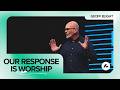
The father sprinted across the field, robes flapping, dust rising as he embraced his stinking son. His calloused hands gripped the boy’s matted hair. “Bring the robe! The ring!” he shouted through tears. No interrogation. No penance. Only a feast for the son who’d wished him dead. The father’s eyes saw worth, not waste. [11:30]
This scene reveals God’s posture toward us. He doesn’t wait for polished apologies. He runs. He interrupts our rehearsed speeches with celebration. The Father’s love isn’t transactional—it’s gravitational, pulling us home through the mess.
When shame whispers you’re too far gone, remember the sprinting Father. His compassion outpaces your worst choices. What broken part of your story do you still hide from His embrace?
“But while he was still a long way off, his father saw him and was filled with compassion for him; he ran to his son, threw his arms around him and kissed him.”
(Luke 15:20, NIV)
Prayer: Thank God for running toward you in your mess. Ask Him to help you receive His embrace today.
Challenge: Write down one regret or failure. Physically open your hands while praying “Father, I receive your compassion for this.”
Music thumped from the house. The older brother stood rigid, arms crossed, smelling of sweat and resentment. “Your son,” he spat, refusing to say “my brother.” The father left the feast to plead with him: “Everything I have is yours.” But the man preferred moral ledgers over mercy. [17:23]
Religious pride locks us out of joy. The older brother’s obedience became a prison, his service a weapon against grace. God begs even the self-righteous to join the celebration—not because they deserve it, but because He’s that generous.
Do you resent God’s kindness to “undeserving” people? Where does your spiritual resume block you from receiving—and sharing—radical grace?
“The older brother became angry and refused to go in. So his father went out and pleaded with him…”
(Luke 15:28-30, NIV)
Prayer: Confess any judgment toward others’ spiritual journeys. Ask for eyes to see people as the Father does.
Challenge: Initiate a conversation with someone you’ve mentally labeled “too far gone.” Listen without agenda.
Shepherds counted sheep nightly. Ninety-nine safe. One missing. He grabbed his staff, leaving the flock with others. All night he searched cliffs and thickets, hoarse from calling. When he found the tangled ewe, he carried her home, shouting, “Celebrate with me!” [07:30]
Jesus highlights the Shepherd’s math: one soul matters more than ninety-nine religious routines. The search party costs something—time, comfort, reputation. But heaven’s economy values rescue over efficiency.
Who feels “lost” in your orbit? Not projects, but people—the coworker who avoids you, the relative who scoffs at faith. Will you let God’s pursuit of you fuel your pursuit of them?
“Suppose one of you has a hundred sheep and loses one of them. Doesn’t he leave the ninety-nine… and go after the lost sheep until he finds it?”
(Luke 15:4-6, NIV)
Prayer: Ask God to make you restless for one specific person’s spiritual homecoming.
Challenge: Text/Call your “one” today with a simple “I was thinking of you.”
Paul grips the Roman church’s shoulders: “Wake up! See what God’s done!” Mercy isn’t a theory—it’s the air you breathe, the reason you’re alive. Your reasonable response? Total surrender. Not grim duty, but awestruck offering. Let grace rewrite your instincts. [24:19]
Worship begins with seeing. The Father’s mercy isn’t a one-time pardon but a daily lens. When we fixate on His compassion, our defenses crumble. We stop trying to pay Him back and start living poured out.
What practical choice today—a conversation, a boundary, a risk—would look different through mercy’s lens?
“Therefore, I urge you, brothers and sisters, in view of God’s mercy, to offer your bodies as a living sacrifice, holy and pleasing to God—this is your true and proper worship.”
(Romans 12:1, NIV)
Prayer: Pray “God, keep my eyes wide open to Your mercies today” every time you touch a door handle.
Challenge: Write “MERGY” on your wrist. Let it redirect complaints to gratitude.
Zacchaeus scrambled up a tree, curiosity overcoming dignity. Jesus didn’t just notice him—He invited Himself over. The town muttered, “He’s eating with sinners!” But the tax collector’s joy erupted: “I’ll repay fourfold!” Mission isn’t programs—it’s carrying the Father’s infectious love. [34:11]
Jesus came to seek. Now He sends us—not as prosecutors, but as witnesses to the Father’s heart. Our worship leaks when we share His relentless pursuit of the lost.
Who needs to see God’s compassion through your hands this week? Not a sermon, but a sandwich. Not a tract, but time.
“For the Son of Man came to seek and to save the lost.”
(Luke 19:10, NIV)
Prayer: Ask God to make you interruptible today by someone needing tangible love.
Challenge: Buy an extra coffee/meal. Ask God to highlight who to give it to.
Jesus sets the tone in Luke 15 by letting “tax collectors and other notorious sinners” draw near while the religious crowd grumbles. Luke 15 then stacks three stories to reveal value and mercy. The sheep is still a sheep. The coin is still a coin. Their intrinsic worth pushes the search. The kicker lands with the son. The younger son treats his father as dead, burns the estate, and ends beneath pigs. He comes home with a true confession, “I am no longer worthy.” The Father sees him, is “filled with love and compassion,” runs, embraces, and kisses him. That running Father frames the heart of God. Mercy moves first. Mercy reaches before stones do. Mercy looks at failure and at faux success with the same eyes, love and compassion. That vision pulls worship up from obligation into gratitude and awe.
Then the older brother steps into view. He has stayed, worked, and tried to repair the damage. He hears music, refuses to go in, and the Father comes out and begs him. That party pictures the kingdom. Offense and judgment can park a soul outside while grace is singing inside. Jesus is not flattering the religious. He is confronting them and pleading with them. Righteousness is a heart thing. A whitewashed cup is still dirty if the inside is untouched. The sin of the younger brother separated him by riotous living. The judgment of the older brother separated him by self-righteous offense. Both need the Father.
Romans 12 names the right response. “With eyes wide open to the mercies of God” the believer offers the body as a living sacrifice. That is intelligent worship. Not earning, surrendering. Not squeezed by the world’s mold, but remolded from within. Transformation is not bait to get God’s attention. Transformation is fruit of his indwelling presence. In Christ comes first, new creation follows.
Acts 1.8 and Luke 19.10 pull the life outward. The Spirit empowers witnesses. The Son of Man came to seek and to save the lost. Tim Keller’s observation lands here. In the first two parables, someone goes looking. In the third, no one does. Culturally the older brother should have gone. Jesus is speaking to older brothers and begging them to come in by going out. True worship carries the Father’s heart to find little brothers. Eyes wide open to mercy. Hands open in surrender. Feet moving toward the lost. That is extraordinary worship.
Church, God loves you. If you don't know Jesus, he's looking at you with love and compassion. That's astonishing to me. I I could imagine Jesus looking at me with disappointment. I could imagine Jesus looking at me with disdain. I can imagine Jesus looking at me going, really? He looks at me with love and compassion. He looks at you with love and compassion. Really? And and so we need to really respond into that love and compassion, and don't let anything get in the way of that. We've so many opportunities to get distracted by that, so many opportunities to become that older brother.
[00:39:51]
(43 seconds)
That's astonishing. Let's just pause and think. When god looks at you, when you've blown it, love and compassion. When god looks at you when you think you've done well, but you really haven't because it's not that good, he just looks with love and compassion. He just loves you. Wake up in the morning. He's looking at me with love and compassion. You with love and compassion. You didn't earn this while we were still sinners. Christ died for us. It's it's amazing that god looks at you with love and compassion. As good or as bad or as indifferent as you are, love and compassion.
[00:13:04]
(28 seconds)
Today, if you realize that Jesus is not in the middle of your world, he's just sort of in the orbit somewhere. He's part of your world. It's he's buzzing around there. He's out there doing his thing. But today, I I just wanna beg you, bring him into the middle with eyes wide open to the mercies of god. Let's present our bodies as living sacrifice. Eyes wide open. God, thank you for what you've done. Here's my life surrendered.
[00:43:02]
(31 seconds)
The thought that occurred to me as I was preparing this that I'd missed the first time at Coolum is why did the father beg him? I'm thinking if Middle Eastern men back in the time of years didn't run much, they probably didn't beg much from their kids. The the reversal of power there is quite astonishing. Why if you're begging, it's because you've really desperate. You're not coming from a place of authority. Why did the father beg him?
[00:17:01]
(36 seconds)
I'm an AI bot trained specifically on the sermon from May 16, 2026. Do you have any questions about it?
Add this chatbot onto your site with the embed code below
<iframe frameborder="0" src="https://pastors.ai/sermonWidget/sermon/gods-father-heart-response" width="100%" height="100%" style="height:100vh;"></iframe>Copy