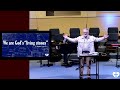
Peter stood face-to-face with Jesus at Caesarea Philippi. Dust swirled as Jesus asked, “Who do you say I am?” Peter’s declaration cut through the tension: “You are the Messiah, the Son of the living God.” Jesus renamed him “Peter” — a small rock — and proclaimed this confession would become the unshakable foundation of His Church. Centuries later, Peter wrote to scattered believers: “You are living stones built on the Cornerstone rejected by men.” [00:36]
Jesus remains the stone that divides human responses. Some stumble over His exclusive claims; others find Him precious. Your confession of Christ as Lord aligns you with Peter’s bedrock truth — the non-negotiable foundation of faith. Without this, no spiritual house can stand.
You’ve declared Christ as Cornerstone. But does your daily life reinforce or undermine that confession? When coworkers question your hope or family mocks your values, does your conduct affirm Christ’s worth? How might your actions today make someone ask, “Why is Jesus so precious to you?”
“As you come to him, the living Stone—rejected by humans but chosen by God and precious to him—you also, like living stones, are being built into a spiritual house to be a holy priesthood, offering spiritual sacrifices acceptable to God through Jesus Christ.”
(1 Peter 2:4-5, NIV)
Prayer: Ask Jesus to reveal areas where you’ve subtly rejected His lordship while claiming Him as Cornerstone.
Challenge: Text one person today: “I’m grateful Jesus is my foundation. How can I pray for yours?”
Workers hauled quarried stones across Jerusalem’s heat. No chisels rang at the temple site — every piece fit perfectly. Solomon’s builders followed the blueprint, joining prepared stones in silence. Peter writes, “You are being built together.” Your past struggles, failures, and victories became the unique contours that let you lock into God’s living temple. [22:27]
God shaped you “off-site” through childhood wounds, career losses, and quiet victories. Like stones dressed in distant quarries, your suffering wasn’t wasted. He used it to carve humility, resilience, or compassion — traits that now bind you to other believers. The Church holds together through the mortar of shared mercy.
Your jagged edges have purpose. That habit you hate? It may equip you to grip someone’s else’s brokenness. That pain you hide? It could fill a crack in another’s faith. What if today’s awkward conversation is God fitting you into His wall? When did a fellow believer’s “rough edge” recently support you?
“In him the whole building is joined together and rises to become a holy temple in the Lord. And in him you too are being built together to become a dwelling in which God lives by his Spirit.”
(Ephesians 2:21-22, NIV)
Prayer: Thank God for three specific “rough edges” in others that have strengthened your faith.
Challenge: Write down one personal struggle, then circle how it helps you relate to others’ pain.
Exiles scattered across Pontus and Cappadocia opened Peter’s letter. “You are aliens,” he wrote. Their Babylonian ancestors knew exile; now they faced Roman disdain. Yet their foreignness became their witness. Pagans watched these “living stones” reject temple orgies, forgive persecutors, and share bread. Some sneered. Others glorified God. [32:54]
You’re a stone from heaven’s quarry planted in enemy territory. Your citizenship labels you an alien, your values a foreign language. But this displacement is strategic. God placed you precisely where your holiness contrasts most sharply with darkness. Your difference isn’t a flaw — it’s your witness.
What “local custom” have you adopted to avoid standing out? Maybe laughing at crude jokes, hiding your tithe, or skipping church for sports. Jesus didn’t stumble into the world’s mold; He disrupted it. Where can you lean into holy foreignness today? What daily practice makes you say, “This isn’t my home’s way of doing things”?
“Dear friends, I urge you, as foreigners and exiles, to abstain from sinful desires, which wage war against your soul. Live such good lives among the pagans that…they may see your good deeds and glorify God.”
(1 Peter 2:11-12, NIV)
Prayer: Confess one way you’ve blended in with darkness to avoid discomfort.
Challenge: Today, decline an expected social ritual (e.g., gossip, vulgar media) with “That’s not how my Family does things.”
Builders tossed aside a peculiar stone — wrong shape, odd angles. But when the arch crumbled, they placed the rejected stone at the peak. It locked the structure into place. Peter quotes Psalm 118: “The stone the builders rejected became the capstone.” Jesus’ resurrection proved Him the ultimate keystone — His victory holds eternity together. [02:58]
Human logic discards Christ’s paradoxes: weakness as strength, death as life, surrender as victory. We want a decorative cornerstone — pretty but inert. Instead, God gives a capstone that demands we bend to His shape. To reject Him is to be crushed by truth; to trust Him is to be secured by grace.
What kingdom logic feels upside-down to you? Maybe “forgive 70×7” when justice screams for payback. Or “lose your life to find it” when culture preaches self-actualization. Which of Jesus’ hard teachings have you tried to discard? How might embracing that “ill-fitting” truth stabilize your spiritual arch today?
“The stone the builders rejected has become the cornerstone…Everyone who falls on that stone will be broken to pieces; anyone on whom it falls will be crushed.”
(Luke 20:17-18, NIV)
Prayer: Name one area where you’re wrestling with God’s “illogical” command. Ask for trust to fall on Him.
Challenge: Share a verse that once offended you with a believer, discussing how it now sustains you.
Smoke curled from morning sacrifices as Old Testament priests approached the temple. Peter startles his readers: “You’re a royal priesthood.” No more animal blood — their entire lives became spiritual offerings. Each meal cooked, child disciplined, and wage earned became worship when done “to declare His praises.” [10:51]
You don’t visit God’s house — you are God’s house. Your kitchen, cubicle, and gym are temple courts. When you work with integrity, parent with patience, or confront sin courageously, you burn incense more fragrant than Old Testament sacrifices. Your priesthood isn’t a role; it’s your reborn identity.
What mundane task today can become your priestly duty? Folding laundry as an act of domestic worship? Processing emails with excellence as a tribute to your King? How will you present your “spiritual sacrifice” at day’s end? What ordinary moment will you sanctify by doing it “for the Audience of One”?
“You are a chosen people, a royal priesthood, a holy nation, God’s special possession, that you may declare the praises of him who called you out of darkness into his wonderful light.”
(1 Peter 2:9, NIV)
Prayer: Offer today’s most tedious task to Christ as a priestly sacrifice.
Challenge: Set a phone reminder: “3 PM – Priesthood Check: Is this action declaring His praise?”
First Peter two presents the image of a divine building project that centers on Jesus as the living stone and on believers as living stones. Jesus stands as the chosen, precious cornerstone whose identity as the Christ anchors every spiritual structure. Those who trust him become part of a spiritual house, fashioned into a holy priesthood that offers spiritual sacrifices through Christ. The confession that Jesus is the Son of the living God forms the Petra foundation; from that confession the Petros stones arise, alive and joined to form God’s temple.
The living-stone metaphor carries practical and moral demand. Lifelike stones produce zeal, mercy, devotion, and conviction; dead stones produce only form without heart. God gathers people of different backgrounds, purchases them from their scattered places, and brings them on-site to be fitted together according to a precise design. Scripture gives the blueprint. The foundation is the Word incarnate and the building rises only when workers read and obey the plans. Obedience to holiness matters because the blueprint calls for lives that reflect the foundation.
The text also warns that the same stone that anchors believers becomes a stumbling block to those who reject the message. Rejection results not merely from intellectual disagreement but from disobedience to the call to repentance and transformation. The church’s strength lies in its living members who live visibly different lives, so that outsiders may see good deeds and glorify God. Paul’s teaching in Ephesians echoes this: the whole building joins together to become a dwelling of the Spirit.
The project remains ongoing. Each person who confesses Christ, who is baptized, and who commits to life under the Word becomes another living stone, broadening and strengthening the walls. The workmanship that shaped each stone off-site informs its fit on-site; past trials and formation prove useful when placed into God’s design. The result is a unified, holy people whose corporate witness rests on the unshakable Petra and whose visible life invites others to join the work.
Without that profession of faith, without acknowledging who Jesus is, unless until you get to that point in your life where you acknowledge that he is the Christ, that he is the son of God, that he came to Earth, and that he put on flesh, that he lived a perfect life, that he died on the cross to pay the full atonement of your sin, that he was dead, and he was buried, and he rose again on the third day until you have that settled in your heart. There is no forgiveness.
[00:06:10]
(29 seconds)
#FaithForForgiveness
Who do you say that Jesus is? We came to understand, and we confessed it with our mouth that he is the Christ, the son of the living God. He is my savior. He is my lord. He died and rose again. It's at the heart of each and every profession of faith. You and I cannot gain access to god unless we acknowledge who Jesus is. It is the first step to our faith. It is the first step to our reconciliation.
[00:05:30]
(28 seconds)
#DeclareJesusFirst
Why is Jesus a stumbling stone? Is it because he asks us to deny ourselves and take up our cross and follow him? Is it because he said to us, turn the other cheek, don't respond in anger? When he said to us, forgive 70 times seven, don't hold grudges, forgive the person who has hurt you. When he says, let he who has no sin cast the first stone when you very well want to be the one to throw that stone. When he said, I am the way, the truth, and the life, and no one comes to the father except through me?
[00:26:17]
(37 seconds)
#JesusTheStumblingStone
Why living stones? Because dead stones form lifeless buildings. Regular old brick and mortar form lifeless buildings. There isn't any life in a building or in a church that is built with dead stones. There's no life, no heart, no spirit, no passion, no zeal, no devotion, and no conviction in a lifeless form, in a lifeless body. But when you have been made alive, when God's church is built with something that is living, you have quite the opposite.
[00:11:18]
(47 seconds)
#LivingStonesAlive
Jesus has gone to the store, and he has purchased every single piece, every single stone, every single nail, every single piece of plywood, every roll of carpet, everything that was necessary, and brought it on-site and built his church. And, of course, I'm talking about each and every one of us. Different walks of life, different personalities, different ways of doing things, different techniques, different opinions, and yet we've all been purchased by God and brought together on-site and put together to be his church.
[00:17:02]
(44 seconds)
#PurchasedAndPlaced
It is the foundation upon which the church of god is built. It is the Petra on which our faith is built. It comes by no other means, no other measures, nothing you could else you can do, no amount of good that you can do. There's no amount of rules that you could check off of your list. There's no amount of money that you could give. There's no buy in to this. It is a 100% absolute confession of faith in the person and work of Jesus Christ.
[00:06:48]
(31 seconds)
#FaithNotWorksFoundation
There's a fairy tale story about Sparta where a king boasted to a visiting king about Sparta's mighty walls. And that king looked around, and he said, I don't see any mighty walls around here. And the king of Sparta pointed out his army, and he pointed at each of them, and he said, that is my wall. And in a similar way, we build up that wall. We are the living stones that comprise the walls of God's true church.
[00:12:06]
(36 seconds)
#WeAreGodsWall
He has fit you right into place. Some may even say, you know, I I don't belong. Some might even say, I don't deserve. Some may even say, how can it be possible that a person like me, I don't deserve this. I've I've heard this said when we were talking to men in the church about becoming deacons. I don't deserve to be a deacon. No. God puts you right into place in this church for the purpose of seeing him glorified.
[00:24:19]
(38 seconds)
#PlacedByGod
Add this chatbot onto your site with the embed code below
<iframe frameborder="0" src="https://pastors.ai/sermonWidget/sermon/gods-building-1-peter-2" width="100%" height="100%" style="height:100vh;"></iframe>Copy