Jul 28, 2026
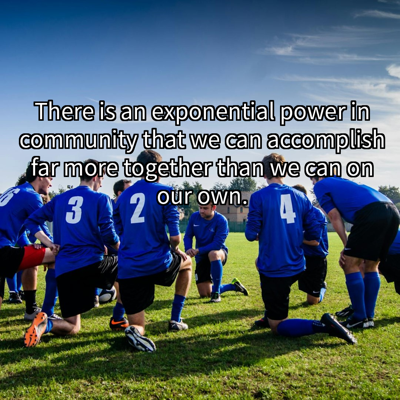
The scripture in Leviticus presents a mathematical mystery. Five people chase one hundred. One hundred people should then chase two thousand. But God says one hundred will chase ten thousand. This is not a math error. It is a divine principle. There is an exponential power released when God’s people move together in community. We accomplish far more collectively than we ever could alone.
This principle shows that God’s design is for multiplication, not just addition. He blesses the unified efforts of his people with a supernatural increase. Your individual strength is good, but our collective strength in Christ is exponentially greater. This is God’s strategy for impacting the world.
You may feel your personal contribution is small. Do not believe that lie. Your presence and participation in the body of Christ multiplies its effectiveness. What frustration have you faced that might be overcome by leaning into the strength of your spiritual community?
“Five of you will chase a hundred, and a hundred of you will chase ten thousand, and your enemies will fall by the sword before you.”
(Leviticus 26:8, NIV)
Prayer: Ask God to open your eyes to the exponential power available to you through your local church.
Challenge: Identify one practical need in your church community and commit to helping meet it this week.
A family’s dog left a constant mess of paw prints and hair on the clean tile floors. The daily cleanup was a source of frustration and complaint. After the dog was gone, the floors stayed clean. The mess was gone, but so was the life, love, and companionship the dog brought. The mess was evidence of a living presence in the home.
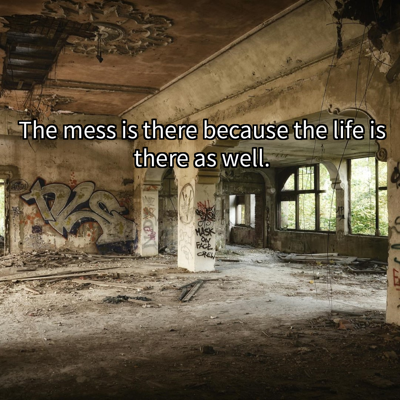
In the same way, the church is a living body. Life together creates mess. There is friction, hurt, and frustration. This is the cost of deep relationship. But the mess is there because the life is there. To avoid the mess is to avoid the profound life God gives through his people.
Your desire for a tidy, conflict-free life can cause you to disengage. You might think it is better to withdraw. But a clean house without life is a hollow victory. Where are you tempted to withdraw from community to avoid the potential for mess?
“Now you are the body of Christ, and each one of you is a part of it.”
(1 Corinthians 12:27, NIV)
Prayer: Thank God for the life that exists even in the midst of relational mess and frustration.
Challenge: Write down one recent friction with another believer and pray for God’s perspective on it.
A bummer lamb is one rejected by its mother. It will die unless the shepherd intervenes. The shepherd feeds it by hand, warms it, and raises it. This hand-reared lamb forms an exceptionally close bond with its caregiver. It learns to recognize the shepherd’s voice above all others. It knows the one who saved its life.
This is a picture of Jesus, our Good Shepherd. We are like those rejected lambs, utterly dependent on his care. He has hand-reared us, saving us from certain death. He calls us by name. Our primary identity is not as independent individuals but as sheep who belong to a shepherd and a flock.
You can easily live as if you are your own shepherd, making your own plans. But your life and safety are found in listening for his voice and staying with the flock. When you hear competing voices today, which one will you follow?
“I am the good shepherd; I know my sheep and my sheep know me— just as the Father knows me and I know the Father—and I lay down my life for the sheep.”
(John 10:14-15, NIV)
Prayer: Confess any tendency to act as your own shepherd and ask to hear Jesus’ voice more clearly.
Challenge: Set aside ten minutes of silence today to simply listen for the Shepherd’s voice.
Scripture speaks of a mysterious restrainer holding back the full force of darkness in the world. Some commentators believe this restrainer is the Holy Spirit working through the church. The church has historically been a vehicle of light, restraining evil and promoting justice, human dignity, and compassion.
This means your local church is not just a social club. It is part of God’s strategy to push back the darkness in your city. When the church is healthy and active, it holds back forces of chaos and despair. Your participation has cosmic significance.
It is easy to see the church’s flaws and failures. You might think it is irrelevant or powerless. But God has chosen the church as his instrument. How does understanding your church as a ‘restrainer’ change your view of its importance?
“For the mystery of lawlessness is already at work. Only he who now restrains it will do so until he is out of the way.”
(2 Thessalonians 2:7, ESV)
Prayer: Pray for your church to be a strong, effective restrainer of darkness in your community.
Challenge: Underline one news headline about local darkness and pray for your church to be a light in that specific area.
God no longer dwells in a temple made of stone. He dwells in his people. Peter calls us living stones, being built into a spiritual house. Each believer is a unique, alive brick. We are connected to one another and founded upon Christ, the cornerstone. Together, we are a dwelling place for God’s glorious presence.
This means the church is holy ground. When you gather with other believers, you are participating in something ancient and magnificent. You are part of the construction of God’s eternal dwelling place. Your presence matters to the structural integrity of the whole.
You may approach church as a spectator, critiquing the music or the preaching. But you are not a visitor to a building; you are a stone in the building. What shift must you make to move from being a spectator to being a committed part of the structure?
“As you come to him, a living stone rejected by men but in the sight of God chosen and precious, you yourselves like living stones are being built up as a spiritual house.”
(1 Peter 2:4-5, ESV)
Prayer: Ask God to help you see your local church as his sacred dwelling place.
Challenge: Text one person in your church to encourage them in their role as a ‘living stone.’
The series opens by distinguishing God with me from God with us, arguing that Scripture primarily addresses communities rather than isolated individuals. Western individualism warps reading of Scripture into a self-centered lens, but Leviticus 26:8 and other texts illustrate exponential power when people act together: community amplifies presence, power, and purpose. Four biblical pictures of the church—body, bride, building, and flock—frame the church’s identity and mission.
The body image (Ephesians 4:15–16; Romans 12:5; 1 Corinthians 12) highlights representation: the visible congregation reflects Christ to the world and each member belongs to the others. Disunity and individualism leave the body ineffective; coordinated submission to Christ as head enables spiritual potency. A personal household story about a dog named Vita and the daily mess of life supplies a concrete metaphor: mess accompanies life and love, and the church’s untidiness often signals where God is at work. Colossians 1:24 reframes suffering and sacrifice as part of the body’s maturation, presenting a balance of giving, receiving, and the danger of remaining neutral.
The bride image (Revelation 19) situates the church as a people preparing for the wedding of the Lamb and engaged in mission. 2 Thessalonians 2 raises the idea of a restrainer—often associated with the Spirit active through the church—holding back lawlessness until God’s appointed time. Historical examples trace how Christian institutions restrained darkness and advanced human dignity, science, and care.
The building image (1 Peter 2; 2 Chronicles) emphasizes living stones joined on Christ the cornerstone so that God dwells among his people; the temple’s fire and the glory that filled Solomon’s house become a preview of corporate habitation by God’s Spirit. The flock image (Psalm 95; John 10) stresses listening to the Shepherd, dependence, and protection. The bummer-lamb motif underscores vulnerability and the intimacy by which sheep recognize their caretaker’s voice.
A conditional promise threads the sermon: if Christ remains head, cornerstone, shepherd, and groom—if the church discerns his voice, submits, and prepares—then the congregation will shine light into darkness and fulfill God’s prepared works together.
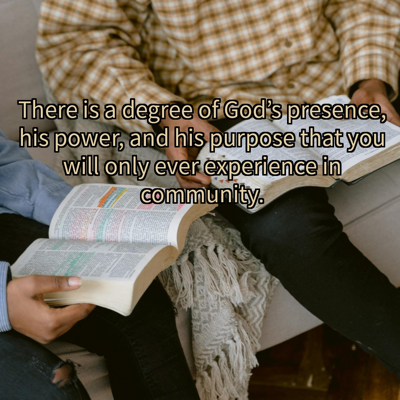
There is a degree of God’s presence, his power, and his purpose that you will only ever experience in community.
There is an exponential power in community that we can accomplish far more together than we can on our own.
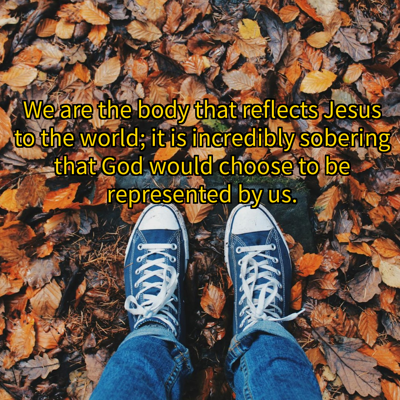
We are the body that reflects Jesus to the world; it is incredibly sobering that God would choose to be represented by us.
The mess is there because the life is there as well.
Sometimes only when those things aren't in your life do you realize how precious they are.
The church is God's answer to the darkness in the world.
The church has been a vehicle the Holy Spirit has used to restrain the forces of darkness.
If we keep Christ as the head, we will see his light shine through us into the darkness.
God has prepared good works for us to do, and he has a mission that requires each and every one of us.
Hi, I'm an AI assistant for the pastor that gave this sermon. What would you like to make from it?
Add this chatbot onto your site with the embed code below
<iframe frameborder="0" src="https://pastors.ai/sermonWidget/sermon/god-with-us5" width="100%" height="100%" style="height:100vh;"></iframe>Copy