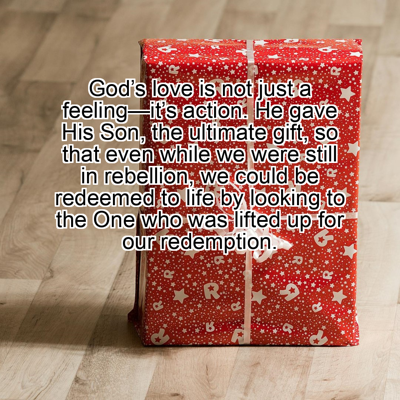
God’s love is shown not as a nice idea but as a deliberate, costly action. When God lifts up His Son, the picture is of purpose and price: a remedy provided where none could be made by human effort. This is the same pattern as the bronze serpent in the wilderness—an object given by God that people were commanded to look to for life. The love on display was planned and paid for before anyone deserved it.
This truth changes how you see yourself and God. You are not loved because of what you have done or how well you measure up; you are loved because God chose to give what was most precious. That should soften pride and harden confidence—not in yourself, but in the certainty that the cost of your rescue has already been met.
2 Corinthians 8:9; Numbers 21:8–9 (ESV)
For you know the grace of our Lord Jesus Christ, that though he was rich, yet for your sake he became poor, so that you by his poverty might become rich.
And the LORD said to Moses, “Make a fiery serpent and set it on a pole, and everyone who is bitten, when he sees it, shall live.” So Moses made a bronze serpent and set it on a pole. And if a serpent bit anyone, he would look at the bronze serpent and live.
Reflection: Identify one area where you try to “earn” God’s favor (behavior, service, reputation). What concrete act this week can you replace with a simple act of looking to Christ—prayer, confession, or resting in His finished work?
Salvation is not a self-help program; it is the work of God from first stirring to final keeping. The heart that trusts is awakened and sustained by the Spirit, not merely by mental agreement or moral effort. Grace initiates the rescue, grace continues it, and grace will complete it—so the believer’s confidence rests in God’s faithfulness rather than in fluctuating feelings or performance.
Because salvation is God’s doing, humility follows. You are invited to receive rather than manufacture faith. That should free you to depend on the means God gives—word, Spirit, community—knowing that your role is responsive trust, and God’s role is effective transformation.
Titus 3:5–7 (ESV)
He saved us, not because of works done by us in righteousness, but according to his own mercy, by the washing of regeneration and renewal of the Holy Spirit, whom he poured out on us richly through Jesus Christ our Savior, so that being justified by his grace we might become heirs according to the hope of eternal life.
Reflection: Think of one daily habit (reading Scripture, silence, worship, confession) you can begin or restore this week as an act of receiving God’s work. Schedule a specific time and place to practice it for the next seven days.
People are not neutral before God; apart from his intervention, the moral condition is one of separation and sentence. Condemnation is the natural consequence of sin—an honest diagnosis of brokenness rather than God’s initial posture of hatred. Recognizing this truth flips the script: Christ did not come to add to a good standing, but to rescue the condemned.
That reshapes evangelism and compassion. When you realize others are not merely mistaken but enslaved, urgency and mercy rise together. The mission of God is to bring the lost out of a justified state of judgment into true life—so the response is both proclamation and patient love toward those still under the sentence.
Romans 3:10–12 (ESV)
As it is written: “None is righteous, no, not one; no one understands; no one seeks for God. All have turned aside; together they have become worthless; no one does good, not even one.”
Reflection: Name one person or group in your life whose spiritual condition you’ve minimized or overlooked. What is one specific, compassionate step you can take this week to speak hope or show help to them?
Belief is not a checklist of doctrines but the handing over of life’s reins to Christ. To believe truly is to let Christ reorder priorities, desires, and plans—not just assent with the mind but trust with the will. That kind of surrender often costs comfort, control, or reputation, but it opens the door to real freedom and new identity.
Surrender is a daily practice, not a one-time event. You will be tempted to hold back in places that matter most—money, relationships, time—but each small act of handing over becomes proof that faith is working. The Spirit enables this surrender, and the posture of humility is the soil in which it grows.
Philippians 3:7–9 (ESV)
But whatever gain I had I counted as loss for the sake of Christ. Indeed I count everything as loss because of the surpassing worth of knowing Christ Jesus my Lord. That I may gain Christ and be found in him, not having a righteousness of my own that comes from the law, but that which comes through faith in Christ.
Reflection: Choose one specific area (finances, schedule, a relationship, your reputation) you are unwilling to fully surrender. What is a concrete first step you can take today to give that area to Christ—and who will you ask to hold you accountable?
People naturally hide from light because light exposes sin and demands change. Yet God’s light is not meant to shame without remedy; it reveals reality so healing can begin. When someone steps into the light, they risk exposure but also receive cleansing and the power to change—transformation follows truth.
Responding to God’s call out of darkness is both courageous and ordinary: it means confessing what is hidden, receiving forgiveness, and letting new desires shape new actions. The community of faith is the place where this light becomes visible and contagious—so stepping into the light also means stepping into fellowship that helps the change endure.
Ephesians 5:8–14 (ESV)
For at one time you were darkness, but now you are light in the Lord. Walk as children of light (for the fruit of light is found in all that is good and right and true), and try to discern what is pleasing to the Lord. Take no part in the unfruitful works of darkness, but instead expose them. For anything that becomes visible is light, and anything that is illuminated is light.
Reflection: What is one secret or pattern you have been hiding that needs to be brought into the light? Name one trusted person you can confess this to this week and set a specific time to meet or speak.
of the Sermon:**
In this sermon, we explored John 3:14–21, focusing on the depth and nature of God’s love as revealed through the giving of His Son, Jesus Christ. The passage moves from the necessity of being born again to the means by which that new birth is made possible: the sacrificial love of God demonstrated in Christ being lifted up on the cross. We examined four distinct ways God’s love is displayed—by lifting up His Son, by sending Him not to condemn but to save, by showing the only way to life, and by calling sinners out of darkness into His light. The message emphasized that salvation is entirely God’s work, initiated and completed by His grace, and that genuine belief is a heart-level surrender, not mere intellectual assent. Ultimately, the sermon called us to respond to God’s love by stepping into the light and trusting in Christ.
**K
God’s love is not just a feeling—it’s action. He gave His Son, the ultimate gift, so that even while we were still in rebellion, we could be redeemed to life by looking to the One who was lifted up for our redemption.
Jesus didn’t come to push the guilty down, but to lift the condemned up. He came not to condemn the world, but to save it, offering freedom from the condemnation we inherit and continue in by our own willing sin.
Belief in Jesus is more than head knowledge or acknowledging He existed. It’s surrendering your life, letting Him change not just what you want, but all of you. True belief transforms your heart and your desires.
Condemnation isn’t coming because God rejects certain people. It comes because people have already rejected Him, choosing to remain in their sin rather than turning to the light of His love and mercy.
The problem isn’t a lack of knowledge about God—it’s a heart problem. Sinful people love the things of this world more than the light, and apart from God’s grace, we would all still be condemned by our sin.
God’s grace is mysterious, but it lands on those He chooses, when He chooses. Not by our merit or effort, but by His love, He draws us to Himself and secures us in faith.
The good news is that anyone drawn by God’s Spirit responds, leaving darkness behind and walking in the light of His truth and love. Transformation happens not by our works, but by His work in us.
God’s love is on display in the New Covenant: all the work belongs to Him. He awakens hearts, calls us out of darkness, and transforms us from condemned to free in Christ.
Even if you haven’t loved God, He has loved you—despite your rebellion and your sin. He sent His Son to save you from condemnation, to redeem and transform you from death to life, from shame to freedom and peace.
God shows us His love by lifting up His Son, sending Him to free us from condemnation, showing us the way to eternal life, and calling us out of darkness into the light of Jesus.
Add this chatbot onto your site with the embed code below
<iframe frameborder="0" src="https://pastors.ai/sermonWidget/sermon/god-who-loves" width="100%" height="100%" style="height:100vh;"></iframe>Copy