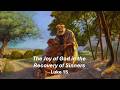
The scriptures reveal a profound and beautiful truth: the God of all creation finds infinite joy in the recovery of those who are lost. This is not a passive acceptance but an active, celebratory joy. He does not merely tolerate the return of a wayward soul; He rejoices over it with gladness. This divine joy is rooted in His own character and the display of His glory through redemption. It is a joy that exists independently of our fluctuating emotions or circumstances, anchored in the finished work of Christ. [05:42]
“And as the bridegroom rejoiceth over the bride, so shall thy God rejoice over thee.” (Isaiah 62:5, KJV)
Reflection: When you consider your own life, what makes it difficult to believe that God rejoices over you with the celebratory joy of a bridegroom? How might accepting this truth change the way you approach Him, especially in moments of failure or shame?
God in His kindness allows us to experience moments of profound, unearthly joy in our lives. These are not mere earthly pleasures but are glimpses of a greater reality, shadows of the perfect joy that awaits in eternity. They are moments that feel like how it was always meant to be, pointing our hearts toward our ultimate home. In eternity, this joy will be made complete, unhindered by sin, shame, or separation, as we worship Christ together with all the saints. [04:03]
“Thou wilt shew me the path of life: in thy presence is fulness of joy; at thy right hand there are pleasures for evermore.” (Psalm 16:11, KJV)
Reflection: Recall a specific moment in your life where you experienced a deep, ‘otherworldly’ joy. How did that moment point your heart toward God and the promise of eternal joy with Him?
The parable of the prodigal son illustrates the true cost of living outside of God’s design. The younger son’s request for his inheritance was a profound act of shame, essentially wishing his father dead. His subsequent rebellion led him to squander his future for temporary pleasure, ultimately leaving him destitute and living among pigs. This is a picture of the human condition—choosing to live as less than what we were created to be, trading our divine inheritance for the fleeting comforts of the world. [35:04]
“And not long after the younger son gathered all together, and took his journey into a far country, and there wasted his substance with riotous living.” (Luke 15:13, KJV)
Reflection: In what ways are you, or have you been, tempted to “sell your future inheritance for pennies on the dollar” by pursuing a path of independence from God? What is one area where you are being invited to trust His design over your own?
In a stunning reversal of cultural expectations, the father in the parable responds to his son’s shameful request and rebellion not with honorable punishment, but with what would have been seen as shameful grace. He gives the son what he asks for, allowing him to experience the painful consequences of his choices. This reflects God’s own patience with us, granting us free will not because He approves of our sin, but because He loves us enough to allow the pain of our rebellion to work its conforming work, ultimately drawing us back to Himself. [28:20]
“And he said, A certain man had two sons: And the younger of them said to his father, Father, give me the portion of goods that falleth to me. And he divided unto them his living.” (Luke 15:11-12, KJV)
Reflection: Where have you experienced the patient, gracious hand of God allowing you to face the consequences of a decision, not to punish you, but to lovingly draw you back to Himself?
The climax of the parable is not the son’s repentance, but the father’s joyful, celebratory, and culturally shameful response to it. While the world expected scorn and punishment, the father ran to his son, embraced him, and restored him fully with a robe, a ring, and a feast. This is the heart of God toward sinners who turn to Him. His joy over our recovery is so great that it defies human convention and logic, compelling Him to meet us in our shame and clothe us in His own righteousness, sparking celebration in heaven. [43:52]
“But the father said to his servants, Bring forth the best robe, and put it on him; and put a ring on his hand, and shoes on his feet: And bring hither the fatted calf, and kill it; and let us eat, and be merry: For this my son was dead, and is alive again; he was lost, and is found. And they began to be merry.” (Luke 15:22-24, KJV)
Reflection: What would it look like for you to truly accept that God’s response to your turning to Him is not a reluctant nod, but a joyful celebration? How does this truth empower you to come to Him just as you are today?
God’s delight in reclaiming what was lost frames the whole argument: recovery is not incidental but central to divine joy. The narrative of Luke 15—lost sheep, lost coin, lost son—is pressed into service to show that God rejoices over sinners who return, not because of their merit but because of His consistent, gracious inclination to restore. Earthly glimpses of joy (weddings, births) are presented as shadows of the fuller, familial joy God intends for His people when sin is finally removed and adoption is fulfilled.
The cultural lens of honor and shame sharpens the shock of the prodigal story: the younger son’s demand for his inheritance was shameful, the father’s compliance scandalous, and the son’s later life of excess a tragic squandering of what was meant for sonship. Yet those same cultural expectations make the father’s response more revealing of God’s heart—he runs, embraces, clothes, rings, and feasts—actions that reinstate identity rather than merely punish or ignore. That restoration is costly: the son learned by pain what instruction might have accomplished, and the preacher insists that God’s allowance of freedom and its consequences can be a means of moral reformation.
Christ’s mission is set squarely in this framework: the Son of Man seeks and saves the lost, and heaven itself rejoices at repentance. Theological anchors—Isaiah’s bridegroom imagery, Jeremiah’s covenantal promises, and the apostolic call to reconciliation—underscore that salvation is both an accomplished work (Christ’s vicarious atonement) and an open invitation (repentance and faith). Repentance is depicted not as a mere emotional shift but as a return to rightful status and relationship, an exchange from pig slop to robe, from alienation to familial fellowship. The closing appeal is pastoral and urgent: because God delights in recovery, those estranged from Him are invited now to trust Christ, enter restored sonship, and participate in the joy that heaven celebrates.
The father said to the servants, quick, bring the best robe and put it on who? The boy with the pig slop on his breath and the dirt under his fingernails. Give him my robe. Bring the best robe and put it on. Put a ring on his finger and sandals on his feet. He's barefooted. He's lost everything. He doesn't even have food to eat. He's barefooted, and he gets a robe that is his father's, and he gets the sandals that his father had worn.
[00:43:03]
(37 seconds)
#restoredSon

For our sake, he made him to be sin who knew no sin. This is Jesus. For our sake, he, God, made him, Jesus, to be sin who knew no sin so that in him, Jesus, we might become the righteousness of God. God loves to recover what is unrecoverable. He loves to redeem what is unredeemable, and he loves to find what is lost. That's your invitation today.
[00:46:49]
(38 seconds)
#righteousByChrist
Why does the boy think he can come home? Because he knows the heart of the father. Don't lose me now. Come on now. Why does the boy think he can just march back into town? Because he knows the heart of the father. That the father is different than other men. He believes that his father will receive him even though receiving him would have been the last thing an honorable man in his culture would have done.
[00:39:21]
(32 seconds)
#knowingFathersHeart
In the same way, I tell you there is rejoicing in the presence of the angels of God over one sinner who repents. Imagine the God of glory, this great and awesome, omniscient, all all powerful God, Actually rejoicing when you say yes to His Lordship and to His Son, the Lord Jesus.
[00:21:16]
(29 seconds)
#angelsRejoice
Sometimes the Lord allows us to feel this rare, unearthly thing that comes only upon special occasions. Utter joy. It's not just an earthly pleasure. There are moments of utter joy that God allows us to experience, and these little glimpses are like a shadow of what we shall experience in the eternity with our God and with His saints.
[00:03:47]
(29 seconds)
#utterHeavenlyJoy
I'm talking about the joy of God in bringing about recovery. And this recovery is what you need greatest in your human life. Recovery from the ruin and harm of yourself that you have done to yourself and the pain and difficulty of living in this fallen world.
[00:20:17]
(26 seconds)
#joyOfRecovery
You may come to church today feeling low and depressed and sad and concerned and feeling like a failure. And as the bridegroom rejoices over his bride, so shall God rejoice over you. You say, yes, but on what merit shall He rejoice over me? On the merit of His decision to cast His gracious mercy upon His chosen people. As much as I rejoice to see Dina and rejoice to hold my two children, God rejoices over you.
[00:05:53]
(38 seconds)
#GodRejoicesOverYou
and the Lord your God is in your midst, a mighty one who will save. He will rejoice over you with gladness, and He will quiet you by His love, and He will exalt over you with loud singing. Imagine the great God, the creator, rejoicing, exalting over people like us. Here's the call to all. If you have ears to hear, hear this. God desires a relationship with you if you will turn to Him.
[00:06:48]
(39 seconds)
#GodWantsYou
I'm an AI bot trained specifically on the sermon from Feb 09, 2026. Do you have any questions about it?
Add this chatbot onto your site with the embed code below
<iframe frameborder="0" src="https://pastors.ai/sermonWidget/sermon/god-joy-recovery-sinners" width="100%" height="100%" style="height:100vh;"></iframe>Copy