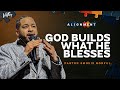
Life often brings moments where others intend to cause you harm or circumstances feel designed to break you. You may feel the weight of betrayal or the sting of unfair treatment, yet there is a greater reality at work. God is able to take the very things meant for your destruction and pivot them toward a redemptive purpose. This shift does not deny the reality of your pain, but it acknowledges that human intervention is never higher than God’s authority. You can rest in the confidence that your tears and trials are being woven into a story of goodness. [01:46]
As for you, you meant evil against me, but God meant it for good, to bring it about that many people should be kept alive, as they are today. (Genesis 50:20 ESV)
Reflection: What is one difficult situation in your life right now where you need to trust that God’s "but" is more powerful than the "harm" intended by others?
In a world that demands instant gratification, it is easy to develop a microwave mentality toward your spiritual growth. You might want the promise immediately, but God values the process because it builds the character necessary to sustain the blessing. Anything that grows too fast often grows too weak to withstand the storms of life. Deep roots are formed in the quiet, difficult seasons of waiting and prayer. When your roots are wrapped around the Rock, you will not bend or break when the winds begin to blow. [22:16]
For I know the plans I have for you, declares the Lord, plans for welfare and not for evil, to give you a future and a hope. (Jeremiah 29:11 ESV)
Reflection: When you consider the pace of your life, what is one area where you have been trying to "microwave" a result that God is inviting you to develop through patient process?
The pit is often the first step in the journey toward God’s ultimate plan for your life. It is a place where God removes the things that cannot survive in the palace, such as pride and a need for external affirmation. While the pit feels like a place of abandonment, it is actually a place of excavation where God digs out what doesn't belong. You may lose your "coat of favor" for a season, but it is only so you can eventually gain true authority. Trust that being emptied is a prerequisite for being elevated in His timing. [37:32]
So when Joseph came to his brothers, they stripped him of his robe, the robe of many colors that he wore. And they took him and threw him into a pit. The pit was empty; there was no water in it. (Genesis 37:23-24 ESV)
Reflection: Is there a "coat" of external affirmation or a sense of entitlement you feel God is asking you to lay down so He can build deeper internal character in you?
Sometimes the process takes you from the pit to a place of service, only to land you in a "prison" season of confinement and waiting. The prison is not a sign that God has forgotten you, but a sign that He is finishing the work within you. It is in these restricted spaces that your character catches up with your calling. You learn to be faithful in places you do not own and to serve without the applause of others. This season of delay is actually a season of development, ensuring you are mature enough to handle the weight of the coming promise. [43:53]
And we know that for those who love God all things work together for good, for those who are called according to his purpose. (Romans 8:28 ESV)
Reflection: In your current season of waiting or restriction, what is one specific way you can practice faithfulness today, even without the recognition of others?
The ultimate goal of your process is never just about your personal comfort or elevation. God shapes you and preserves you so that you can become a source of provision for others. Your private endurance is designed to serve people you will eventually meet in public. When you finally reach the "palace" moment, you will see that the famine in the land required the strategy God built in you during the struggle. Your alignment with His plan is directly connected to the survival and redemption of those around you. [58:25]
As for you, you meant evil against me, but God meant it for good, to bring it about that many people should be kept alive, as they are today. (Genesis 50:20 ESV)
Reflection: Looking back at a past trial you’ve overcome, who is one person in your life today who might benefit from hearing the "but God" testimony of how you survived that season?
Genesis 50:20 serves as the theological hinge: human schemes can intend harm, but divine intention transforms those very events into instruments of good and salvation. The preacher insists that alignment with God requires knowing God's person first—only then can a believer discern divine purpose, receive God's plan, and endure God’s process. Purpose secures power; plan guarantees outcome; process develops character. The work of formation is not accidental or punitive but intentional: God recruits trials to build capacity rather than to break identity.
The sermon maps a clear four-stage journey—pit, house, prison, palace—showing how each season strips, trains, tests, and finally establishes. The pit excavates pride and entitlement; the house cultivates faithfulness under responsibility; the prison cultivates patience and perspective; the palace receives a leader formed in humility, integrity, and wisdom. Rapid visibility without root growth produces brittle success; the present culture’s microwave impulse for instant gratification is exposed as spiritually dangerous. Quick roots, quick results yield weak roots; only deep, hidden formation secures what rise can retain.
Central is the conviction that process is redemptive: private suffering becomes public provision. Joseph’s delay is reframed as preparation to preserve nations—what a person endures privately may become the very provision others need publicly. Believers are urged to praise under pressure, to declare promises in advance, and to hold expectation steady while character catches up with calling. The closing invitation ties redemption to the cross: salvation opens the relationship by which alignment is possible, and the same sovereign God who works through trials invites responders into life, peace, and purpose. The final charge is both pastoral and prophetic: resist rushing God’s work, trust that divine intention supersedes human intervention, and steward trials as formative gifts that will one day point many to God’s saving design.
``The second thing is that you need to recognize God's promise. God's promise, but but God identified it. You meant it to harm me, but God intended it for my good. Did y'all hear what I said? Yeah. Let me try it one more time for the people in the back section. You intended it to harm me, but God intended it for my good. So you gotta recognize that not just human propensity, but recognize God's promise. Because God intended it for good, then the process was purposeful even though it was still painful. And the Bible places divine into intention in direct contrast to human harm. Notice this. The same event carries two intentions. Are you with me? The same event holds two different agendas. The same process has two different authors. Man meant it one way. God meant it another way. The Hebrew word for intended implies planning with purpose, so this was not reaction. God didn't take him through that process because he was reacting to what man did.
[00:51:33]
(85 seconds)
#IntendedForGood
Are you with me? Yeah. So he was sent to the pit. Because the pit the pit exposes your pride. The pit confronts your entitlement. I don't know why they didn't choose me. I'm better than them anyway. You know how many times I said to my mama, they can't even sing. Look at that. I don't know why they meet because I I can sing. I sing better than them. Yeah, but you ain't been through the pit. And god is not a microwave god. God, he values process too much to just give you promise. The pitch strips you of external affirmation. Ain't nobody calling your name. Ain't nobody celebrating you so god can build internal character. And some of us some of us keep asking god to lift us while he is trying to empty us. You can't be elevated until you've been excavated. He gotta dig some stuff out. Next come on. I gotta hurry up. The pit,
[00:36:31]
(75 seconds)
#ExcavatedBeforeElevation
I'm an AI bot trained specifically on the sermon from Jan 26, 2026. Do you have any questions about it?
Add this chatbot onto your site with the embed code below
<iframe frameborder="0" src="https://pastors.ai/sermonWidget/sermon/god-builds-blesses-alignment" width="100%" height="100%" style="height:100vh;"></iframe>Copy