The story of the shepherds shows that the glory of God can break into the most ordinary tasks without warning. People who were tending sheep in the dark were not preparing a stage or polishing a resume; they were simply doing the work they had been given. Yet that routine became the setting for an extraordinary encounter—reminding the church that sacred moments often arrive inside daily rhythms, not outside them.
You are invited to look for God in the simple places where you spend most of your time: the commute, the kitchen, the quiet moments before sleep. God does not wait for elaborate spiritual preparation before revealing himself; he meets ordinary people in ordinary places and turns routine into revelation.
1 Kings 19:11–13 (ESV)
And he said, "Go out and stand on the mount before the LORD." And behold, the LORD passed by, and a great and strong wind tore the mountains and broke in pieces the rocks before the LORD, but the LORD was not in the wind. And after the wind an earthquake, but the LORD was not in the earthquake. And after the earthquake a fire, but the LORD was not in the fire. And after the fire the sound of a low whisper.
Reflection: Name one ordinary task you will deliberately watch for God's presence in today (washing dishes, driving, a work break). For the next hour, practice quiet receptivity and ask God to highlight one thing he wants you to notice.
God often entrusts his message to those whom society has set aside. The shepherds were not priests or officials; they were overlooked workers. That choice communicates a clear truth: the power of God’s message rests in God, not in human status. When the message goes through humble hands, it removes the temptation to credit human excellence rather than divine action.
This reality frees you from needing special credentials to be useful in God’s work. If you feel small, unprepared, or unnoticed, remember that willingness matters more than position. Saying yes in your small corner can make you an instrument through which God announces hope to others.
Judges 6:11–14 (ESV)
Now the people of Israel did what was evil in the sight of the LORD. The angel of the LORD came and sat under the terebinth at Ophrah, which belonged to Joash the Abiezrite, while his son Gideon was beating out wheat in the winepress to hide it from the Midianites. And the angel of the LORD appeared to him and said to him, "The LORD is with you, O mighty man of valor." And Gideon said to him, "Please, my lord, if the LORD is with us, why then has all this happened to us?"
Reflection: Who in your life seems overlooked or underestimated? Identify one practical way (a kind word, an invitation, a shared resource) you can involve them in something hopeful this week.
An encounter with God’s glory is not meant to leave people unchanged or stagnant. The shepherds responded by going—stepping out of their fields and into the place of revelation. Encounters with God press us to move toward what we have seen: to seek, to kneel, to bring what we have, and to tell others what God has done.
When you sense God’s nearness—even in a whisper or a small prompting—take that next step. The movement may be physical, like visiting someone, or spiritual, like confessing, praying, or offering a gift. True faith is embodied; it turns wonder into action.
Acts 8:26–31 (ESV)
Now an angel of the Lord said to Philip, "Rise and go toward the south to the road that goes down from Jerusalem to Gaza." And he rose and went. And behold, an Ethiopian eunuch, a eunuch of great authority under Candace the queen of the Ethiopians, had come to Jerusalem to worship and was returning, seated in his chariot and reading the prophet Isaiah. And the Spirit said to Philip, "Go over and join this chariot."
Reflection: What is one immediate, concrete action you can take in response to a recent sense of God’s presence—who will you call, visit, or pray for in the next 24 hours? Do it and note what changes.
Light shared rarely stays small. When one person lets their faith, kindness, or generosity shine, it encourages another, who then passes it on. The image of a candle lighting another candle reminds the church that spiritual influence multiplies when given away rather than hoarded.
Your small, faithful acts—encouraging text, a meal for a neighbor, steady prayer—matter more than they may appear in the moment. Those tiny offerings can begin chains of hope that extend far beyond what you can see, making you part of a larger, multiplying movement of grace.
2 Timothy 2:2 (ESV)
and what you have heard from me in the presence of many witnesses entrust to faithful men who will be able to teach others also.
Reflection: Choose one simple spiritual practice (a short blessing, a prayer for a friend, a Scripture shared) to do this week with the intention that the recipient will pass it along. Who will you share it with, and how will you encourage them to keep it moving?
When ordinary people say yes to God, the results often outsize the moment. The shepherds’ yes led them into a story that changed the world’s trajectory. Likewise, small acts of surrender—allowing God use a skill, giving time, forgiving—can become the channels of lasting hope and joy for others.
You don’t have to wait for a dramatic call to participate in God’s work. A willingness to offer everyday life to God is itself a powerful act. Trust that simple obedience, repeated over time, can produce outcomes that only God could imagine.
Esther 4:13–14 (ESV)
Then Mordecai told them to reply to Esther, "Do not think in your heart that you will escape in the king's palace any more than all the Jews. For if you keep silent at this time, relief and deliverance will rise for the Jews from another place, but you and your father's house will perish. And who knows whether you have not come to the kingdom for such a time as this?"
Reflection: Identify one ordinary habit or responsibility you can consciously offer to God this season (work tasks, parenting routines, a hobby). What concrete change will you make to offer it—an intention, a brief daily prayer, or a specific act—and begin it today.
This sermon, “Glory In the Fields,” explores the story of the shepherds in Luke 2:8–20, highlighting how God chose ordinary, overlooked people to receive the announcement of Jesus’ birth. The shepherds, considered unimportant by society, were the first to hear the good news, showing that God delights in using the humble and unexpected to accomplish His purposes. The message encourages us to recognize that God meets us in our everyday routines and invites us to participate in His extraordinary story. When we encounter God’s glory, it moves us to action, transforming us from passive observers into active participants who carry His light into the world. The sermon calls us to let our light shine, especially in ordinary moments, so that others may see God’s love and be drawn to Him.
In the middle of an ordinary night, heaven exploded into song. God chose the least likely audience to hear the greatest news, reminding us that He meets us in the ordinary and invites us into the extraordinary.
If you’ve ever felt like you’re not enough, this week is for you. God chooses you to carry the good news of Jesus. He delights in choosing the unlikely, the overlooked, and the unqualified.

God didn’t send angels to the palace or the temple. He sent them to shepherds in the fields, people no one else thought mattered. As God tells the whole story of Christmas, the least likely characters get added in.

God often chooses ordinary, overlooked people to accomplish extraordinary purposes. When ordinary people carry extraordinary news, there’s no doubt about who gets the glory.
God isn’t impressed by titles or status; He looks for open hearts. He delights in using those the world overlooks to put His greatness on display.
When God uses us, it’s like hanging our little handmade ornament on the tree of His glory. He doesn’t need polished, professional, or perfect—He delights in the ordinary, the humble, the ones willing to be used.
The glory that breaks into our lives isn’t meant to stay contained, it’s meant to spill out. When we encounter Jesus, we carry His light into our neighborhoods, workplaces, schools, and families.
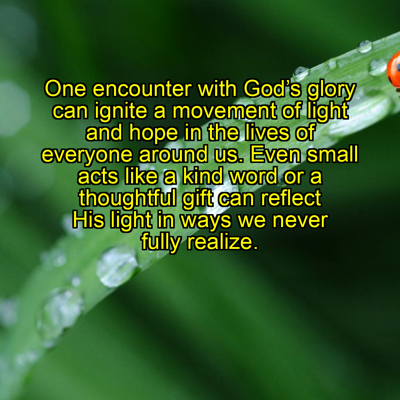
One encounter with God’s glory can ignite a movement of light and hope in the lives of everyone around us. Even small acts like a kind word or a thoughtful gift can reflect His light in ways we never fully realize.

Sometimes, it’s not about what we have or how polished we are, it’s about saying yes to what God asks and allowing His glory to shine through us.
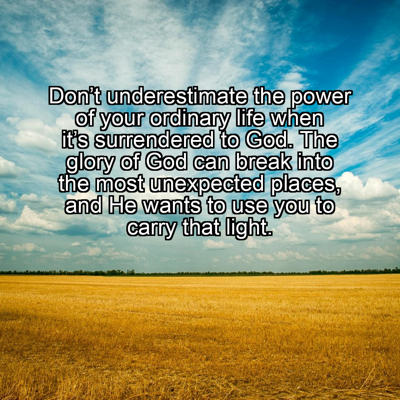
Don’t underestimate the power of your ordinary life when it’s surrendered to God. The glory of God can break into the most unexpected places, and He wants to use you to carry that light.
Add this chatbot onto your site with the embed code below
<iframe frameborder="0" src="https://pastors.ai/sermonWidget/sermon/glory-fields" width="100%" height="100%" style="height:100vh;"></iframe>Copy