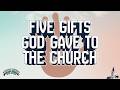
Ephesians 4 announces that Christ himself gives gifts to his body, not as ornaments, but as working grace. The text names apostles, prophets, evangelists, pastors, and teachers and then says why they exist: to equip saints for the work of ministry and to build up the church until unity, maturity, and the full stature of Christ appear. 1 Corinthians 12 confirms the same pattern of God’s ordering and the Spirit’s distribution, and even clarifies that not all carry the same role, and that tongues in view are corporate and interpreted. Christ sets the cadence. He gives the gifts. He remains the head who fits the whole body together so the whole body grows up in love.
The claim that these gifts have ceased gets cut off by the word until. Ephesians 4 says these graces run until the church measures up to the fullness of Christ, which does not land until Jesus returns. The argument also refuses self-appointment and title-chasing. These are not careers to grab, but callings Christ assigns. In fact, pastor and teacher overlap, and every office is about function, not nameplates.
A hand becomes the picture. Teachers are the pinky that gets into the ear. Teachers ground by establishing people in truth. They break down Scripture so the church can digest it, fight error, and stop being tossed by new winds of doctrine. The church does not need comedians in pulpits; the church needs Bible teachers who actually equip people to live and witness Monday through Saturday.
Pastors are the ring finger, married to the local church. Pastors guard. They lead and feed, protect unity, and, when needed, bring loving correction. Evangelists stand like the middle finger with the longest reach. Evangelists gather by preaching Christ with conviction and power, drawing the lost in, then partnering with pastors and teachers so newborn believers are actually discipled. Prophets point the way like the index finger. Prophets guide by declaring Spirit-given insight into God’s will, bringing encouragement, clarity, and often timing, not mean-spirited fortune-telling. Apostles are the thumb that can touch every finger. Apostles govern. They father and plant, lay foundations, oversee order, and keep the house aligned with kingdom strategy. Acts 6 shows the pattern: release others to tables so apostles give themselves to prayer and the word, and the church multiplies.
All of this lands where Ephesians 4 aimed. The fivefold exists so every saint becomes a working minister, the body grows up into Christ, and the church stops living on goosebumps and starts bearing fruit.
Key Takeaways
- 1. Christ gives gifts, not titles These graces are assigned by Jesus, not claimed by ambition. The office is a task, not a label to brand. Humility protects the house; entitlement fractures it. Function matters more than nameplates, always. [50:09]
- 2. The fivefold continues until Christ’s fullness Ephesians uses the word until, aiming at unity and maturity that only arrive in Christ’s return. If the church still falls short of the full stature of Christ, the gifts have not timed out. Cessationism gets out-argued by the text itself. [44:45]
- 3. Teachers ground, pastors guard, evangelists gather Teachers anchor people in truth so hype does not replace holiness. Pastors protect and nourish a flock, correcting in love. Evangelists reach far, then hand newborns into communities that disciple. The body needs all three in sync. [54:16]
- 4. Apostles govern for kingdom advance Apostles lay foundations, father leaders, and keep the house aligned with prayer, word, and mission. Acts 6 shows wise delegation that multiplies ministry rather than bottlenecking it. Vision and order are not luxuries; they are oxygen for growth. [91:27]
- 5. Every believer is a working minister Equipping the saints is not a slogan; it is the job description. Career does not cancel calling, it becomes the field where calling bears fruit. If a believer does the work of ministry, that believer is a minister, right where God has planted them. [101:56]
Youtube Chapters