The universe is vast beyond comprehension, filled with galaxies, stars, and life forms that stretch our imagination. Every detail, seen and unseen, was spoken into existence by God and belongs to Him. When we pause to consider the immensity and beauty of creation, it should humble us, reminding us that we are not the center of the story. We are caretakers, entrusted with the stewardship of God’s world, not its owners.
Let the grandeur of creation move you to awe and gratitude. Instead of responding with pride or a sense of entitlement, allow the wonder of God’s handiwork to draw you into deeper worship. Recognize that your place in creation is a gift, and your calling is to honor God by caring for what He has made.
“He it is who made the earth by his power, who established the world by his wisdom, and by his understanding stretched out the heavens. When he utters his voice, there is a tumult of waters in the heavens, and he makes the mist rise from the ends of the earth. He makes lightning for the rain, and he brings forth the wind from his storehouses.” (Jeremiah 10:12-13, ESV)
Reflection: Take a walk outside today and notice something in creation you’ve never paid attention to before. How does this small detail point you to God’s greatness, and how can you respond in worship and stewardship?
Among all living things, only humanity is made in the image of God. This unique identity is not about being above the rest of creation, but about being set apart for relationship and representation. You are designed to reflect God’s character—His love, justice, creativity, and presence—in the world.
Living as an image-bearer means intentionally seeking communion with God and allowing His likeness to shape your actions, words, and attitudes. It is a calling to live differently, not for your own sake, but so that others might see God through you. Embrace this privilege and responsibility, knowing that your life is meant to mirror the One who made you.
“And God said, ‘Let us make man in our image, after our likeness. And let them have dominion over the fish of the sea and over the birds of the heavens and over the livestock and over all the earth and over every creeping thing that creeps on the earth.’” (Genesis 1:26, ESV)
Reflection: In what specific way can you reflect God’s character to someone in your life today—through kindness, patience, or forgiveness?
God set apart the seventh day, not because He needed rest, but to invite humanity into a rhythm of work and rest. The Sabbath is not a heavy rule to follow, but a gracious gift—a day to step away from striving and productivity, and to be refreshed in God’s presence.
Trusting God with your rest means believing that He sustains you, even when you are not producing or achieving. Sabbath is an opportunity to receive, not to earn; to be, not just to do. Make space in your week to accept this invitation, knowing that God’s rest is for your good and His glory.
“For thus said the Lord God, the Holy One of Israel, ‘In returning and rest you shall be saved; in quietness and in trust shall be your strength.’ But you were unwilling.” (Isaiah 30:15, ESV)
Reflection: What is one practical way you can set aside time this week to rest and be present with God, trusting Him to provide for what you leave undone?
True Sabbath is more than just stopping work; it is a sacred space to reconnect with God and reflect on His goodness. Rest is not meant to be filled with distractions or mindless entertainment, but with worship, prayer, and gratitude.
Use your day of rest to recalibrate your heart, remembering God’s faithfulness and realigning your life with His purposes. When you fill your rest with intentional reflection and communion, it becomes a source of renewal and hope, not just a break from busyness.
“Return, O my soul, to your rest; for the Lord has dealt bountifully with you. For you have delivered my soul from death, my eyes from tears, my feet from stumbling.” (Psalm 116:7-8, ESV)
Reflection: How can you intentionally use your next time of rest to reconnect with God—through prayer, worship, or gratitude—instead of simply seeking distraction?
The weekly rhythm of Sabbath is a reminder that God promises an ultimate rest—a day when all striving and sorrow will end. As you practice Sabbath, let it fill you with hope for the new creation, where Christ’s finished work brings complete restoration.
Resting in Christ means trusting that your salvation is secure, not because of your efforts, but because of what He has accomplished. Each Sabbath is an act of faith, anticipating the fullness of God’s redemption and the joy of eternal communion with Him.
“So then, there remains a Sabbath rest for the people of God, for whoever has entered God’s rest has also rested from his works as God did from his. Let us therefore strive to enter that rest, so that no one may fall by the same sort of disobedience.” (Hebrews 4:9-11, ESV)
Reflection: As you rest this week, what is one area of your life where you need to trust more deeply in Christ’s finished work and the hope of His coming restoration?
In this sermon, we explored Genesis 2:1-3 and the significance of the seventh day—God’s day of rest. After creating the vast and diverse universe in six days, God set apart the seventh day, not because He needed rest, but to establish a rhythm for humanity: a day to step back, reflect, and commune with Him. We considered the uniqueness of humanity as the only species made in God’s image, set apart for relationship and representation. The Sabbath is not just a command or a rule, but a gift—a purposeful invitation to rest in God’s presence, to remember His provision, and to look forward to the ultimate rest He promises. True rest is not merely the absence of work, but a sacred space for worship, gratitude, and hope.
In six days, God made the vast array of the heavens and the earth. Everything you see and don’t see, from the farthest galaxy to the tiniest atom, was made by the Lord and all of it belongs to him.
God created a vast array of species, each with their own diverse kinds, all to declare his glory. And yet, there is only one species of humans—set apart to bear the image of God.
Humans were made from the beginning to be unique and distinct, set apart from all of the rest of God’s creation. We are the one species that bears the image of God on the planet.
God rested on the seventh day to establish a break for us in the pattern of weekly work. It’s as if he was saying, “humans will work, but they will not be made to work every day of their lives.”
By resting on the seventh day, God inserted himself into the rhythms of our time to call us into his rest. It is the meeting place for God and humans—a day for meaningful and restful relationship.
Rest taken outside of the rest that God calls us into can turn dangerous, and at the very least, can feel purposeless and useless. The rest God calls us into is filled with purpose and meaning.

The day of rest is a day to remember the Lord’s benefits in your life—a day to enjoy the fruit that God has brought about in your life and to praise him for it.
Rest reminds us that we are valued not for what we do, but for who we are in God. Resist the pressure to stay constantly busy. Let go of guilt when you’re not working—Jesus invites you into rest.
Sabbath is for reconnection, not just relaxation. Use rest to reflect on God’s work, not just escape your own. Worship, pray, and give thanks during your day of rest.
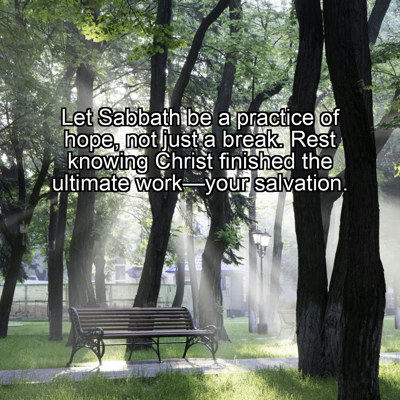
Let Sabbath be a practice of hope, not just a break. Rest knowing Christ finished the ultimate work—your salvation.
Add this chatbot onto your site with the embed code below
<iframe frameborder="0" src="https://pastors.ai/sermonWidget/sermon/gen_2_1_3_the_seventh_daydocx" width="100%" height="100%" style="height:100vh;"></iframe>Copy