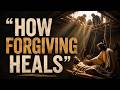
Mark’s story takes place in Capernaum, in the house of Simon and Andrew, where Jesus has made his home after the rejection in Nazareth. The house is packed full, so full that it is impossible even to get near the doorway. The crowd fills the courtyard where Jesus is teaching, and the doorway is blocked by people hungry to hear him.
The four friends come carrying a paralyzed man on a stretcher, and their love refuses to settle for disappointment. Their faith does not stop at the closed door. Their ingenuity goes up to the roof, tears through branches, dirt, and planks, and lowers the man down by ropes into the crowded courtyard. Jesus sees their faith, not simply the faith of the man on the mat, but the faith of friends who will not let paralysis have the last word.
Jesus speaks first to the deeper wound. His word is not, at first, “stand up,” but “your sins are forgiven.” The moment feels strange because the man came for healing, not forgiveness. Yet Jesus seems to know something nobody else knows. The man’s body is paralyzed, but guilt may be doing an even deeper crippling work.
The scribes hear blasphemy because only God can forgive sins. Jesus answers by asking which is easier, to say “your sins are forgiven,” or to say “stand up, take your mat, and walk.” The physical healing becomes the visible sign of an invisible authority. The Son of Man has authority on earth to forgive sins, and the man rises in full view of them all.
The Christian faith recognizes with compassion the power of guilt to cripple. Guilt is a painful feeling of self-reproach, and it comes in different forms. Normal guilt can be like pain, warning that something is wrong. Exaggerated guilt can become a voice that cries, “failure, failure, failure,” far beyond the truth of the matter. Repressed guilt can bury what is too painful to face, while its power still shows up in distorted and damaging ways.
The way toward healing begins by facing guilt, confessing it, making reparation where harm has been done, and accepting God’s forgiveness. Confession names the demon, and demons lose their power when they are named. Reparation returns what was stolen, apologizes where offense was given, retracts the lie, and works for justice where justice was denied. God’s forgiveness is the most powerful therapeutic in the world, because Jesus still says, “your sins are forgiven,” and then, “stand up, take your mat, and go to your home.”
Key Takeaways
- 1. Friends open holes in roofs The four friends do not accept the blocked doorway as the final answer. Their faith becomes practical, creative, and tenacious enough to carry another person where he cannot take himself. Friendship, in this story, is not sentiment but holy labor that makes room for healing. [24:11]
- 2. Guilt can cripple the soul The paralyzed man receives forgiveness before physical healing, and that order is not accidental. Jesus sees that guilt can bind a person as surely as sickness can bind the body. Christian compassion does not minimize guilt, but it refuses to let guilt become a life sentence. [27:34]
- 3. Confession names what enslaves Confession brings hidden things into the light where they begin to lose their power. What remains unnamed can keep feeding on a person’s strength and peace. Naming sin, harm, or even the evil done by others is not weakness, but a first act of freedom. [32:23]
- 4. Reparation straightens what was bent Forgiveness does not make wrongdoing unreal or unimportant. Stolen things must be returned, lies must be retracted, offenses must be acknowledged, and denied justice must be pursued. Grace does not erase moral responsibility, but gives courage to repair what can be repaired. [33:17]
- 5. Forgiveness gives power to rise God’s forgiveness does not merely comfort the guilty conscience. It breaks the fear beneath the guilt and opens the possibility of new life. The old guilt tapes can stop playing because Christ’s word is stronger than the accusation. [34:18]
Youtube Chapters
- [00:00] - Welcome
- [15:49] - Jesus Sees Their Faith
- [21:03] - A Crowded House in Capernaum
- [21:43] - Four Friends Refuse Rejection
- [22:20] - Opening a Hole in the Roof
- [23:36] - Faith That Carries Another
- [24:47] - Forgiveness Before Physical Healing
- [25:33] - Scribes Question Jesus’ Authority
- [26:37] - The Son of Man Forgives
- [27:34] - Guilt’s Power to Cripple
- [28:12] - Three Kinds of Guilt
- [31:43] - Facing and Confessing Guilt
- [33:17] - Making Reparation
- [34:03] - Accepting God’s Forgiveness
- [35:17] - Stand Up and Move On