Generosity is not just a duty or a rule to follow—it is a heartfelt response to the goodness and faithfulness of God. Long before tithing became a command in the Law, Abraham gave a tenth of his spoils to Melchizedek as an act of worship and gratitude. This shows that giving is woven into the story of God’s people as a way to honor Him and acknowledge His provision. When we give, we are not simply checking off a religious box; we are participating in a much larger story of trust, worship, and relationship with our Creator.
God invites us to see our giving as a joyful response to His love, not as a burdensome obligation. Each act of generosity is a declaration that we trust God to provide for us, and that we want to be part of what He is doing in the world. As you consider your own giving, remember that you are joining a legacy of faith that stretches back to the very beginning of God’s people.
“And Melchizedek king of Salem brought out bread and wine. (He was priest of God Most High.) And he blessed him and said, ‘Blessed be Abram by God Most High, Possessor of heaven and earth; and blessed be God Most High, who has delivered your enemies into your hand!’ And Abram gave him a tenth of everything.” (Genesis 14:18-20, ESV)
Reflection:
What is one way you can make your giving this week a personal act of worship and gratitude, rather than just a routine or obligation?
God does not measure generosity by the size of the gift, but by the heart and sacrifice behind it. The story of the poor widow who gave two small coins reminds us that what matters most to God is not the amount we give, but the trust and love with which we give it. Jesus honored her offering above all others because she gave out of her poverty, trusting God with everything she had.
True generosity often requires sacrifice. It is easy to give out of abundance, but giving when it costs us something reveals the depth of our faith. God sees and values every act of sacrificial giving, no matter how small it may seem to others. He delights in hearts that trust Him enough to give, even when it feels risky.
“And he looked up and saw the rich putting their gifts into the offering box, and he saw a poor widow put in two small copper coins. And he said, ‘Truly, I tell you, this poor widow has put in more than all of them. For they all contributed out of their abundance, but she out of her poverty put in all she had to live on.’” (Luke 21:1-4, ESV)
Reflection:
Is there an area in your life where God is inviting you to give sacrificially, even if it feels small or unnoticed by others?
When we give, we are not losing something—we are sowing into God’s economy, trusting Him to provide and multiply what we offer. The Bible teaches that God supplies seed to the sower and increases the harvest of our righteousness. Our generosity is an act of faith that God will use what we give to bless others and to provide for our own needs as well.
Giving with expectation means believing that God is both able and willing to take care of us. It is an invitation to trust Him with our resources and to look for the ways He will show His faithfulness. As we sow generously, we can expect to see God’s provision and blessing, not just for ourselves, but for the advancement of His kingdom.
“He who supplies seed to the sower and bread for food will supply and multiply your seed for sowing and increase the harvest of your righteousness. You will be enriched in every way to be generous in every way, which through us will produce thanksgiving to God.” (2 Corinthians 9:10-11, ESV)
Reflection:
What is one area where you can give today with the expectation that God will use your gift to bless others and provide for your needs?
Our limitations and needs are not obstacles to God’s work—they are opportunities for His grace to shine. The apostle Paul learned that God’s strength is made perfect in weakness, and that when we give or pray from a place of need, we open ourselves to experience God’s sufficiency in new ways. Rather than waiting until we feel strong or have plenty, we are invited to trust God with what we have right now.
God delights in meeting us in our weakness and showing His power through our dependence on Him. When we step out in faith, even when we feel inadequate, we make room for God to do what only He can do. Our need becomes the very place where His grace is most visible.
“But he said to me, ‘My grace is sufficient for you, for my power is made perfect in weakness.’ Therefore I will boast all the more gladly of my weaknesses, so that the power of Christ may rest upon me. For the sake of Christ, then, I am content with weaknesses, insults, hardships, persecutions, and calamities. For when I am weak, then I am strong.” (2 Corinthians 12:9-10, ESV)
Reflection:
Where do you feel weak or lacking today, and how can you invite God to show His strength and sufficiency in that area?
God’s resources are not limited—His generosity knows no bounds. The vision of the New Jerusalem in Revelation reminds us that God is not stingy; His kingdom is marked by abundance, beauty, and provision beyond our imagination. When we give, we are aligning ourselves with the character of a God who delights to give good gifts to His children and to advance His gospel in the world.
Living in light of God’s abundance frees us from fear and scarcity. We can give boldly, knowing that we serve a God whose streets are gold and whose gates are pearls. Our generosity becomes a testimony to the world of the limitless grace and provision of our King.
“And the twelve gates were twelve pearls, each of the gates made of a single pearl, and the street of the city was pure gold, like transparent glass. And I saw no temple in the city, for its temple is the Lord God the Almighty and the Lamb.” (Revelation 21:21-22, ESV)
Reflection:
How does remembering the abundance of God’s kingdom change the way you view your resources and your ability to give generously today?
:
Today’s sermon explored the heart behind giving, especially tithing, and how it connects to prayer and expectation. We looked at the biblical roots of tithing, even before the Law, and considered how generosity is a principle that runs throughout Scripture. The story of the poor widow reminded us that God values the heart and sacrifice behind our giving, not just the amount. We also discussed how giving is tied to faith—trusting that God is our provider, and that He multiplies what we offer. Finally, we were encouraged to give with expectation, knowing that God’s resources are abundant and that our generosity advances His kingdom.
“Argue all you want – we give generously, we reap generously. The measure of our giving is not about the amount, but the heart and expectation behind it.”
“Money doesn’t grow on trees… YES IT DOES. The Tree of Life is our source, and God’s provision is bigger than we can imagine.”
“Keep giving… advancing the gospel. Every act of generosity is a seed that grows into something far greater than we can see.”
“Tithing isn’t just about following a rule; it’s about trusting God with our first and best, believing He will supply and increase our store of seed.”
“The story of the poor widow reminds us: it’s not about how much you give, but the sacrifice and faith behind your gift.”
“When we give, we do so with expectation—knowing that God is able to enlarge the harvest of our righteousness and meet every need.”
“Generosity isn’t measured by wealth, but by willingness. Even in our lack, we can give everything and trust God to provide.”
“You can’t link every verse to tithing, but you can’t deny the principle: those who sow generously will also reap generously.”
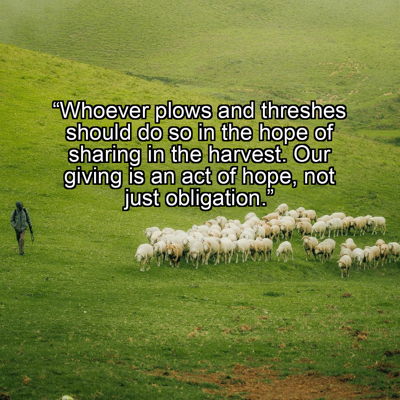
“Whoever plows and threshes should do so in the hope of sharing in the harvest. Our giving is an act of hope, not just obligation.”
Hi, I'm an AI assistant for the pastor that gave this sermon. What would you like to make from it?
Add this chatbot onto your site with the embed code below
<iframe frameborder="0" src="https://pastors.ai/sermonWidget/sermon/first-fruits-prayer-expectation" width="100%" height="100%" style="height:100vh;"></iframe>Copy