
Faithful Ministry: Preaching the Word with Purpose
May 16, 2024
Devotional
Sermon Summary
Bible Study Guide
Sermon Clips
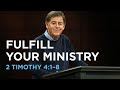
I charge you in the presence of God and of Christ Jesus who is to judge the living and the dead and by his appearing in his kingdom preach the word be ready in season and out of season reprove rebuke and exhort with complete patience and teaching for the time will come when people will not endure sound teaching but having itching ears they will accumulate for themselves teachers to suit their own passions. [00:02:15]
Timothy as a young man in the ministry was responsible for those who were under his care in Ephesus he would have had colleagues around him who were important to him from whom he was learning and who were also being the beneficiaries of his instruction it is important for Timothy to understand that ultimately his accountability is to God himself that he's not ultimately accountable to his congregation in Ephesus. [00:06:30]
Preach the word preach the word all that Paul has already written in this letter concerning the pattern of sound teaching in uh chapter one uh the importance of looking after the good deposit in uh chapter one as well all of that underpins the charge which he now gives in relationship to the scriptures it's very very important that we keep in mind that the responsibility that is given to us is a responsibility to be a servant of the word. [00:12:24]
Preach the word ready in season and out of season press the message home on All Occasions convenient or inconvenient when it's a season of receptivity or when it's a series of uh hostility when the prospect fills you with Dread on a Saturday evening or whether it fills you with delight on a Saturday evening when your listeners are tuned in or where your when your listeners are tuned out When the Crowds Are dwindling or the crowds are growing preach the word. [00:15:17]
The time is coming when people will not endure sound teaching here's the challenge he's already told Timothy that uh he was deserted by folks in Asia back in uh chapter 1 you're aware that all who are in Asia turned away from me and he mentions in particular felis and hermogenes and so he says I I want you to expect a similar reaction the time is coming when people will not endure sound teaching. [00:23:32]
The doctrine of the authority of scripture is challenged most vifer usly at this point in my lifetime in relationship to the doctrine of man to the nature of what God has made in making us in His image you can apply that on your own but why would people be attracted to that because it's attractive the the Bible's assessment of things is not immediately appealing is it because the Bible is telling us that we are by Nature sinful that we're guilty that we're lost that we're responsible and that we're unable to rectify the situation. [00:26:06]
Do the work of an evangelist is Paul suggesting a change of job here I don't believe so for a moment it's not a new job description he's giving him he's not suggesting that he moves from what he's doing and pastoring uh to take on a particular role of evangelism but he is actually making clear that if he is going to be teaching the Bible in this way then he is going to be involved in pointing people consistently to Christ. [00:32:19]
Preaching is not less than teaching it's more because what we're then doing is we're making an appeal to people's wills and to their emotions to respond to what they have just understood through teaching that's why you see it's very very important that we don't think that we've preached the gospel when we tell people that there are great benefits in leaving the gospel and there are great dangers in rejecting the gospel. [00:35:00]
I am already being poured out as a drink offering I'm already on my way out you know the picture there a wine or an oil poured out alongside another sacrifice an animal sacrifice was offered up and then there was the pouring out of the wine or the oil and he's picking that picture up and he's saying you know I'm being poured out just like a drink offering the time has come for me to leave my departure. [00:41:04]
The fight I fought it the race I finished it the faith I kept it what a testimony huh he's not facing death proud of his own achievements Mercy Mercy was there I think he would have been he would certainly wouldn't have been singing I did in my way I think he might have sung um is that with is it top lady I don't remember depth of Mercy can there be Mercy still reserved for me can my God his wrath forbear me the chief of Sinners SP SP that was his perspective. [00:41:40]
Henceforth you know Paul's whole life in Ministry is about moving from what is out there to what what is he experiencing in the Here and Now forgetting those things which are behind his as I press on towards the goal to win the prize for which God has called me heavenward in Christ Jesus he's not coming to the end of his ministry talking about the good old days he's not actually saying you know it was I don't know how you followers are going to get on on your own now when I go. [00:42:23]
There's laid up for me the crown of righteousness the athletes to which he he has already referred back in Chapter 2 an athlete is not crowned unless he competes according to the rules but they got a crown of leaves Olive Laurel Pine whatever they got a perishable Crown he says but we receive an imperishable Crown we don't earn it we're rewarded it it's not unique to me he says that's why I want to do the to the end of the uh the chapter to see how all these other people are so vital to his ministry. [00:43:53]
Alistair Begg
This sermon · AI assistant

-
I'm an AI bot trained specifically on the sermon from May 16, 2024. Do you have any questions about it?