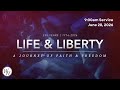
Hebrews 11:1 sets the frame: faith is assurance in what is hoped for and certainty in what is not seen. The journey of life in liberty looks back over two hundred and fifty years of American history, not with political nostalgia and not to glorify a nation, but with spiritual wonder at the hand of God. God remains at work through revival and ruin, courage and compromise, blessing and heartbreak. Second Chronicles 16:9 gives the steady truth: the eyes of the Lord search the whole earth to strengthen hearts fully committed to him.
Christ-centered faith must shape a better future, and that faith must be present in the lives of God’s people and passed to the next generation. The Cane Ridge revival gives a picture of that kind of faith, as thousands came by wagon, horseback, and on foot to hear the gospel, sing praise, pray, and seek the presence of the Lord. The restoration movement grew from the conviction that America did not need more denominations or more creeds, but needed to return to the original blueprint: no creed but Christ and no book but the Bible.
Lamentations 3 speaks into a time when the weight of a nation lay heavy upon the people. Jeremiah does not pretend that everything is fine. Jeremiah names affliction, wanderings, wormwood, and gall. Grief has a voice, but grief does not get the final word. Verse 21 becomes the turning point: “this I call to mind, and therefore I have hope.” Faith is not denial of pain. Faith is the discipline of redirecting focus from pain to the character of God.
The first habit of hope is to remember. The soul must stop feeding on fear, bitterness, and despair, and must call to mind the truth of God. The second habit is to rely. Jeremiah anchors his soul in God’s steadfast love, God’s mercy that is new every morning, and God’s great faithfulness. The Lord is the portion, the inheritance, the security, and enough even when everything else is stripped away.
The third habit is to reach. Jeremiah calls the faithful to wait, seek, and quietly trust the salvation of the Lord. Discipline formed early helps a generation stand when storms come later. A better future will not be shaped by complaint, nationalism, or human strength alone, but by humble dependence on God, steadfast hope, and faith that seeks the Lord in his timing.
Key Takeaways
- 1. Faith redirects pain toward God Jeremiah does not put a smile on suffering or pretend that grief is not real. Jeremiah names affliction, bitterness, poison, and the pain that keeps replaying in the soul. Faith begins to rise when the soul stops rehearsing pain as the final story and calls to mind the character of God as the deeper truth. [52:35]
- 2. Hope is anchored, not wishful Biblical hope is not a thin wish that circumstances might improve. Hope is a certainty rooted in the character of the one true God, who will provide and prevail. That kind of hope keeps suffering from having the final word in a life, a church, a community, or a nation. [53:57]
- 3. God’s mercy meets each morning Jeremiah ties hope to the steadfast love, mercy, and faithfulness of God. Mercy being new every morning means the past does not get to exhaust the compassion of the Lord. The question becomes whether the soul runs toward that mercy or spends another day running away from the very provision it needs. [60:48]
- 4. The Lord is enough “The Lord is my portion” means the Lord is inheritance, security, and anchor. Jeremiah’s hope does not depend on everything being restored immediately, but on God remaining present when everything else is stripped away. In Christ, steadfast love, mercy, and faithfulness come into full view at the cross and resurrection. [63:01]
- 5. Waiting forms sturdy faith Jeremiah’s words wait, seek, and good call for hopeful expectation rather than empty delay. Discipline in youth forms habits that can carry a soul through later hardship. A generation taught to seek the Lord in prayer, Scripture, worship, and surrender will be able to stand when storms come. [66:29]
Youtube Chapters