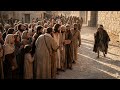
This passage introduces us to Bartimaeus, a blind beggar on the side of the road. Despite being an outcast, rejected by society, and told to be silent, he recognized Jesus and cried out to Him. His faith wasn't quiet; it was a desperate, vocal plea for healing and recognition. This reminds us that sometimes, our faith needs to be expressed boldly, even when others try to silence us. [09:47]
Mark 10:47 (ESV)
And when he heard that it was Jesus of Nazareth, he began to cry out and say, “Jesus, Son of David, have mercy on me!”
Reflection: When have you felt the urge to cry out to Jesus for help or intervention, and what held you back from doing so?
Bartimaeus, despite his blindness, possessed a profound insight into who Jesus was, calling Him the "Son of David." This was a messianic title, revealing a spiritual discernment that surpassed many who could physically see. It highlights that true sight comes not from physical eyes, but from a heart that recognizes Jesus for who He is, even when surrounded by the noise and distractions of the world. [11:05]
John 1:5 (ESV)
The light shines in the darkness, and the darkness has not overcome it.
Reflection: In what ways do the "crowds" of daily life—responsibilities, opinions, or distractions—make it challenging to clearly perceive Jesus' presence and leading?
When Jesus called for Bartimaeus, he didn't hesitate. He threw off his cloak, his only source of security, business, and identity as a beggar. This act signifies a willingness to abandon everything that has defined him in his past, trusting that Jesus offers something far greater. It’s a powerful picture of surrendering our comfort, our perceived safety nets, and our old identities to embrace the new life Jesus offers. [16:01]
Luke 9:23 (ESV)
And he said to all, “If anyone would come after me, let him deny himself and take up his cross daily and follow me.”
Reflection: What is one "cloak"—a comfort, a habit, or an identity—that you might be clinging to, which prevents you from fully embracing Jesus' call?
Jesus asked Bartimaeus, "What do you want me to do for you?" This wasn't a generic question; it was an invitation for a specific, heartfelt request. Bartimaeus didn't ask for money or temporary relief; he asked to see. This demonstrates the importance of bringing our deepest needs and desires to God with clarity and honesty, trusting that He desires to bring about profound transformation in our lives. [19:25]
Matthew 7:7 (ESV)
“Ask, and it will be given to you; seek, and you will find; knock, and it will be opened to you.”
Reflection: If Jesus were to ask you today, "What do you want me to do for you?", what specific, life-altering request would you bring before Him?
After Bartimaeus was healed, he didn't return to his old life. Instead, he followed Jesus along the road. This is the natural outflow of a genuine encounter with Christ: a transformed life that actively pursues Him. It’s a testament to the power of Jesus to not only heal and restore but also to redirect our paths and empower us to walk with Him, embracing His purpose for our lives. [31:30]
2 Corinthians 5:17 (ESV)
Therefore, if anyone is in Christ, he is a new creation. The old has passed away; behold, the new has come.
Reflection: In what tangible ways can you choose to "follow Jesus along the way" this week, reflecting the transformation He has brought into your life?
Mark’s account of the blind man at Jericho unfolds as a portrait of faith that sees, acts, and abandons old securities. A nameless outcast given the identity “son of the unclean” sits by the road and hears a crowd pass; instead of shrinking, he cries out for mercy. His cry — “Son of David” — names Jesus as Messiah before any formal theology could, and that recognition draws Jesus’ attention. Jesus ignores religious boundaries and social taboos, halting a procession to reach an excluded beggar.
The blind man’s response models decisive surrender: he casts aside his cloak — his only shelter, his livelihood, his identity — and approaches. The cloak becomes a vivid metaphor for every thing people clutch that keeps them from true sight: victim narratives, financial idols, secret sins, even self-identity. Jesus’ question, “What do you want me to do for you?” exposes the heart’s true desire; his simple, specific request for sight contrasts sharply with the disciples’ ambition for rank. Healing comes immediately when faith is clear, sacrificial, and bold.
The passage issues practical demands. Faith that sees is not private sentiment but active petition; it disrupts the crowd’s conformity and refuses to be silenced. It requires honest naming of needs and a willingness to surrender the comforts or disguises that block restoration. Even in the shadow of the cross, Jesus prioritizes the outcast’s restoration, showing that the kingdom’s work attends to those whom society has forsaken. The healed man does not return to the roadside; he follows Jesus. The narrative calls others to move from passive spectatorship to bringing hurting people to Christ, to pray specifically, and to live a faith whose works visibly bear witness to God’s intervention.
But, again, think about this culturally. No rabbi in his right mind would reach out to an outcast. No rabbi would stop a parade, stop a crowd, and go, bring me that outcast guy there that nobody gives any value to him. If you were a rabbi, you kept yourself away from the deceased, away from the prostitutes, away from the tax collectors, and away from those who actually are suffering because of their parents' sin. Rabbis did not even look at them. Jesus stops everything, and he says, bring that man to me.
[00:12:14]
(47 seconds)
#ReachOutToOutcasts

So this means that not only was it his security his home, but it also meant this was what? His business. And what does Mark write here? As soon as he hears Jesus calling him, what? He tosses it away. His probable probable only earthly possession. He throws it away, and he comes towards Jesus. I don't know about you, but I think this is beautiful, isn't it? He comes towards towards Jesus now with everything that he has, probably his only earthly possession, and he throws it out, so he comes to Jesus.
[00:15:40]
(47 seconds)
#LeaveEverythingForJesus
Add this chatbot onto your site with the embed code below
<iframe frameborder="0" src="https://pastors.ai/sermonWidget/sermon/faith-sees-wont-be-quiet" width="100%" height="100%" style="height:100vh;"></iframe>Copy