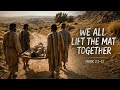
Mark sets Jesus back in Capernaum, the house packed wall to wall. The crowd blocks the door, but four friends refuse to let a body on a mat be the end of the story. The roof becomes the doorway. Dirt falls, ropes creak, and a paralyzed man comes down right in front of Jesus. The text then shifts the focus: Jesus sees their faith. Not just the man’s. Their faith. On the strength of that communal trust, Jesus speaks first to the deeper break, “Child, your sins are forgiven.” Legal experts bristle. Only God forgives. Jesus reads their thoughts and presses the test, “Which is easier…?” Then the visible mercy confirms the invisible grace: “Get up, take your mat, and go home.” He stands, he carries what once carried him, and the room erupts in praise.
That mat becomes the image that carries the day. The weight is real. The distance is unknown. The obstacles are not small. Yet the friends are “all in” for the one who cannot move himself. Love looks like calloused hands and a torn roof. The line from the story in Mark then meets a line from another story: “We all have our bridges to carry,” and the answer lands, “but we carry the bridge together.” The church does not drag this mat alone. Fifty sets of hands for a single week of serving kids are not extra; they are the method. Some hold ropes. Some clear a path. Some handle the spreadsheets that keep the ropes from snapping. Some bake cookies so strength does not fail. Each gift becomes a corner of the same mat.
Mark’s scene names the order of grace. The Christ who forgives also heals, and the sign of healing is meant to make clear the authority to forgive. The authority is his. The approach is theirs. “Their faith” moves his heart, and once his heart is moved, anything becomes possible. So the invitation is simple and costly. Lift where it is heavy. Share the work that brings people to Jesus. Let Jesus do the saving. Let the church do the carrying. The mat is heavy, but it is less heavy when many lift together.
Key Takeaways
- 1. Jesus sees faith that carries friends. Communal trust can bear the weight a single soul cannot shoulder today. In the room with Jesus, the faith on display is plural, and that corporate faith becomes the conduit for mercy. This does not erase personal faith; it shows how love covers a gap and brings a neighbor within earshot of grace. Carrying a friend to Jesus is a confession of faith with calloused hands. [38:56]
- 2. Corporate faith moves Jesus to act. The text makes a plain claim about “their faith,” and then shows authority flowing from Christ to forgive and to heal. When a church reaches together, it is not performing sentiment; it is presenting a real petition before a real Lord. Such unity does not guarantee outcomes, but it does meet Jesus in the place he loves to answer. [31:44]
- 3. The mat is carried together. The roof will not open to half-hearted love. Real friendship accepts real inconvenience, even the kind that breaks a sweat and breaks a roof. Shared effort turns an impossible hallway into an open sky, and the burden lightens when the load is distributed. The miracle begins with four corners lifted at once. [38:33]
- 4. Many gifts lift the same corner. Quiet skills count. So do cookies, spreadsheets, art supplies, and a steady presence. Not every gift looks like a microphone; many look like rope burns and late-night logistics that make room for someone else to hear Jesus. The Spirit weaves different abilities into one doorway of grace. [43:49]
- 5. Love shows up before results. The friends act before they know how the story will end, because love is willing to look foolish for the sake of a neighbor. Faith goes first, results follow. That sequence keeps the church honest, invested in obedience more than optics, ready to praise God however he answers. [30:22]
Youtube Chapters