
Entering God's Rest: Trust, Obedience, and Peace
Devotional
Sermon Summary
Bible Study Guide
Sermon Clips
Therefore since the promise remains of entering his rest let us fear lest any of you seem to have come short of it for indeed the gospel was preached to us as well as to them but the word which was heard did not profit them not being mixed with faith in those who heard it. [00:39:43]
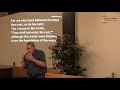
For we who have believed do enter that rest now remember he said that they did not enter because of unbelief and remember he uses unbelief and Disobedience interchangeably as we sang that him again tonight trust and Obey if we believe we obey and so we who have believed into their rest. [00:07:26]
God rested on the seventh day from all his works and again in this place they shall not enter my rest since therefore it remains that some must enter it and those to whom it was first preached did not enter Because of a Disobedience again he designates a certain day saying in David today after such a long time. [00:01:08]
And so he is speaking about the idea of rest the complication here is that there are different rests that he is talking about he's talking about the rest of God that God rested he's talking about the rest of the people of Israel when they entered into the land at the end of Joshua. [00:02:08]
And so entering his rest let us fear lest any of you seem to come short of it for indeed the gospel has preached to us as well as to them but the word which they heard did not profit them not being mixed with faith in those who heard it so we spoke about the importance of Faith. [00:07:01]
And so God institutes this principle for Israel and it's it feeds right through all of their culture through all of the laws uh not just as far as they were concerned in terms of working for six days and resting the seventh day but the land was to be worked for six years and was to let to be to life fallow for the seventh year. [00:18:16]
And so the same way as Joshua was the man who took them in Jesus is the one who's going to take us in all right but now here's the other spanner in the works if G Joshua or Jesus had given them rest then why would he not afterward have spoken of another day now I've just told you that he gave them rest. [00:38:02]
And so for the Christian there is a rest now today as we arrested in what Christ has done in terms of our salvation but there is also a rest that we are looking forward to when we come to when we get to heaven and I'm just calling it that because otherwise we get we get too complicated now. [00:40:13]
For he who has entered his rest has himself also ceased from his works as God did from his now you need to pay attention to the details for he who who's who's the he the person the Christian who has entered into his rest whose rest God's rest so the Christian must enter into God's rest. [00:41:18]
And so God has done the work he's done the work for our Salvation he's done the work that we might be at peace and at rest in him come unto me all the labor heavy laden he's done it so I need to stop working I need to stop working I need to enter into his rest. [00:44:34]
And so I need to work at trusting him and obeying him and when I do that there's a wonderful peace and there's a wonderful rest but when I work out of sync with God and I'm doing my thing but God's not in it and God's saying but I want you to do this no no I'm there's no rest. [00:50:43]
And Lord that as we apply ourselves in that we will enter into your rest and so Lord the the writer to the Hebrews has expressed this incredible concern over these last two chapters that there is a rest for the people of God that we seem to come short of and Lord when I look at Christians. [00:51:48]
Chatbot

-
I'm an AI bot trained specifically on the sermon from Dec 08, 2021. Do you have any questions about it?