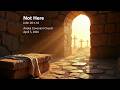
The discovery of the empty tomb was not a cause for despair but the greatest news in human history. Where the women expected to find death, they found life. Where they expected to find an ending, they found a glorious new beginning. This moment redefines every disappointment, turning our "not here" moments into opportunities to witness God's power and faithfulness. The absence of Jesus' body is the foundation of our eternal hope. [34:17]
John 20:1-2
Now on the first day of the week Mary Magdalene came to the tomb early, while it was still dark, and saw that the stone had been taken away from the tomb. So she ran and went to Simon Peter and the other disciple, the one whom Jesus loved, and said to them, “They have taken the Lord out of the tomb, and we do not know where they have laid him.” (ESV)
Reflection: When have you experienced a profound disappointment, a "not here" moment where your plans fell apart? How might the reality of the empty tomb invite you to view that same situation through a lens of hope and God's sovereign purpose?
The first disciples were puzzled and afraid, struggling to comprehend the reality before them. They saw the evidence but did not yet understand its meaning. In their confusion, Jesus Himself drew near and walked with them. He meets us in our moments of uncertainty, not with condemnation, but with patient presence, ready to open our eyes to His truth. [53:18]
Luke 24:13-16
That very day two of them were going to a village named Emmaus, about seven miles from Jerusalem, and they were talking with each other about all these things that had happened. While they were talking and discussing together, Jesus himself drew near and went with them. But their eyes were kept from recognizing him. (ESV)
Reflection: In what area of your life are you currently feeling puzzled, saddened, or unable to see God's plan? What would it look like to invite Jesus into that confusion, asking Him to walk with you and explain the Scriptures concerning your situation?
As Jesus explained the Scriptures, the disciples felt their hearts burn within them. This was not merely an intellectual exercise but a spiritual awakening. The truth of God's Word, illuminated by the presence of Christ, ignites a fire within us. It brings clarity, passion, and a deep recognition of who Jesus is and all He has accomplished for us. [58:02]
Luke 24:32
They said to each other, “Did not our hearts burn within us while he talked to us on the road, while he opened to us the Scriptures?” (ESV)
Reflection: When have you last experienced your heart "burning within you" during prayer, worship, or reading the Bible? What specific truth about Jesus or His character was He revealing to you in that moment?
The encounter with the risen Christ transformed the disciples from a state of sad confusion into passionate witnesses. Their fatigue was replaced by a renewed vigor that compelled them to immediately return and share the good news. A genuine experience with Jesus naturally overflows into a testimony that we cannot help but share with others. [59:12]
Luke 24:33-35
And they rose that same hour and returned to Jerusalem. And they found the eleven and those who were with them gathered together, saying, “The Lord has risen indeed, and has appeared to Simon!” Then they told what had happened on the road, and how he was known to them in the breaking of the bread. (ESV)
Reflection: How has your own understanding of Jesus' resurrection recently been renewed or deepened? Who is one person in your life with whom you could naturally share this hope and what it means to you?
The glorious truth is that Jesus is not merely a historical figure in a tomb. Because He is risen, He is here, alive, and present by His Spirit within every believer. Communion is a tangible reminder that we do not merely remember a past event; we celebrate a present reality. Christ lives in us, offering His life and power for our daily journey. [01:02:16]
Colossians 1:27
To them God chose to make known how great among the Gentiles are the riches of the glory of this mystery, which is Christ in you, the hope of glory. (ESV)
Reflection: As you go about your daily routines this week, how can you cultivate a greater awareness of the truth that Christ Himself lives within you? What one practical step can you take to depend more consciously on His indwelling life and power?
On Easter morning worship erupted around the empty tomb and the living Christ. The narrative follows Mary Magdalene arriving at the grave while it was still dark, finding the stone rolled away and no body where it belonged; the scene registers as puzzling, not chaotic. Two disciples run to inspect: one peers in and notes the linen wrappings, the other enters and sees the head cloth folded apart from the linens—an ordered scene that argues against theft and points toward a deliberate, divine act. Confusion and partial belief mark the first witnesses: they see that Jesus is not there, yet they do not yet grasp the scriptural necessity of his rising.
Luke’s Emmaus account deepens the theological frame. Two disciples walk seven miles, burdened and bewildered, when a stranger joins them and opens the Scriptures to show how suffering leads to glory. Their hearts stir as the stranger explains prophecy; recognition finally breaks when he takes, blesses, breaks, and gives the bread. That ritual act triggers clarity: resurrection breaks expectation and expands the Messiah’s scope beyond political deliverance to universal redemption.
The resurrection appears both as historical event and living reality. The empty tomb invites observation and questions; scripture supplies a pattern that turns astonishment into understanding; the breaking of bread reveals presence. Communion becomes the enacted memory that joins the body of Christ with the risen Lord—an invitation open to those who trust Jesus. Worship, witness, and ordinary acts of fellowship connect believers to a risen Savior who dwells within and commissions followers to live with renewed purpose and boldness.
Practical invitations weave through the account: join small groups that study Micah and the Gospels, engage in service opportunities, and receive the Lord at the table. The narrative ends with a benediction that sends believers away with hearts aflame—called to recognize Jesus in scripture, in sacrament, and in the ordinary movement of life.
Now you're saying, pastor, wait a second. Isn't faith all about belief and this isn't a monumental thing? Yes. It is. But right here at this moment, that's not the kind of belief we're talking about. They're just believing that the reality that Jesus' body isn't there. Let's pick it up. Verse nine. For as they had not yet understood the scripture that he must first rise from the dead, then the disciples went back to their homes. See, they went to the tomb, and they didn't understand.
[00:50:56]
(36 seconds)
#FaithVsBelief
But she was very deliberate. And what we see in this tomb is not a crime scene that has disorder, but order to it. We see the face cloth in a certain place folded up nicely. This was not some rush job. This was not somebody running in and taking the body and hauling it out. This was planned, and it was an organized event. And then we pick it up again. Then the other disciple, meaning John, who had reached the tomb first, also went in. Since nothing happened to Peter, he thought, well, I'll go into and look myself.
[00:49:10]
(47 seconds)
#OrderInTheTomb
I'm an AI bot trained specifically on the sermon from Apr 06, 2026. Do you have any questions about it?
Add this chatbot onto your site with the embed code below
<iframe frameborder="0" src="https://pastors.ai/sermonWidget/sermon/empty-tomb" width="100%" height="100%" style="height:100vh;"></iframe>Copy