God’s generous economy begins where ordinary satisfaction ends. Good math feels clean and steady when one plus one equals two, when the checkbook balances, when the lawn is mowed, when the sink is empty, and when the effort has a visible payoff. Most of life, though, refuses to stay that neat. Clean houses get dirty again, hard work still leaves need, faith can run into doubt, bad things happen to good people, and good people do bad things.
God’s math is bad math, at least by the world’s rules, because God creates abundance out of nothing. Poetry helps make sense of that mystery because poetry does not live by one right answer. Kathleen Norris’s classroom image shows that some of the most beautiful things cannot be reduced to rules, formulas, and tidy certainty. Faith, like a poem, is not only an idea to be solved but something “lived, breathed, uttered, left silent,” a process that makes room for ambiguity and mystery.
God’s economy has always worked this way. God makes everything out of nothing, takes dust and breathes holiness into it, and places blessing where nobody expected it. Jesus reveals the same strange arithmetic when one life is given for the sins of millions, when the first become last, when the last become first, and when those who lose their life gain it.
Elisha’s story carries this same pattern. Elijah’s departure looked like loss, subtraction, and grief, but Elisha asked for a double portion of the spirit, and abundance followed him everywhere. Elisha purified water, helped Israel, healed a deadly stew in famine, and multiplied twenty loaves so hundreds could eat with some left over. Elisha was no pushover either, as the “baldy” story makes very clear: don’t mess with this prophet.
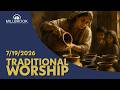
The widow’s crisis brings God’s math close to home. The world’s math said the debt had to be paid, and if it was not paid, her sons could be taken. Elisha asked, “What do you have?” and the little bit of oil became enough as she gathered jars from her neighbors. The widow had to ask boldly when she had almost nothing, and the neighbors had to give what did not seem to add up. God’s economy kicks in when life leaves people lacking, empty, or in need, and grace shows up as empty cups flowing over.
Key Takeaways
- 1. God’s math creates abundance God’s economy does not follow the neat rules that make life feel controllable. The world counts scarcity, debt, effort, and payoff, but God creates everything out of nothing and breathes holiness into dust. The places that look empty may become the very places where grace starts multiplying. [34:34]
- 2. Faith refuses false certitude Faith is not a worksheet with one right answer waiting at the bottom. Like poetry, faith is lived, breathed, spoken, and sometimes left silent. The soul grows deeper when mystery is not treated as failure, but as the place where God’s reality exceeds the world’s arithmetic. [35:41]
- 3. Loss can become double portion Elijah’s departure looked like subtraction, a real grief and a real loss for Elisha. Yet that moment of absence became the place where Elisha asked for a double portion of the spirit. God does not erase loss by pretending it is small, but God can make loss the doorway into unexpected abundance. [36:45]
- 4. Need asks, abundance answers The widow stood in a crisis where the math was brutal: debt unpaid, sons at risk, survival collapsing. Elisha did not begin with what she lacked, but with the small thing still in her hand. God’s abundance often begins with a question that feels almost unreasonable: “What do you have?” [38:41]
- 5. Neighbors hold needed jars The widow’s miracle did not happen in isolation. The neighbors had to give jars without fully knowing how those jars fit the need. God’s generous economy often passes through ordinary acts of sharing that may not make sense at the time, but become vessels for overflowing grace. [39:25]
Youtube Chapters
- [00:00] - Welcome
- [27:56] - God’s Generous Economy Introduced
- [28:31] - When Life Adds Up
- [29:44] - Most Of Life Does Not Add Up
- [30:37] - Poetry, Rules, And Mystery
- [33:36] - Two Plus Two Is Not Always Four
- [34:34] - God’s Math Works Differently
- [35:41] - Faith As A Process, Not A Product
- [36:28] - Elisha And The Double Portion
- [37:28] - Elisha Creates Abundance
- [38:41] - The Widow’s Desperate Need
- [39:25] - Borrowed Jars And Bold Faith
- [40:07] - Where God’s Economy Meets Need
- [41:22] - Empty Cups Flowing Over