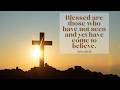
Jesus stood in the locked room, his hands and side still raw from the cross. The disciples huddled in fear when he suddenly appeared. “Peace be with you,” he said, showing them his scars. Their terror turned to joy as they touched his wounds and believed. [30:23]
Jesus didn’t hide his suffering. His scars proved death had lost. By showing his wounds, he turned doubt into faith. He sent the disciples out with the same peace he carried—peace stronger than fear.
You lock doors too—to hide pain, shame, or doubt. Jesus enters anyway. He offers scars as proof: your brokenness is where his peace begins. What locked room are you guarding?
“When it was evening on that day… Jesus came and stood among them and said, ‘Peace be with you.’ After he said this, he showed them his hands and his side.”
(John 20:19–20, NRSV)
Prayer: Ask Jesus to enter one locked place in your heart and speak peace there.
Challenge: Write a fear or doubt on paper, then pray over it aloud: “Jesus, bring peace here.”
Thomas crossed his arms. “Unless I touch his scars, I won’t believe.” A week later, Jesus returned. He stretched his pierced hands toward Thomas. “Put your finger here. Stop doubting—believe.” Thomas fell to his knees: “My Lord and my God!” [31:06]
Jesus met Thomas’s doubt with patience, not scorn. He knew honest questions lead to deeper faith. Thomas’s confession—“My Lord!”—became a model for all who follow without seeing.
Do you demand proof before trusting Jesus? He welcomes your questions but asks for your surrender. Where is Jesus inviting you to move from doubt to declaration?
“Then [Jesus] said to Thomas, ‘Put your finger here; see my hands. Reach out your hand… Stop doubting and believe.’ Thomas said to him, ‘My Lord and my God!’”
(John 20:27–28, NIV)
Prayer: Thank Jesus for being patient with your doubts. Name one struggle to trust him.
Challenge: Tell a trusted friend one doubt you’re wrestling with. Ask them to pray with you.
The people of Nineveh waited seven centuries for the Messiah. When Thomas arrived, preaching a crucified Savior, they believed instantly. Their faith outlasted wars, exile, and generations of silence. Jesus honored their patience with his presence. [36:17]
God rewards persistent faith. The Ninevites’ trust in a promise—not yet fulfilled—shaped their identity. Jesus sees your long waits and hidden faithfulness.
What promise are you clinging to? How might Jesus be shaping you through the waiting?
“The people of Nineveh believed God. They declared a fast, and all of them… put on sackcloth.”
(Jonah 3:5, NRSV)
Prayer: Confess one area where you’ve grown weary of waiting. Ask for strength to keep trusting.
Challenge: Read Jonah 3. Write one sentence about how the Ninevites’ response challenges you.
The church packed bags with socks, water, and snacks for homeless neighbors. Each bag carried a note: “You are loved.” Simple acts—chopping vegetables, filling kits—became holy work. Jesus sends us like he sent Thomas: “As the Father sent me, I send you.” [10:16]
Faith moves hands, not just hearts. Jesus breathes his Spirit into ordinary people to do healing work. Your “small” obedience—giving, serving, praying—fuels God’s kingdom.
What practical step is Jesus asking you to take today?
“If you forgive the sins of any, they are forgiven them; if you retain the sins of any, they are retained.”
(John 20:23, NRSV)
Prayer: Pray for courage to act on one prompting from the Holy Spirit this week.
Challenge: Fill a Ziploc bag with travel-sized toiletries. Keep it in your car to give to someone in need.
The psalmist compared unity to dew from Mount Hermon—a gentle, life-giving miracle. Jesus’ disciples, once divided by fear, became bold witnesses through his peace. Like morning dew, their unity refreshed a broken world. [29:44]
Unity starts when we fix our eyes on Jesus’ scars, not each other’s flaws. His peace heals divisions and fuels mission.
Where do you need to seek unity instead of argument?
“How very good and pleasant it is when kindred live together in unity!… It is like the dew of Hermon, which falls on the mountains of Zion.”
(Psalm 133:1, 3, NRSV)
Prayer: Ask Jesus to show you one relationship to pursue peace in this week.
Challenge: Text or call someone you’ve avoided. Say, “I’m praying for you—how can I support you?”
A warm Eastertide gathering emphasizes shalom—Hebrew and Arabic greetings of peace—and frames faith as a living, communal force. Announcements invite participation in congregational ministries, a Bible study tracing Jesus’ footsteps, and a short mission trip to Cairo that will support refugee and church ministries. The central reading from John 20:19–31 recounts Jesus appearing to the disciples after the resurrection, breathing the Spirit on them, and commissioning them with words of peace. Thomas, absent at the first appearance, demands tangible proof; when Jesus returns, he invites Thomas to touch the wounds, and Thomas responds, “My Lord and my God.” Jesus then pronounces a blessing on those who believe without seeing, and the Gospel writer explains that these signs were recorded so readers may believe and have life in Jesus’ name.
Pastoral reflection reframes Thomas not simply as a cynic but as a disciple whose honesty and need for encounter make his faith concrete. The ancient story of Thomas’s mission to Nineveh surfaces as a striking reversal: a man famous for doubt becomes the bearer of good news to a people who had waited centuries for the Messiah and who received the report with instant faith. That contrast highlights how divine work can outpace human expectation and how encounter transforms doubt into worship.
The message urges daily fidelity: faith must persist through seasons when God’s presence feels absent. Repentance, prayer, Scripture reading, and communal worship remain practical means to deepen trust. Emphasis falls on grace—salvation as a free gift accessed through faith in Christ—and on the communal texture of belief, modeled by the disciples’ shared greeting of peace and the psalmic image of unity like dew on Mount Hermon. The assembly moves from proclamation to intercession, lifting names and needs before God, praying the Lord’s Prayer, and receiving a benediction that sends into the world with the Spirit’s peace, forgiveness, and life-giving witness.
It's called grace. It's the free gift of grace alone through faith in Christ Jesus alone. It's the free gift of grace alone through faith alone in Christ Jesus alone. And if you haven't heard the good news, Jesus is risen. He is risen indeed. Hallelujah. And hallelujah. And Thomas had a moment of doubt, but he ultimately did believe. And when he did believe, Jesus blessed him and just melted his heart beyond his wildest imagination.
[00:39:04]
(32 seconds)
#GraceAlone
what is your faith story? Do you believe in Jesus Christ as your savior unconditionally? You know, the entire year I was in Iraq, I didn't feel his presence once, and I mentioned that before. And that's often in our lives. Right? We don't feel his presence. We go about our daily lives, wondering where the Lord's taken us through the ups and downs, the peaks and the valleys. And that's where faith comes in. I really believe that's where faith comes in.
[00:37:41]
(25 seconds)
#FaithInTheValleys
I'm an AI bot trained specifically on the sermon from Apr 20, 2026. Do you have any questions about it?
Add this chatbot onto your site with the embed code below
<iframe frameborder="0" src="https://pastors.ai/sermonWidget/sermon/doubting-thomas-faith-without-seeing" width="100%" height="100%" style="height:100vh;"></iframe>Copy