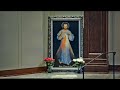
The Church marks Divine Mercy Sunday with a liturgy that centers on forgiveness, the wounded Christ, and the life-giving presence of the Holy Spirit. The assembly moves from a penitential opening—confessing sin and asking for mercy—into prayers that recall baptism, redemption by Christ’s blood, and rebirth by the Spirit. The Gospel scene focuses on the risen Christ entering a room of fear: he offers peace, displays his wounds as proof of merciful love, and breathes the Holy Spirit to empower forgiveness. The encounter with Thomas underscores patient mercy: doubt receives invitation rather than rejection, and faith responds to an offered touch.
The creed and intercessions root the congregation in apostolic faith and in solidarity with the universal Church, the saints, and the faithful departed. The Eucharistic prayer frames Christ as the true Passover Lamb whose death destroys death and whose rising restores life. The assembly asks the Spirit to make bread and wine into the body and blood that unite believers and seal the covenant of forgiveness. The memorial of Christ’s passion and resurrection becomes a present act of union: receiving the sacrament summons continuing transformation of mind and heart and calls the faithful to live mercy in daily relationships.
Communion reinforces the call to tangible faith—an invitation to encounter the wounds of Christ as sources of healing rather than scandal—and to repeat the trustful prayer, “Jesus, I trust in you.” Prayers for peace and unity, petitions for those who suffer, and remembrance of saints articulate a theology that connects private conversion with communal mission. The service closes with blessing and a tribute to a local religious sister, highlighting ongoing service as a fruit of mercy. The liturgy thus weaves Scripture, sacrament, and prayer into a single summons: open closed doors, bring doubts into the light, receive forgiveness, and live the reconciling work of God in the world.
Key Takeaways
- 1. Mercy flows through Christ's wounds Mercy appears not as abstract compassion but as embodied suffering. The wounds of Christ show that divine forgiveness entered human vulnerability and transformed it into a means of reconciliation. To touch those wounds is to recognize that redemption costs love and that mercy heals through remembered sacrifice and present tenderness. [18:29]
- 2. Peace precedes faith's encounter Peace arrives before full understanding or demonstrated faith. The risen Lord greets fear with peace, inviting hearts to trust even amid confusion and closed doors. That peace creates space for honest doubt, where faith can emerge without coercion and receive grace on its own terms. [18:14]
- 3. The Spirit empowers forgiving community The breathed Spirit enlivens the community to forgive and to be forgiven. Forgiveness becomes communal action, sustained by the Spirit’s presence rather than human resolve alone. When the Spirit fills the faithful, reconciliation moves from private sentiment into a shared, sacramental reality. [18:41]
- 4. Eucharist unites life and death The Eucharist makes present the paradox that death becomes the gateway to restored life. Celebrating the bread and chalice anchors the people in a covenant where sacrifice defeats death and forms a community of mutual belonging. Receiving the sacrament commits hearts to live that resurrection reality in daily acts of mercy. [31:06]
Youtube Chapters
- [00:00] - Welcome
- [04:08] - Penitential Rite and Confession
- [07:21] - Opening Prayer: Mercy Implored
- [18:00] - Gospel: Appearance to the Disciples
- [18:41] - Christ Breathes the Holy Spirit
- [19:12] - Thomas: Doubt and Invitation
- [20:54] - The Creed: Faith Proclaimed
- [28:41] - Eucharistic Prayer: Paschal Mystery
- [31:06] - Institution of the Eucharist
- [33:22] - Prayers for the Church and Dead
- [37:38] - Communion: Encounter and Healing
- [46:49] - Post-Communion Prayer: Lasting Effect
- [47:07] - Tribute: Sister Sarah and Mission
- [53:17] - Final Blessing and Dismissal