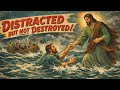
Bible Reading Matthew 14:22-33 (KJV) 22 And straightway Jesus constrained his disciples to get into a ship, and to go before him unto the other side, while he sent the multitudes away.
23 And when he had sent the multitudes away, he went up into a mountain apart to pray: and when the evening was come, he was there alone.
24 But the ship was now in the midst of the sea, tossed with waves: for the wind was contrary.
25 And in the fourth watch of the night Jesus went unto them, walking on the sea.
26 And when the disciples saw him walking on the sea, they were troubled, saying, It is a spirit; and they cried out for fear.
27 But straightway Jesus spake unto them, saying, Be of good cheer; it is I; be not afraid.
28 And Peter answered him and said, Lord, if it be thou, bid me come unto thee on the water.
29 And he said, Come. And when Peter was come down out of the ship, he walked on the water, to go to Jesus.
30 But when he saw the wind boisterous, he was afraid; and beginning to sink, he cried, saying, Lord, save me.
31 And immediately Jesus stretched forth his hand, and caught him, and said unto him, O thou of little faith, wherefore didst thou doubt?
32 And when they were come into the ship, the wind ceased.
33 Then they that were in the ship came and worshipped him, saying, Of a truth thou art the Son of God.
2 Corinthians 4:8-10 (KJV) 8 We are troubled on every side, yet not distressed; we are perplexed, but not in despair;
9 Persecuted, but not forsaken; cast down, but not destroyed;
10 Always bearing about in the body the dying of the Lord Jesus, that the life also of Jesus might be made manifest in our body.
Observation Questions - In Matthew 14:30, what caused Peter to sink after initially walking on water? How does this mirror the idea of distraction mentioned in the sermon? [53:57]
- According to 2 Corinthians 4:8-10, what four contrasts describe the believer’s experience in trials? How were these contrasts illustrated in the testimony about the broken transmission? [34:07]
- What practical example was given in the sermon to show how God’s provision often comes before a storm? [34:07]
- How did the sermon define the purpose of altars, and what action was encouraged in response? [01:18:47]
Interpretation Questions - Why do you think Jesus allowed the disciples to face the storm after obeying His command to get into the boat (Matthew 14:22)? How does this relate to the sermon’s emphasis on storms refining faith? [48:44]
- The sermon warns that distraction can “rewrite destiny” by shifting focus from calling to problems. How might this process happen gradually in a person’s life? [53:57]
- 2 Corinthians 4:10 says suffering allows “the life of Jesus” to be visible in believers. What does this imply about how God uses our struggles to impact others?
- The broken transmission testimony highlighted faithfulness in small trials leading to broader deliverance. Why might God use incremental challenges to prepare us for greater storms? [34:07]
Application Questions - What “contrary wind” in your life right now feels like it’s testing your focus on God’s calling? What practical step could you take this week to refix your eyes on Jesus instead of the storm? [48:44]
- The sermon warned that distractions often target both individuals and their spiritual lineage. Are there areas where your current struggles could negatively influence those who look up to you? How might addressing these distractions protect your purpose? [01:16:44]
- The altar was described as a place where “crawling steps become testimony.” Is there a situation where you need to physically or spiritually “crawl to the altar” this week, even if it feels small or imperfect? [01:18:47]
- Recall a time when God equipped you in advance for a trial (e.g., a scripture, relationship, or skill). How can remembering that preparation help you face current or future storms with confidence? [01:00:25]
- Identify one recurring distraction (e.g., worry, comparison, offense) that subtly shifts your focus from God’s promises. What tangible habit could you build to “reclaim attention” as a spiritual discipline? [53:57]