
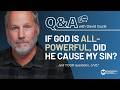
Did God Cause My Sin? LIVE Q&A
Aug 13, 2026
Devotional
Sermon Summary
Bible Study Guide
Sermon Clips
This is what God knows. God knows that the world of redemption is better and gives him more glory than the world of innocence. You and I tend to get caught up on the world of innocence and think that that's how God should have arranged everything. But I'll say it again. God knows that the world of redemption is better and that it gives him more glory than the world of innocence. [00:09:27]
Friends, your sin only prevents you from coming to the table of the Lord if you won't repent of it. I if you've got sin in your life, the perfect thing for you to do is to come to the table of the Lord and to receive the cup and the bread that uh speak to us of the instruments by which our sin is forgiven, the perfect sacrifice of Jesus Christ. [00:36:26]
If a person is comfortable in habitual sin and no longer struggles with it, but just yields to it, that is a danger sign that they may very well not be converted. I I would not give quick assurance of salvation with somebody who had no struggle against persistent sins in their life. Here's what we know is that when a person is born again by God's spirit that they are changed. [00:38:29]
Let's just say this, dear brother, I don't know if you forgive yourself or not. Who cares? Do you believe that God has forgiven you? And you believe that God's forgiveness is greater than any forgiveness that you might grant to yourself. So put the focus not on forgiving himself, but on the forgiveness God has granted to him. [00:13:21]
Any one thing in isolation, it might be very difficult to see how that works for good in the life of a believer. But God didn't say all things work for good in isolation. What God said is that all things work together for good. [00:16:59]
There's something in the d the dynamic of temptation and sin where the longer we entertain a sin or excuse me, let me take that back. The longer we entertain a temptation, the harder it is to resist. So when we are tempted, we should expect that the offramp, that the escape route that God gives us is oftenimes presented to us early in the temptation, early if you want to call that cycle or process of temptation. [00:27:40]
This is what the believer can understand that yes, we will have tribulation in this world. We will have painful experiences. Jesus said in the world you will have tribulation. But then what did Jesus say? But be of good cheer for I have overcome the world. In other words, the Christian's assurance is not that nothing bad will happen in their life, but the Christian's assurance is that no pain, no evil in that is experienced or inflicted upon us uh is wasted. God will use it all for good. [00:15:46]
In the big picture, God thinks that it is better to have a world where people are allowed to sin than it is to have a world where people are prevented from sinning, where sin is impossible, so to speak, and where innocence is sort of enforced. In theory, God could have created a world where sin was impossible, but he did not. God knows it's better to have a world and existence where sin is possible. [00:08:25]
No temptation has overtaken you except such as common to man. But God is faithful who will not allow you to be tempted beyond what you are able. But with the temptation will also make the way of escape that you may be able to bear it. Friends, I I know that sometimes we are severely tempted, but with every temptation, there is a way of escape. [00:10:16]
He called himself the chief of sinners. And you could just simply ask, do do you really think that you're a worse sinner than Paul was? If God could forgive Paul, he's already forgiven the chief of sinners. You can receive the forgiveness of God. [00:14:02]
God is sovereign and he uh does everything and carries out everything in this world according to his will. There is no doubt about that whatsoever. And men and women have real choices that they can make. I'm not going to use the term free will because I don't think anybody's will is perfectly free except God's. But that does not necessarily mean that we don't have real choices we can make. And we're responsible for those real choices. [00:22:22]
I just want you to think of it. God says in Ezekiel 18:20, "The wickedness of the wicked shall be upon himself." not on God, not on somebody else, but on himself. That's the one who's responsible for their sin. It's the sinner himself. A- And if God were to be responsible for our sin, it would be a violation of God's holiness. [00:04:21]
Here's how I would say it. Um because of the work of conversion in our life, for a believer, someone who's been born again by God's spirit that they can't be comfortable in habitual sin. um habitual sin will cause a struggle, will cause a a burden of conscience, will cause a conviction of the Holy Spirit that somewhere somehow must get resolved. [00:37:52]
The whole point of that parable is be ready. Be ready for the return of Jesus Christ. And look, even if it was true that Jesus would not return for another hundred years or another 200 years, uh we should still live our life with a readiness for the return of Jesus Christ. That's what the parable is all about. Be ready for the return of Jesus. Live your life not in a fanatical state of weirdness, but in a genuine proper sense of readiness for his return, especially as demonstrated by our faithfulness in the present moment. [00:57:38]
Just another way that you can say that there's a distance between God and our sin. James 1 13 and 14. Let no one say when he is tempted, I am tempted by God. For God cannot be tempted by evil, nor does he himself tempt anyone. But each one is tempted when he's drawn away by his own desires and enticed. [00:05:24]
Ask a question about this sermon
Friends, your sin only prevents you from coming to the table of the Lord if you won't repent of it. I if you've got sin in your life, the perfect thing for you to do is to come to the table of the Lord and to receive the cup and the bread that uh speak to us of the instruments by which our sin is forgiven, the perfect sacrifice of Jesus Christ. [00:36:26]
If a person is comfortable in habitual sin and no longer struggles with it, but just yields to it, that is a danger sign that they may very well not be converted. I I would not give quick assurance of salvation with somebody who had no struggle against persistent sins in their life. Here's what we know is that when a person is born again by God's spirit that they are changed. [00:38:29]
Let's just say this, dear brother, I don't know if you forgive yourself or not. Who cares? Do you believe that God has forgiven you? And you believe that God's forgiveness is greater than any forgiveness that you might grant to yourself. So put the focus not on forgiving himself, but on the forgiveness God has granted to him. [00:13:21]
Any one thing in isolation, it might be very difficult to see how that works for good in the life of a believer. But God didn't say all things work for good in isolation. What God said is that all things work together for good. [00:16:59]
There's something in the d the dynamic of temptation and sin where the longer we entertain a sin or excuse me, let me take that back. The longer we entertain a temptation, the harder it is to resist. So when we are tempted, we should expect that the offramp, that the escape route that God gives us is oftenimes presented to us early in the temptation, early if you want to call that cycle or process of temptation. [00:27:40]
This is what the believer can understand that yes, we will have tribulation in this world. We will have painful experiences. Jesus said in the world you will have tribulation. But then what did Jesus say? But be of good cheer for I have overcome the world. In other words, the Christian's assurance is not that nothing bad will happen in their life, but the Christian's assurance is that no pain, no evil in that is experienced or inflicted upon us uh is wasted. God will use it all for good. [00:15:46]
In the big picture, God thinks that it is better to have a world where people are allowed to sin than it is to have a world where people are prevented from sinning, where sin is impossible, so to speak, and where innocence is sort of enforced. In theory, God could have created a world where sin was impossible, but he did not. God knows it's better to have a world and existence where sin is possible. [00:08:25]
No temptation has overtaken you except such as common to man. But God is faithful who will not allow you to be tempted beyond what you are able. But with the temptation will also make the way of escape that you may be able to bear it. Friends, I I know that sometimes we are severely tempted, but with every temptation, there is a way of escape. [00:10:16]
He called himself the chief of sinners. And you could just simply ask, do do you really think that you're a worse sinner than Paul was? If God could forgive Paul, he's already forgiven the chief of sinners. You can receive the forgiveness of God. [00:14:02]
God is sovereign and he uh does everything and carries out everything in this world according to his will. There is no doubt about that whatsoever. And men and women have real choices that they can make. I'm not going to use the term free will because I don't think anybody's will is perfectly free except God's. But that does not necessarily mean that we don't have real choices we can make. And we're responsible for those real choices. [00:22:22]
I just want you to think of it. God says in Ezekiel 18:20, "The wickedness of the wicked shall be upon himself." not on God, not on somebody else, but on himself. That's the one who's responsible for their sin. It's the sinner himself. A- And if God were to be responsible for our sin, it would be a violation of God's holiness. [00:04:21]
Here's how I would say it. Um because of the work of conversion in our life, for a believer, someone who's been born again by God's spirit that they can't be comfortable in habitual sin. um habitual sin will cause a struggle, will cause a a burden of conscience, will cause a conviction of the Holy Spirit that somewhere somehow must get resolved. [00:37:52]
The whole point of that parable is be ready. Be ready for the return of Jesus Christ. And look, even if it was true that Jesus would not return for another hundred years or another 200 years, uh we should still live our life with a readiness for the return of Jesus Christ. That's what the parable is all about. Be ready for the return of Jesus. Live your life not in a fanatical state of weirdness, but in a genuine proper sense of readiness for his return, especially as demonstrated by our faithfulness in the present moment. [00:57:38]
Just another way that you can say that there's a distance between God and our sin. James 1 13 and 14. Let no one say when he is tempted, I am tempted by God. For God cannot be tempted by evil, nor does he himself tempt anyone. But each one is tempted when he's drawn away by his own desires and enticed. [00:05:24]
David Guzik
This sermon · AI assistant

-
I'm an AI bot trained specifically on the sermon from Aug 13, 2026. Do you have any questions about it?