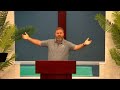
Our lives are designed to be entirely devoted to loving God, yet we often compartmentalize our faith into a few hours on Sunday. True devotion means that the love of God permeates every corner of our 168-hour week, not just the time spent in a church building. This all-encompassing love is not merely a warm feeling but an active life of service and reflection. When we consider our daily habits, we must ask how our ordinary routines might change if God were truly our central focus. We are called to push aside the false idols that compete for our attention and declare that the Lord is one. [06:39]
“Hear, O Israel: The LORD our God, the LORD is one. You shall love the LORD your God with all your heart and with all your soul and with all your might.” (Deuteronomy 6:4-5 ESV)
Reflection: What is one specific routine in your 168-hour week that currently feels "secular," and how might you consciously invite God’s presence into that moment today?
God’s method for ensuring His people remember His commands is through the consistent rehearsal of truth within the home. We are called to teach these words diligently, weaving them into the natural rhythms of sitting, walking, lying down, and rising. This means that every moment—whether a quiet morning or a chaotic afternoon—is a potential opportunity for spiritual formation. Our children and those around us are constantly observing how we handle both the joys and the sideways moments of life. By saturating our homes with the Word, we create an environment where the scriptures become inescapable and foundational. [13:06]
“And these words that I command you today shall be on your heart. You shall teach them diligently to your children, and shall talk of them when you sit in your house, and when you walk by the way, and when you lie down, and when you rise.” (Deuteronomy 6:6-7 ESV)
Reflection: Think about your typical "walking by the way" time, such as a commute or running errands; what is one way you could use that space to speak of God’s goodness to those with you?
Leading a household in worship can feel daunting, especially when schedules are busy or children are restless. However, the goal is not to produce a polished Sunday service, but to create an ordinary expectation that God’s Word is discussed daily. Simple practices like reading a passage, singing a song, or praying together build a lasting foundation for the next generation. It is far more important to be persistent in these efforts than to wait for the perfect moment or the perfect plan. Even when it feels like no one is listening, the seeds of truth are being planted in the hearts of those we love. [23:32]
“Give ear, O my people, to my teaching; incline your ears to the words of my mouth! I will open my mouth in a parable; I will utter dark sayings from of old, things that we have heard and known, that our fathers have told us. We will not hide them from their children, but tell to the coming generation the glorious deeds of the LORD, and his might, and the wonders that he has done.” (Psalm 78:1-4 ESV)
Reflection: If you were to commit just five minutes today to reading Scripture aloud with your family or a friend, what time of day would be the most sustainable for you to protect?
Discipleship is not a solitary project for parents alone; it is the work of the entire covenant community. We need the wisdom of older saints who have walked the path before us and can testify to God’s lifelong faithfulness. One generation commends the works of God to the next, ensuring that the story of His mighty acts is never forgotten. Whether you are a grandparent, an aunt, or a friend, you have a vital role in investing in the lives of the young people around you. By standing shoulder to shoulder, we support one another in the high calling of raising up giants in the faith. [32:45]
“One generation shall commend your works to another, and shall declare your mighty acts. On the glorious splendor of your majesty, and on your wondrous works, I will meditate. They shall speak of the might of your awesome deeds, and I will declare your greatness.” (Psalm 145:4-6 ESV)
Reflection: Who is a "giant in the faith" from a different generation than yours that you could reach out to this week for a word of wisdom or encouragement?
Jesus made it clear that children are not a distraction from the work of the kingdom, but are central to it. When we welcome the noise and the messes of the younger generation, we reflect the very heart of Christ. Our goal as a church is to equip families and walk alongside them, rather than trying to outsource the responsibility of discipleship. By integrating the next generation into our worship and our lives, we provide them with a front-row seat to what it looks like to follow Jesus. We labor together so that the children yet unborn might arise and set their hope in God. [43:37]
“Then children were brought to him that he might lay his hands on them and pray. The disciples rebuked the people, but Jesus said, ‘Let the children come to me and do not hinder them, for to such belongs the kingdom of heaven.’” (Matthew 19:13-14 ESV)
Reflection: When you see children or young people in the church, what is one way you can move toward them with a "disposition of welcome" rather than keeping them at a distance?
Redeemer Community Church’s vision for a week of faithful Christian living centers on the close integration of church and home. Rooted in Deuteronomy 6’s Shema, the congregation is called to love God with all heart, soul, and strength, and to make those words unavoidable within family life. The biblical pattern is practical and pervasive: Scripture should be taught diligently to children, discussed continuously—in the house, on the road, when rising and when lying down—and signposted in everyday life so that faith becomes ordinary, not occasional. Family worship is recommended as the primary means of making that ordinary: short, consistent patterns of reading, singing, and prayer that form habits far more formative than sporadic, programmatic interventions.
Teaching children is not merely parental hobbyism but a divinely entrusted responsibility that guards against cultural idols and forgetfulness. The congregation is encouraged to employ simple, sustainable rhythms—catechisms, memory work, hymns, five minutes of Bible reading—rather than aiming for perfection or replicating corporate worship at home. Persistence in these small disciplines yields outsized fruit; repeated exposure to Scripture forms a spiritual habit that shapes affections, imagination, and moral vision.
The local church’s role is supportive, not substitutive. Community groups, intergenerational fellowship, Titus 2-style mentoring, and intentional ministries—exemplified by Trail Life USA and American Heritage Girls—are presented as structures that resource parents, connect generations, and create places where older saints willingly teach and younger saints faithfully learn. Children belong in corporate worship alongside their families, and the gathered body should model and assist in the transmission of faith rather than outsource it to programs. The ultimate aim is generational faithfulness: a people who tell God’s mighty acts to the next generation so that hope is set on God, not forgotten.
The call is urgent and pastoral: parents are to steward their primary role, older believers to come alongside them, and the whole church to cultivate environments where Scripture is inescapable. If families and the congregation take up small, repeatable disciplines together, they will raise robust, resilient followers of Christ who carry the faith forward.
``Can I give you an encouragement about family worship if you've tried and failed before, if you've never tried it before? And and I'm especially talking to you who are husbands and fathers in the room who have children or or just a spouse to lead faithfully according to the scriptures. Persistence is far more important than perfection. Your commitment to do it is far more important than you're trying to get it right every time. You're gonna fail. You're gonna have a five year old turn and flips on the end of the couch pretending like they don't hear a word you say. And then one day, you're gonna ask a question, and you're gonna hear them answer it. You're gonna go, you heard that while you're upside down screaming at the top of your lungs throwing things across the living room? Yeah. They heard. Persistence is far more important than perfection.
[00:22:51]
(45 seconds)
#PersistenceOverPerfection

Can I put this in perspective for you and make it practical for a second? If you were to commit to read the bible aloud with your family for five minutes a day. Is that a long time? Five minutes? If you're three or four, it might be, but five minutes a day is a pretty short time, pretty low level of commitment. Let me tell you what you could accomplish. In five minutes a day, you would cover the entire bible in less than two and a half years. Now I know we're all tainted by read the bible in a year plans. Right? And that's the only thing that matters if you can read it in a year, but I'd rather you read it in five years and get through the whole thing than start a new read through the bible on a year plan every January and fail every February. So less than two and a half years, you would read through the whole bible with your family. And then if you started that when your child was five years old, by the time they were 18 years old, you would have, as a family, read through the entirety of the scriptures more than five times.
[00:23:36]
(61 seconds)
#FiveMinutesFaith
I'm an AI bot trained specifically on the sermon from Jan 26, 2026. Do you have any questions about it?
Add this chatbot onto your site with the embed code below
<iframe frameborder="0" src="https://pastors.ai/sermonWidget/sermon/deuteronomy-6-home-church" width="100%" height="100%" style="height:100vh;"></iframe>Copy