Jul 21, 2026
The psalmist speaks directly to his own soul. He asks a raw, honest question. He feels a deep disquiet within himself. His emotions are in turmoil. Yet he does not stop with the question. He commands his soul to hope in God. He declares a future reality of praise. He affirms that God is his help and his God.
This passage shows a faithful way to process deep sadness. The writer acknowledges his feelings without letting them have the final word. He turns his focus from his internal storm to the unchanging character of God. He preaches truth to his own heart. He anchors his identity not in his fluctuating emotions, but in his relationship with a constant Lord.
You may feel a similar disquiet today. Your soul may be cast down by circumstances, exhaustion, or grief. Hear the psalmist’s example. Be honest about your pain, but then speak truth to it. Will you tell your soul to hope in God, even when you do not feel it?
Why are you cast down, O my soul? And why are you disquieted within me? Hope in God; For I shall yet praise Him, The help of my countenance and my God.
(Psalm 42:5, NKJV)
Prayer: Ask God to give you the courage to be honest with Him about your pain and the faith to declare His goodness in the midst of it.
Challenge: Write down one sentence that honestly describes your current feeling, then write one truth about God’s character you can praise Him for.
A broken heart feels shattered and alone. A contrite spirit is crushed by weight it cannot bear. In this place of utter brokenness, God makes a promise. He does not promise to instantly remove the pain. He promises His nearness. He commits to saving those who are in this state. He draws close to the one who feels most abandoned.
This truth confronts the lie that God is distant in our suffering. His presence is His primary answer to our despair. He is not a God who observes from a safe distance. He is a God who enters the valley with us. His nearness does not always change the circumstance, but it changes our experience within it. We are not alone.
You might feel that your brokenness has pushed God away. The enemy whispers that you are too damaged for His care. This verse declares the opposite. Where is God when your heart breaks? He is right there. Will you let yourself believe He is near to you today?
The LORD is near to those who have a broken heart, And saves such as have a contrite spirit.
(Psalm 34:18, NKJV)
Prayer: Thank God that He is near to you right now, even if you cannot feel His presence.
Challenge: Set a timer for five minutes today. Sit in silence and consciously acknowledge God’s promised nearness to you.
Elijah had just witnessed God’s power in a stunning victory. Then, a single threat from Queen Jezebel sent him running. He collapsed under a juniper tree and prayed to die. He was utterly exhausted. God’s response was gentle. An angel did not bring a sermon. The angel brought food, water, and the gift of sleep. God cared for Elijah’s body before addressing his spirit.
This story reveals God’s compassionate understanding of our humanity. He knows we are physical beings. Severe exhaustion can make everything seem hopeless. God’s first intervention was practical, not theological. He provided rest and nourishment. He strengthened Elijah’s body so he could later hear God’s gentle whisper and receive renewed purpose.
Your despair may be fueled by sheer physical and emotional exhaustion. You may need rest more than you need a rebuke. God is not impatient with your fatigue. He meets you in it. What is one practical need—sleep, food, quiet—that your body is craving today?
Then as he lay and slept under a broom tree, suddenly an angel touched him, and said to him, “Arise and eat.” Then he looked, and there by his head was a cake baked on coals, and a jar of water. So he ate and drank, and lay down again.
(1 Kings 19:5-6, NKJV)
Prayer: Ask God to show you the simple, practical ways He wants to care for your physical needs today.
Challenge: Identify one thing you can do to honor your body’s need for rest—such as going to bed 30 minutes earlier or taking a break from screens.
David’s prayer in Psalm 13 begins in a place of raw desperation. He feels forgotten by God. He wrestles with sorrow daily. He feels the oppression of his enemy. He asks God “How long?” four times. He holds nothing back. Yet, his prayer does not end in the despair where it began. He remembers God’s unfailing love. He recalls his own history of God’s salvation. He moves from a question to a decision to trust.
This psalm models a full journey through pain. David does not pretend he is fine. He brings his anger, his questions, and his sadness directly to God. His honesty is an act of faith. Remembering God’s past faithfulness becomes the bridge that carries him from despair to a declaration of trust and praise.
You may have questions for God that feel too bold or too angry to voice. David shows us that God can handle our honest cries. The key is to move from complaining to remembering. What past evidence of God’s love can you recall to anchor your heart today?
How long, O LORD? Will You forget me forever? How long will You hide Your face from me? How long shall I take counsel in my soul, Having sorrow in my heart daily? How long will my enemy be exalted over me?… But I have trusted in Your mercy; My heart shall rejoice in Your salvation. I will sing to the LORD, Because He has dealt bountifully with me.
(Psalm 13:1-2, 5-6, NKJV)
Prayer: Confess to God one honest fear or question you have been afraid to say out loud, then thank Him for a specific time He was faithful to you.
Challenge: Write down one memory of God’s past faithfulness in your life on a notecard and place it where you will see it.
God’s design for healing often includes other people. Isolation deepens pain, while community shares its weight. The apostle Paul instructs the Galatian church to actively carry each other’s burdens. This command assumes we will have burdens too heavy to carry alone. It calls us to both receive help and to give it. Fulfilling this law of Christ means participating in His work of love through practical, supportive relationships.
This verse moves healing from a private struggle to a communal responsibility. We are not meant to suffer in silence. A burden shared is a burden halved. This is how the body of Christ functions. We are the hands and feet of Jesus, offering His presence and practical care to one another. We make God’s nearness tangible.
Who in your life needs you to help bear their burden? Who has God placed in your life to help bear yours? Overcoming the urge to withdraw is a step toward healing. Will you reach out to one person today, either to offer support or to humbly ask for it?
Bear one another’s burdens, and so fulfill the law of Christ.
(Galatians 6:2, NKJV)
Prayer: Ask God for the humility to share your burden with a trusted believer and the sensitivity to see someone else’s need.
Challenge: Call or text one person today. Either ask how they are really doing, or honestly share a struggle you are facing.
Depression affects people across every social and spiritual boundary, and Scripture treats it honestly rather than hiding it. The text distinguishes normal grief or situational discouragement from clinical depression and affirms that seeking qualified medical or counseling help does not indicate a lack of faith; God frequently works through prayer, Scripture, community, and medical care together. Depression can show itself as prolonged sadness, loss of hope and joy, fatigue, worthlessness, withdrawal, numbness, sleep or appetite changes, and difficulty concentrating—symptoms that may be hidden behind a public smile yet ravage the inner life. Psalm 42 models lament that asks hard questions while clinging to hope: the soul’s cry and the call to hope in God coexist.
Scripture demonstrates that God understands and draws near to broken hearts (Psalm 34:18). The biblical examples offered show varied responses to deep despair. Elijah, exhausted after victory, begged God to end his life; God responded not with rebuke but with rest, food, gentle conversation, renewed purpose, and companionship through Elisha—addressing physical, emotional, and spiritual needs before issuing instruction. David repeatedly voiced raw complaints and then returned to trust, modeling honesty with God without abandoning hope. Job endured catastrophic loss and prolonged suffering while God remained present and ultimately restored. Jeremiah’s lament turned toward remembrance of God’s faithfulness as the root of returning hope.
The causes of depression include physical exhaustion, grief and loss, fear and anxiety, isolation, and spiritual attack; each factor contributes differently and may require different responses. Isolation and misunderstood suffering often intensify despair, while fear can magnify present threats and erase memory of past deliverances. The text emphasizes practical pastoral wisdom: attend to restoration when people are exhausted, foster community to bear burdens, remain spiritually alert without attributing every struggle to demonic activity, and remember that healing often involves both divine comfort and professional care. Above all, hope in God endures as both a command and a practice amid ongoing emotional struggle.
Depression is one of the greatest emotional and mental struggles affecting people today.

Christians are not immune to depression, and seeking help from qualified healthcare professionals or counselors when needed is not a lack of faith.
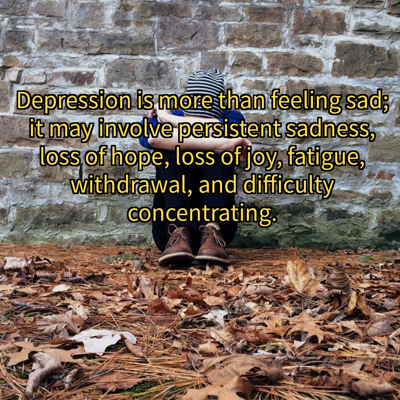
Depression is more than feeling sad; it may involve persistent sadness, loss of hope, loss of joy, fatigue, withdrawal, and difficulty concentrating.

God cares about every part of our lives; our spirit, soul, and body.

People may not understand. Friends may disappear. Family may misunderstand. But God draws closer.

A frightened child doesn't need the storm to end; the child needs to know someone trustworthy is present.
Lesson: Sometimes exhausted people need restoration before they need instruction.

Isolation often deepens emotional pain; God designed believers for community.
The enemy seeks to steal hope, but Scripture reminds believers to remain spiritually alert.
Hi, I'm an AI assistant for the pastor that gave this sermon. What would you like to make from it?
Add this chatbot onto your site with the embed code below
<iframe frameborder="0" src="https://pastors.ai/sermonWidget/sermon/depression-hope-god" width="100%" height="100%" style="height:100vh;"></iframe>Copy