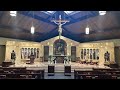
The Easter candle, lit at baptisms and funerals, symbolizes the enduring light of Christ. This light dispels darkness, sin, and error, offering guidance throughout our earthly journey and leading us toward the gift of heaven. It is a powerful reminder of the grace we receive through Christ, a grace that purifies us and configures us to God, enabling us to live out our faith. This light is meant to be passed on, a beacon for ourselves and for those we love. [17:49]
1 Corinthians 1:3
ESV: Grace to you and peace from God our Father and the Lord Jesus Christ.
Reflection: In what ways has the light of Christ been a guiding force in your life, and how can you intentionally share that light with others this week?
God is the eternally present one, the Alpha and the Omega, here with us now. To truly practice and live in faith, we must enter into this reality, encountering God in the present moment. This is the essence of the liturgy, where past events become present, and God Himself is here with us. Embracing this presence allows us to live fully, meeting others with the light of Christ within us. [19:57]
John 14:16-17
ESV: And I will ask the Father, and he will give you another Helper, to be with you forever, even the Spirit of truth, whom the world cannot receive, because it neither sees him nor knows him. You know him, because he abides with you, and he will be in you.
Reflection: Where in your daily life do you most easily sense God's presence, and how can you cultivate a deeper awareness of His presence in those moments?
Jesus declared, "I am the resurrection and the life. Whoever believes in me, even if he dies, will live." This profound truth offers hope and assurance, even in the face of death. It reminds us that life is changed, not ended, and that an eternal dwelling awaits those who believe. This promise is prefigured in our earthly relationships and fulfilled in God's kingdom. [15:37]
John 11:25-26
ESV: Jesus said to her, “I am the resurrection and the life. Whoever believes in me, though he die, yet shall he live, and everyone who lives and believes in me shall never die. Do you believe this?”
Reflection: When confronted with loss or uncertainty, how can you hold onto the truth of Jesus as the resurrection and the life to find comfort and strength?
Martha's journey, from her initial distress to her eventual confession of faith, mirrors our own experiences. She grappled with grief and the difficulty of letting go, yet she also held a profound confidence in Jesus' power and the reality of life beyond this world. This confidence in the gift of heaven can bring solace to our hearts and challenge us to live our own faith with conviction. [23:45]
1 Peter 1:3
ESV: Blessed be the God and Father of our Lord Jesus Christ! According to his great mercy, he has caused us to be born again to a living hope through the resurrection of Jesus Christ from the dead.
Reflection: In what specific ways can you nurture your own confidence in the gift of heaven and allow that hope to shape your perspective on current challenges?
The faith we live and the love we share are not confined to this world; they are carried forward. We are called to take the light of Christ that dwelled within us and shine it in our own lives, handing it on to our children and loved ones. By focusing on God and our relationship with Him, we can approach all aspects of life with a spirit of gratitude and thanksgiving, meeting others as if Christ is truly present. [49:55]
Colossians 3:17
ESV: And whatever you do, in word or deed, do everything in the name of the Lord Jesus, giving thanks to God the Father through him.
Reflection: Considering the legacy of faith and love that has been passed down to you, what is one tangible way you can actively live out and pass on that faith with gratitude this week?
The liturgy frames death as a passage into the presence of God, rooted in baptism and sustained by the Eucharist. From the sign of holy water to the white garment and Easter candle, the rites point to a life baptized into Christ’s death and raised with him. The account of Martha and Mary at Bethany is read as a pastoral mirror: grief is honest and immediate, yet faith names a deeper reality—Jesus as “the resurrection and the life.” Presence, not absence, is the decisive truth; where Christ is present, death’s power is exposed and hope is kindled.
Attention falls on ordinary fidelity: daily reception of the Eucharist, quiet prayer, and simply being present to those before one are shown as the practical means by which the baptized live out their calling. The funeral rites do not erase sorrow but reshape it, asking the community to let go of physical presence while trusting the soul’s life with God. The homily points to the sacramental images—light, garment, bread and wine—as continuing signs that configure believers to God and orient how grief is carried.
Past life and vocation are celebrated in concrete habits: presence with people, attentive work, passing faith to children. Those habits are presented as ways the light of Christ that shone in one life becomes a legacy for others. Prayer petitions and the Eucharistic memorial reinforce a theology of changed, not ended, life: mortal dwelling returns to dust while an eternal home is prepared. The dismissal gathers these convictions into daily practice—carry forward the charity, prioritize God, and live toward the heavenly banquet with confidence that mercy and consolation accompany those who mourn.
And for all of us to really practice the faith and to live in the faith, we have to kinda enter into that reality that we encounter God here now in the moment that God is here. And the liturgy of the mass is principally about that, you know, where we remember something that took place two thousand years ago with his death on the cross and that last supper, and when he ordained his apostles, priests, and he gave them the Eucharist. He washed their feet. Those things it took you know, it happened two thousand years ago. Every time we remember it in the mass, it becomes present in the here and now. The Eucharist becomes present. God becomes present. Jesus Christ is here.
[00:19:57]
(35 seconds)
#EucharistNow

And what I think Jesus shows her very clearly is I am here. And where I am, you know, the the miraculous power of God is. You know? A moment takes place where Lazarus is risen from death resuscitated for a period of time. Obviously, Lazarus died again. He's in the kingdom of heaven, and, you know, his his life didn't go on forever. It was a a miracle that God provided to show the power of Christ and to show what happens when the presence and the power of God is in a moment and, you know, can be there over a situation. But Martha's response, I know, Lord, what you are the resurrection life. I know what you say and with your presence here that this is what will be. And she represents so many of the aspects of our hearts where and when we're grieving, it can be hard to let go, and it can be hard to let things be as they are right now in this moment and to let go of our loved ones. And and she can also represent to us a confidence of faith that I know my loved ones have gone on before me, where they are, and what they're enjoying in the gift of heaven. It can bring confidence to our own faith
[00:23:13]
(60 seconds)
#FaithInResurrection
Add this chatbot onto your site with the embed code below
<iframe frameborder="0" src="https://pastors.ai/sermonWidget/sermon/david-bussan-funeral" width="100%" height="100%" style="height:100vh;"></iframe>Copy