True spiritual authority is not about controlling others or circumstances, but about learning to govern oneself through the power of the Holy Spirit. The Spirit grants believers the ability to align their desires and actions with God’s will, rather than using faith as a means to manipulate outcomes or people. This self-control is not about denying our humanity, but about allowing the Spirit to shape our responses, making room for genuine love and freedom to flourish in our relationships.
When we practice self-control, we resist the urge to impose our will on others. Instead, we create an environment where grace and freedom can grow. This discipline is a sign of spiritual maturity, showing that our lives are being transformed from the inside out, reflecting Christ’s love in a world that often values dominance and control.
“For the grace of God has appeared, bringing salvation for all people, training us to renounce ungodliness and worldly passions, and to live self-controlled, upright, and godly lives in the present age.” (Titus 2:11-12, ESV)
Reflection: Where in your life do you most often try to control others or situations? How can you invite the Holy Spirit to help you practice self-control instead today?
The mind is a battleground where countless thoughts and temptations pass through each day. While we cannot always prevent what enters our minds, we are responsible for what we allow to settle and grow. Paul teaches that spiritual growth involves learning to recognize the difference between fleeting temptations and the mindsets we choose to nurture.
Setting our minds on what the Spirit desires is an intentional act. It means dismissing thoughts that lead us away from God and choosing to dwell on what is true, noble, and life-giving. This daily practice shapes our character and responses, helping us become people who reflect Christ’s peace and wisdom, even when our thoughts are under attack.
“Set your minds on things that are above, not on things that are on earth. For you have died, and your life is hidden with Christ in God.” (Colossians 3:2-3, ESV)
Reflection: What is one recurring thought or temptation you struggle with? What practical step can you take today to set your mind on what the Spirit desires instead?
Throughout history, people have tried to use religion as a way to control others—through force, pressure, or even spiritualized language. But true Christian influence is not about coercion or bending the world to our will. Instead, it is about being transformed ourselves so that we can faithfully represent Christ’s love and truth.
Rejecting manipulation means letting go of the need to have power over others and trusting God to work in their lives. It calls us to humility and honesty, recognizing that our role is to love and serve, not to dominate. When we live this way, our faith becomes a witness to the freedom and grace found in Christ, rather than a tool for control.
“But we have renounced disgraceful, underhanded ways. We refuse to practice cunning or to tamper with God’s word, but by the open statement of the truth we would commend ourselves to everyone’s conscience in the sight of God.” (2 Corinthians 4:2, ESV)
Reflection: Is there a relationship or situation where you have tried to use your faith to get your way? What would it look like to let go of control and trust God with the outcome?
Living in a world that often feels offensive or antagonistic to Christian values can tempt us to respond with anger or defensiveness. Yet, the call of Christ is to embody grace, patience, and compassion—even toward those who oppose or misunderstand us. This posture requires both strength and humility, rooted in the Spirit’s work within us.
Choosing to respond with love rather than offense is not a sign of weakness, but of deep spiritual maturity. It means trusting that God’s grace is sufficient, even when we feel misunderstood or mistreated. As we practice this, we become living examples of Christ’s love, offering peace and hope in a divided world.
“Repay no one evil for evil, but give thought to do what is honorable in the sight of all. If possible, so far as it depends on you, live peaceably with all.” (Romans 12:17-18, ESV)
Reflection: Who is someone you find difficult to love or understand right now? How can you show them grace and patience today, even if they never change?
Sustaining a Spirit-led mind is not just about willpower; it requires a deep delight in God’s Word and regular meditation on His truth. As we continually orient our thoughts around Scripture, God’s law shapes our desires and responses, providing a foundation for lasting spiritual fruit.
Meditation is more than reading—it is allowing God’s Word to sink deep into our hearts, transforming the way we think and act. This daily practice brings blessing and stability, helping us to remain rooted in God’s love no matter what challenges we face.
“My son, be attentive to my words; incline your ear to my sayings. Let them not escape from your sight; keep them within your heart. For they are life to those who find them, and healing to all their flesh.” (Proverbs 4:20-22, ESV)
Reflection: What is one verse or passage you can meditate on today? How might regularly reflecting on God’s Word change the way you respond to challenges this week?
of the Sermon**
In this sermon, Pastor Mark Lovato explores the concept of control from a biblical perspective, focusing on Romans 8:5-6. He challenges the common Christian impulse to control others or the world, tracing this tendency through history and contrasting it with Paul’s teaching on the Spirit-led life. Rather than using faith as a tool to manipulate circumstances or people, Paul calls believers to cultivate self-control through the Holy Spirit. The sermon emphasizes that while we cannot always choose which thoughts or temptations come our way, we do have the power to decide what we dwell on and how we respond. Ultimately, true spiritual maturity is marked not by dominance over others, but by a Spirit-empowered self-control that reflects Christ’s love and grace in a broken world.
**K
Paul boldly states that we as humans have the power to decide what we will allow our minds to be set on. We can’t always control what comes and goes, but we have the capability to decide whether to let those things stay or move on.
The Spirit-anointed person is not given a form of spiritual life that allows us to control others, circumstances, or the world. The only form of control that the Spirit-anointed person receives is self-control.
Self-control becomes the antidote to controlling others. Those who have developed self-control can often be the people who allow others to be themselves and don’t feel the need to dominate them.
Paul never taught that the spiritual power within was one to be utilized to bend the world to one’s own will. Rather, the Spirit is the transforming Divine person who changes us so we can be faithful to God in the world.
While other belief systems may claim to give people lordship over others or the world, Paul envisions something different: a movement of people so rooted in the life of God that, in an uncontrolled world, they exhibit self-control, bringing peace and grace wherever they go.
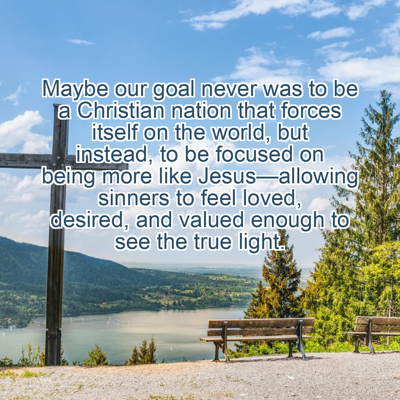
Maybe our goal never was to be a Christian nation that forces itself on the world, but instead, to be focused on being more like Jesus—allowing sinners to feel loved, desired, and valued enough to see the true light.
We need to be self-controlled enough to live in an offensive world without being constantly offended. We need to be strong enough to not become hateful to people who only know how to live by the flesh.

Having a thought and setting one’s mind on a thought is far from being the same thing. You can’t always control what thoughts come, but you can choose which ones you let stay and shape your life.

Paul is not saying we should ignore the evils and dangers around us, but that we should make better choices about how we exhibit truth and light—eliminating selfish desires and focusing on a discipleship that allows God’s power to work within hearts.
Add this chatbot onto your site with the embed code below
<iframe frameborder="0" src="https://pastors.ai/sermonWidget/sermon/cultivating-control" width="100%" height="100%" style="height:100vh;"></iframe>Copy