Jul 29, 2026
The Nicene Creed declares the Holy Spirit is the Lord. This is the very name of God. It says He is the giver of life. He proceeds from the Father and the Son. The early church leaders wrote these words to protect a vital truth. They wanted everyone to know the Holy Spirit is not a lesser being. He is fully God.
This means the Holy Spirit possesses all the attributes of God. He is eternal. He is omnipresent. He is the same in being as the Father and the Son. When Ananias lied to the Holy Spirit, Peter said he lied to God. The Spirit is not an impersonal force. He is a divine Person to be worshipped and glorified.
You may have thought of the Spirit as a vague power or feeling. The Bible presents Him as a Person who knows you and desires to know you. He is the very presence of God moving into your life when you trust Christ. How does your understanding of the Holy Spirit shift when you see Him as a divine Person, not a force?
“Then Peter said, ‘Ananias, why have you let Satan fill your heart? You lied to the Holy Spirit, and you kept some of the money for yourself. The property was yours to sell or not sell, as you wished. And after selling it, the money was also yours to give away. How could you do a thing like this? You weren’t lying to us but to God!’”
(Acts 5:3–4, NLT)
Prayer: Ask the Holy Spirit to reveal Himself to you today as the Lord, the giver of life.
Challenge: Read Genesis 1:2 and Psalm 139:7, noting the Holy Spirit’s role in creation and His omnipresence.
Jesus told His disciples it was better for them if He went away. This seemed confusing. How could His absence be better? He explained that His departure would allow the Advocate to come. This Helper is the Holy Spirit. Jesus referred to the Spirit as “He,” not “it.” The Spirit has a mind, a will, and emotions. He can be grieved.
This personal Holy Spirit takes up residence inside every follower of Jesus. He is the paraclete, the one who walks alongside you. His mission is to transform you from the inside out. He produces His fruit in your life: love, joy, peace, and more. Without the Spirit living in you, you do not belong to Christ.
You are never alone. The Spirit is your constant Helper and Counselor. He guides you into truth and conforms you to the image of Jesus. His presence is the definitive mark of a Christian. In what area of your life do you most need the Helper’s guidance and transformation today?
“And I will ask the Father, and he will give you another Advocate, who will never leave you. He is the Holy Spirit, who leads into all truth. The world cannot receive him, because it isn’t looking for him and doesn’t recognize him. But you know him, because he lives with you now and later will be in you.”
(John 14:16–17, NLT)
Prayer: Thank the Holy Spirit for being your ever-present Helper and for taking up residence within you.
Challenge: Identify one specific situation today where you will consciously depend on the Holy Spirit’s guidance.
Jesus gave His followers a final command. He told them to go and make disciples of all nations. Then He gave them the formula for baptism. They were to baptize people in the name of the Father and the Son and the Holy Spirit. Jesus brought these three names together as one. This three-fold name points to the triune nature of God.
The Bible consistently presents one God who exists as three distinct Persons. This is not a contradiction but a beautiful mystery. The Father, Son, and Holy Spirit are each fully God. They share one divine essence. They exist in perfect, loving community with each other. This is the God who made you in His image.
You were made for relationship because you reflect a relational God. The loneliness of our culture stems from building a self in isolation. The Trinity invites you into the bigger room of perfect intimacy. Where have you been trying to build your identity alone instead of resting in the community of God?
“Therefore, go and make disciples of all the nations, baptizing them in the name of the Father and the Son and the Holy Spirit.”
(Matthew 28:19, NLT)
Prayer: Worship the Father, the Son, and the Holy Spirit, thanking God for His three-fold nature.
Challenge: Write down the names “Father, Son, and Holy Spirit” and reflect on what each Person means to you.
Sometimes we do not know what to pray. We feel weak and confused. Our words fail us. Paul tells us the Holy Spirit helps us in our weakness. He does not stand aloof from our struggles. The Spirit Himself intercedes for us. He prays for us with groanings that words cannot express. He pleads for us in harmony with God’s own will.
The Spirit seizes our feeble prayers and amplifies them. He translates our sighs into perfect petitions before the Father. This means prayer is never a solo effort. It is a Trinitarian activity. We pray to the Father, in the name of the Son, through the power of the Holy Spirit. We are drawn into the divine conversation.
You are not shouting into a void when you pray. You are participating in the eternal community of God. Your prayers are joined with the intercession of the Spirit. How does it change your approach to prayer knowing the Holy Spirit is actively interpreting your heart to the Father?
“And the Holy Spirit helps us in our weakness. For example, we don’t know what God wants us to pray for. But the Holy Spirit prays for us with groanings that cannot be expressed in words. And the Father who knows all hearts knows what the Spirit is saying, for the Spirit pleads for us believers in harmony with God’s own will.”
(Romans 8:26–27, NLT)
Prayer: Confess to God your weakness in prayer and ask the Holy Spirit to intercede for you.
Challenge: Set aside five minutes to pray silently, trusting the Holy Spirit to express the needs you cannot.
At the very center of reality is not a solitary individual. God has always been a “we.” The Father, Son, and Holy Spirit have existed in perfect, loving community for all eternity. This love could not be contained. It overflowed into creation. You were made out of the laughter of the Trinity. You were made in the image of this perfect intimacy.
This truth dismantles the lonely self of liquid modernity. You are not meant to construct your identity from scratch. You are invited into the room you did not build. Your deepest longing for connection finds its answer in the relational nature of God. You are welcomed into the divine “we.”
Your value and purpose are found in reflecting the God who is community. You are called to love because He is love. Which relationship in your life most needs to reflect the self-giving love of the Trinity?
“May the grace of the Lord Jesus Christ, and the love of God, and the fellowship of the Holy Spirit be with you all.”
(2 Corinthians 13:14, NIV)
Prayer: Thank God for the grace of Jesus, the love of the Father, and the fellowship of the Spirit.
Challenge: Call or text one person today to express love and foster community, reflecting God’s triune nature.
The Nicene Creed, born at the Council of Nicaea in 325, functions as a concise, authoritative statement of historic Christian belief, articulating the oneness of God and the deity of Father, Son, and Holy Spirit. Scripture supplies the Creed’s content: the Father reigns as Almighty Creator, the Son is fully divine and incarnate, and the Holy Spirit is likewise God—eternal, omnipresent, and of the same being. Biblical texts portray the Spirit with personal attributes—mind, will, feeling—and as the one who inspires the prophets, convicts and transforms people, and indwells believers as Advocate or Helper. Passages cited emphasize the Spirit’s work in creation (Genesis), in Christ’s offering (Hebrews), in the life of the church (Acts, Romans), and in prayer (Romans 8), establishing the Spirit’s full deity and active role in redemption.
The Creed insists on three Persons who are one God: monotheism expressed in tri-personal form. Scripture supports this unity in baptismal formulae, divine speech in Genesis, and apostolic benedictions that link Father, Son, and Spirit together. Several analogies—multiplication rather than addition, an egg, water in three states, human love, and the concept of perichoresis—seek to illumine the mystery without collapsing it into crude models. The most helpful image presented is community: God as perfect, eternal relationship, whose overflowing life calls creation into communion. That theological truth reframes human longing and counters modern individualism by locating human identity within a created resemblance to divine relationality.
Objections and alternative movements that deny either Christ’s divinity or the Spirit’s deity reveal why the Creed remained necessary: it delineates what Christianity affirms and what variants reject. The Creed functions not as a moral passport but as a humble description of reality—meant to clarify, not to exclude or to confer merit. Mystery belongs to the doctrine: divine realities surpass full human comprehension without becoming irrational. Practical life flows from these truths: worship and prayer remain Trinitarian—addressing the Father, in the name of the Son, empowered by the Spirit—so that prayer becomes entry into the eternal community rather than an isolated plea.
In a liquid world — one that tells you to construct your own truth and build your own identity from scratch, then leaves you with nothing solid underneath — the Creed is something you didn't build.
Three Persons who are one God: Father, Son, and Holy Spirit, not three gods.
The Holy Spirit indwells Christ-followers as Advocate and Helper — the paraclete, one who walks alongside.
Only the Holy Spirit can penetrate the hidden recesses of our personality and transform us from the inside out.
God is community. He exists in community — perfect, complete, whole community.
If my mind could fathom all of God, He'd be no larger than my mind — and that would make Him no God at all.
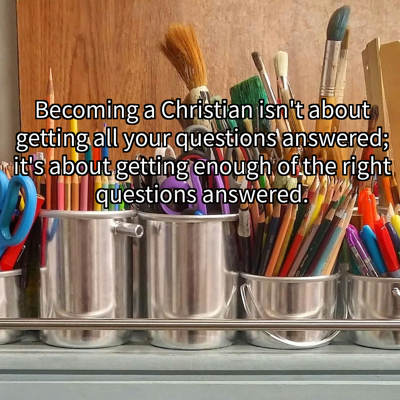
Becoming a Christian isn't about getting all your questions answered; it's about getting enough of the right questions answered.
When you pray, you aren't shouting alone into the dark; you are drawn into a God who has never been alone.
Prayer itself decenters the lonely, self-made self and centers you in the bigger room.
Hi, I'm an AI assistant for the pastor that gave this sermon. What would you like to make from it?
Add this chatbot onto your site with the embed code below
<iframe frameborder="0" src="https://pastors.ai/sermonWidget/sermon/creed-week-3-manuscript" width="100%" height="100%" style="height:100vh;"></iframe>Copy