Jul 23, 2026
Jesus stood before a group of religious leaders. They challenged His authority. They asked if He was greater than their ancestor Abraham. Jesus answered with a claim that shook the room. He said, "Before Abraham was born, I am." He used the sacred name of God for Himself. This was not a casual statement. It was a direct claim to divinity.
Jesus identified Himself as the great I AM. This is the name God revealed to Moses at the burning bush. It is the most holy name. By using this name, Jesus declared He was Yahweh. He was not just a good man or a prophet. He was God in human flesh. This truth is the foundation of everything.
Many of us have a Jesus we have constructed. We prefer a teacher who agrees with us. We want a Lord who demands little. But the real Jesus does not fit our preferences. He is the eternal I AM. He invites us to know Him as He truly is. Hear His question personally. Which Jesus are you following—the one you built or the one who built you?
God said to Moses, “I AM WHO I AM. This is what you are to say to the Israelites: ‘I AM has sent me to you.’”
(Exodus 3:14, NIV)
Prayer: Ask God to reveal any ways you have reduced Jesus to a manageable teacher instead of your sovereign Lord.
Challenge: Write down one area of your life where you consistently resist Jesus’ authority.
The first believers had a simple confession. They declared, "Jesus is Lord." This was more than a title. In their world, the word "Lord" was a direct substitute for God’s personal name. To call Jesus "Lord" was to call Him God. This confession was the mark of a true Christian. Paul said declaring "Jesus is Lord" was essential for salvation.
Calling Jesus Lord means recognizing His ultimate authority. It means He is Yahweh, the creator of all things. The earliest Christians understood this. They knew they were pledging allegiance to the one true God when they said those words. This confession could cost them their lives. They said it anyway.
You too must decide what those words mean. To say "Jesus is Lord" is to surrender your entire life. It is to dethrone yourself and crown Him as King. It is a confession that changes everything. Stop and ask yourself. Does your life demonstrate that Jesus is your Lord?
If you openly declare that Jesus is Lord and believe in your heart that God raised him from the dead, you will be saved.
(Romans 10:9, NLT)
Prayer: Confess to Jesus any area where you have acted as your own lord instead of submitting to Him.
Challenge: Tell one person today that Jesus is your Lord. Explain what that word means.
A voice spoke from heaven at Jesus’ baptism. It said, "This is my dearly loved Son." God the Father affirmed Jesus’ identity. This happened again at the transfiguration. Jesus stood in radiant glory. The Father said, "This is my Son. Listen to him." Even the demons recognized who Jesus was. They shrieked, "You are the Son of God!"
The title "Son of God" means Jesus shares the same nature as the Father. He is not a created being. He is God Himself. A son shares the qualities of his father. Jesus is the exact representation of God the Father. To see Jesus is to see God. To know Jesus is to know God.
Many people want a God who is distant and vague. Jesus shows us a God who is near and personal. He is the Son who reveals the Father’s heart. You can know God because Jesus made Him known. Will you listen to the Son today?
…a voice from the cloud said, “This is my dearly loved Son… Listen to him.”
(Matthew 17:5, NLT)
Prayer: Thank God for sending His Son to make the invisible God known and accessible to you.
Challenge: Identify one thing Jesus said in the Gospels and make a plan to obey it this week.
A false teacher named Arius spread a dangerous idea. He said Jesus was a perfect creature. He said, "There was once when he was not." The church gathered at Nicaea to confront this lie. They declared Jesus was "eternally begotten, not made." This means Jesus was never created. He has always existed as the Son with the Father.
This truth is not just ancient history. Many people today believe the same error. They think Jesus is the first and greatest creation. This is heresy. If Jesus is not fully God, He cannot save anyone. Only God can save. Salvation depends on getting Jesus’ identity right.
You cannot afford a wrong view of Jesus. A created Jesus cannot bear the weight of your sin. Only the eternal Son of God can do that. Have you placed your trust in the real Jesus or a diminished substitute?
In the beginning was the Word, and the Word was with God, and the Word was God. He was with God in the beginning. Through him all things were made; without him nothing was made that has been made.
(John 1:1-3, NIV)
Prayer: Ask God to root out any trace of the belief that Jesus is less than fully God.
Challenge: Read John 1:1-14 aloud and underline every phrase that describes Jesus’ divine nature.
John’s biography of Jesus begins with a stunning claim. He calls Jesus "the Word." He says the Word was with God and the Word was God. Then he says the Word became flesh. God the Son did not just appear as a man. He became a man. He took on human flesh. The eternal Creator entered His creation.
This is the incarnation. God became a real human being. He had a particular height and hair color. He experienced hunger and thirst. He felt pain and sorrow. The infinite God confined Himself to a human body. C.S. Lewis said it would be like a person choosing to become a slug. The humility is staggering.
This truth changes how you see your own humanity. God values your body and your life. He experienced them firsthand. He is not distant from your struggles. He entered into them. Where do you need to know that God is with you in your flesh and blood reality?
The Word became flesh and made his dwelling among us. We have seen his glory, the glory of the one and only Son, who came from the Father, full of grace and truth.
(John 1:14, NIV)
Prayer: Thank Jesus for the specific humility He showed by becoming human and dwelling among us.
Challenge: Do one physical act of kindness today to reflect God’s love in the flesh.
of Christian belief—credo, “we believe”—to preserve unity and expose false teaching as the faith spread geographically. The Creed’s opening lines receive careful unpacking: it names one God the Father and then, with deliberate contrast, names Jesus as Lord and as the only Son of God, using precise phrases—“eternally begotten, not made,” “Light of Light, very God of very God,” and “one in being with the Father”—to insist on Jesus’ full divinity.
Scripture anchors each claim. The title “Lord” links Jesus to the divine name revealed to Moses (I AM / Yahweh), and claims such as “before Abraham was…I AM” demonstrate Jesus’ self‑identification with the God of Israel. The designation “Son of God” appears across baptismal, transfiguration, and demonic testimonies, indicating divine identity embodied in historical life. The Creed’s “begotten, not made” language directly opposes Arianism, the ancient claim that Jesus was a created being; the modern persistence of Arian‑like views receives attention through recent survey data showing widespread confusion about Christ’s nature.
John’s prologue (the Word/Logos) and the doctrine of the Incarnation receive emphasis: the eternal Word who made all things “became flesh,” a radical claim that God the Son took real human existence. C.S. Lewis’s formulation—if not Lord, then lunatic or liar—reappears to sharpen moral and logical consequences of Jesus’ claims. Culture’s impulse to domesticate Jesus into a figure that fits personal preferences gets named as a spiritual danger; the Creed stands as the objective boundary against reshaping Christ to taste. The sermon closes by pointing ahead to the Creed’s next element—the Trinity—and by calling the faithful to accept the given identity of Jesus as Lord, Son, and God, rather than reconstructing Him to suit contemporary inclinations.
K
The Creed is something you didn't build. It was handed to us. It's the room we didn't build, but get to step into.

The opening section has one headline — clear and carefully worded: Jesus was not just a man. He was divine.
We're not just talking about Jesus as a man. Jesus is Lord — Adonai, Kyrios, Yahweh, the great "I AM." Jesus is God.
If Arius was right, Christ could not save anyone. No mere creature can save another creature. Only God can save — and salvation comes through Jesus.
Jesus was eternally begotten, not made. The Father has always been the Father — which means Jesus has always been the Son. They are co-eternal.
The Word isn't some energy field or force. The Word is God — the Being who created everything that is.

A Jesus you build in your own image can never save you, never surprise you, never be bigger than you. Only the real one can.
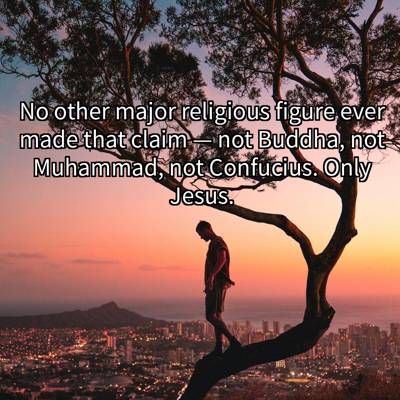
No other major religious figure ever made that claim — not Buddha, not Muhammad, not Confucius. Only Jesus.
Hi, I'm an AI assistant for the pastor that gave this sermon. What would you like to make from it?
Add this chatbot onto your site with the embed code below
<iframe frameborder="0" src="https://pastors.ai/sermonWidget/sermon/creed-week-2-manuscript" width="100%" height="100%" style="height:100vh;"></iframe>Copy