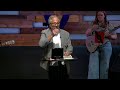
The Corinthian believers shoved past the hungry to fill their plates. Paul rebuked their communion chaos: drunk members gorging while others starved. They treated Christ’s table like a buffet line, trampling community for self-interest. Jesus’ broken body became an afterthought to their appetites. [48:43]
Paul called this “despising the church of God.” When we prioritize comfort over Christ’s command to love, we repeat Corinth’s error. Communion isn’t private spirituality—it’s a shared feast where no one gets overlooked. Jesus designed His table to nourish both soul and neighbor.
How often do you rush through communion without seeing the family around you? This week, pause before taking the elements. Count three faces in the room. Remember: His body was broken so ours could be whole. Who have you overlooked at Christ’s table lately?
“When you come together, it is not the Lord’s supper you eat. For as you eat, some of you go ahead with your own private suppers. As a result, one person remains hungry and another gets drunk. Don’t you have homes to eat and drink in? Or do you despise the church of God by humiliating those who have nothing?”
(1 Corinthians 11:20-22, ESV)
Prayer: Confess any hurry or distraction during communion. Ask Jesus to make you hunger for His people as much as His presence.
Challenge: Before your next communion, write one sentence naming how you’ll actively honor someone else at the table.
Jesus took bread on betrayal night. Not in a temple, but a dim upper room. He broke the loaf—a sound echoing His coming fracture. “This is My body,” He said, handing crusts to traitors and deniers. The cup followed: “This covenant is sealed in My blood.” Every chew and sip shouted, “I choose you anyway.” [49:38]
The disciples didn’t grasp it then, but we know: that meal rewired history. Communion isn’t memorial—it’s a mercy transfusion. Jesus’ brokenness heals our fractures. His poured-out blood drowns our debts. Each crumb declares, “I am yours,” before we whisper, “We are Yours.”
You’ve tasted regret sharper than bread. Yet His covenant still stands. Hold the elements this week—a cracker, juice—and say aloud: “This cost Him everything.” What shame keeps you from receiving His “anyway” love today?
“The Lord Jesus, on the night He was betrayed, took bread, and when He had given thanks, He broke it and said, ‘This is My body, which is for you; do this in remembrance of Me.’ In the same way, after supper He took the cup, saying, ‘This cup is the new covenant in My blood; do this, whenever you drink it, in remembrance of Me.’”
(1 Corinthians 11:23-25, ESV)
Prayer: Thank Jesus for choosing the cross while knowing every future time you’d dishonor His sacrifice.
Challenge: Tell one person this week how Jesus’ last meal reveals His relentless commitment to them.
Paul warned against “unworthy” communion—not because we’re flawless, but because flippancy poisons the feast. The Corinthians gulped grace like cheap wine, ignoring the Lamb’s scars. To eat without examining our divisions, our grudges, our secret sins? That’s not faith—it’s force. [50:06]
Jesus welcomes the wrecked, not the reckless. Self-examination isn’t self-condemnation; it’s clearing debris so His grace flows deeper. When we taste the bread honestly, we remember: this body was broken to mend what we’ve shattered.
You’ve taken communion while nursing bitterness. So have I. Today, name one relationship where pride has built a wall. What step will you take to dismantle it before next Sunday’s table?
“Everyone ought to examine themselves before they eat of the bread and drink from the cup. For those who eat and drink without discerning the body of Christ eat and drink judgment on themselves.”
(1 Corinthians 11:28-29, ESV)
Prayer: Ask God to spotlight any unconfessed sin or unreconciled relationship before your next communion.
Challenge: Text or call one person you’ve avoided. Say, “I value our unity in Christ more than being right.”
Every crumb of communion bread is a war cry. “He died!” we announce to darkness. “He’s coming!” we whisper to despair. The Corinthians forgot this: the table isn’t just remembrance—it’s rebellion. Each “do this” defies death’s lie that the cross changed nothing. [55:32]
When you lift the cup, you join a global chorus: martyrs, monks, missionaries, and misfits. Across time and borders, one story echoes—blood bought, body broken, victory sure. Your sip shouts, “The grave lost!” to a world drowning in defeat.
What defeat have you accepted as permanent? This week, take a walk. At each corner, declare: “Christ’s death defeated this.” Where do you need to proclaim His victory louder?
“Whenever you eat this bread and drink this cup, you proclaim the Lord’s death until He comes.”
(1 Corinthians 11:26, ESV)
Prayer: Ask Jesus to make your next communion a bold declaration of hope to someone watching your life.
Challenge: Write down one area of defeat, then circle it with the words “Christ’s victory covers this.”
The Corinthians fractured the church into factions—rich vs. poor, insider vs. outsider. Paul reordered their vision: “One bread, one body.” Communion’s miracle isn’t just vertical (God to us) but horizontal (us to us). The same loaf that feeds CEOs feeds custodians. [28:29]
Jesus’ table flattens hierarchies. Your job, pedigree, or past don’t upgrade your portion. We all starve equally—and get filled equally. When you pass the plate, you’re saying, “Your hunger matters as much as mine.”
Who feels like a stranger in your church family? This Sunday, stand near them during communion. What practical step can you take to reflect Christ’s equalizing love?
“Because there is one loaf, we, who are many, are one body, for we all share the one loaf.”
(1 Corinthians 10:17, ESV)
Prayer: Confess any prejudice or indifference toward someone in your church. Ask for eyes to see them as Christ does.
Challenge: Sit with someone different from you during next week’s service. Learn one story of how Jesus met them.
Paul confronts Corinth with a hard word: their gathering is “not for the better, but for the worse,” because status games, factions, and self-indulgence have turned holy awe into “holy awful.” The text names the sin as irreverence. When the church forgets whom the Supper is for and why it exists, “it is not the Lord’s Supper that you eat.” The rebuke lands because the table the Lord designed to knit the body together has become a stage to perform wealth and trample the poor. The result is schismata and even “heresies,” because a divided table preaches a false gospel.
The institution narrative re-centers the church: Jesus takes bread and cup and says, “Do this in remembrance of me.” The Supper proclaims the Lord’s death until he comes, so the church must not take it casually, but seriously. Hence the charge: “Let a man examine himself.” Unworthy does not mean un-sinful, since no sinner could come; unworthy means irreverent, unthinking, unmoved. The text puts it plainly: remember Jesus, examine you.
The historical scene sharpens Paul’s point. House churches gathered in well-to-do homes; a full meal sandwiched the bread and the cup. In Corinth, that meal was “parenthesized” by pride. Some are sloshed, some go hungry, the poor are humiliated. God’s heart is with the least, so despising them invites discipline. The table is not a catwalk; it is a cross-marked common place where blood-bought sinners receive mercy together.
Paul then lifts two anchors. First, communion is about victory. The bread and the cup are a loudspeaker for the gospel: salvation is not advice about what to do, but news about what God has done. Evangelion is a victory announcement. The General has already won; the church receives the news and lives by it. Communion protects the church from gospel amnesia by rehearsing, again and again, that what the sinner could not do, Christ has done.
Second, communion is about unity. The Supper is vertical and horizontal. At the table, labels bow to the Lamb. Rich or poor, educated or not, Republican or Democrat, the main label rules. Like a NASCAR hood, the minor stickers must not conflict with the primary sponsor. The church therefore refuses to let politicians it does not know teach it to stop loving people it does know. The call is simple and searching: stop shopping for cultural discounts; somebody has died. Come to the table with tears if needed, with faith always, and with a readiness to be realigned with God and reconciled to one another.
So let me crown this thought with this. The gospel is not advice about what I need to do to reach Jesus. The gospel is news about what God has done to reach me. Amen? Amen. That's the gospel. The gospel is the Greek word, evangelion. Okay? Evangelion was used to speak of a messenger whose news would dramatically change everyone's life. Evangelion was often used in the context of the fact that someone had just won a great battle and they send a u a a u a eulangelion to go tell everybody about the victory, that somebody had just won that battle.
[01:21:27]
(46 seconds)
And maybe in the church, we ought to be more like NASCAR. Okay? We don't let the little labels of world come into conflict with the main label, of our shared communion together that we have in Christ Jesus our lord. Don't let little labels get in the way of big labels. And by the way, let me drop a word. Stop letting politicians you don't know make you stop loving people that you do know. Amen? Amen. And communion is that reminder of that.
[01:28:19]
(33 seconds)
God is saying to us, this is no longer the Lord's Supper that you're eating. You just have this wafer and some juice, and that's what it is. That's all it is to you. That's why I get to say you ought to feel something. We need to feel something as we study through this, as we celebrate together the Lord's Supper. Somebody has died. This is the way the text is. This is irreverence that is happening here.
[01:01:25]
(28 seconds)
He's essentially saying to us, a lot of people here are unworthy, and they think I'm not good enough. But here's the thing, the reason you take communion is because you're not good enough. And you celebrate that he was good enough for you. So a lot of people hear that and say, you know what? They think they're supposed to come to the table only when they're perfect. But that's not what it's saying at all because no one can do that. Not a one of us are is able to do that. He's saying you're supposed to come to the table not with perfection, but with seriousness.
[01:29:05]
(41 seconds)
I'm an AI bot trained specifically on the sermon from May 18, 2026. Do you have any questions about it?
Add this chatbot onto your site with the embed code below
<iframe frameborder="0" src="https://pastors.ai/sermonWidget/sermon/communion-victory-unity-irreverence" width="100%" height="100%" style="height:100vh;"></iframe>Copy