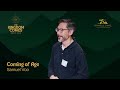
Paul insists that when the "fullness of time" arrived something decisive happened: humanity was not merely given better circumstances but was given a new legal and relational standing before God — no longer slaves or children kept under guardians, but adopted sons and daughters who now cry out to God as "Abba, Father" because the Spirit testifies to that new status within them. [10:04]
Galatians 4:4-7 (ESV)
But when the fullness of time had come, God sent forth his Son, born of woman, born under the law, to redeem those who were under the law, so that we might receive adoption as sons. And because you are sons, God has sent the Spirit of his Son into our hearts, crying, "Abba! Father!" So you are no longer a slave, but a son, and if a son, then an heir through God.
Reflection: What is one belief or habit that keeps you living as a "child" or "slave" rather than as God's child? Write it down, pray asking the Spirit to reveal your new status, and tell one trusted believer about it today as a step toward living in that identity.
The language of redemption draws on Israel's rescue from Egypt: redemption is not abstract but familial and practical — God, as family, steps into power and obligation to bring a relative out of slavery, to right wrongs, and to restore inheritance and dignity to those who were captive. [12:16]
Exodus 6:6 (ESV)
Say therefore to the people of Israel, "I am the LORD, and I will bring you out from under the burdens of the Egyptians, and I will deliver you from slavery to them, and I will redeem you with an outstretched arm and with great acts of judgment."
Reflection: Identify one situation where you feel trapped or enslaved (fear, addiction, debt, shame). What is one concrete step you can take this week to accept God's redeeming help (seek counsel, join a support group, confess to a friend, pray a specific prayer)? Commit to that step today and name it to someone who will hold you accountable.
When circumstances are unstable, the sermon warns, worldly hope tied to changing conditions is fleeting; true Christian hope is an anchor that holds the soul because it rests not on what will happen next but on who God is and on the finished work and promise that secure believers until the end. [03:58]
Hebrews 6:19 (ESV)
We have this as a sure and steadfast anchor of the soul, a hope that enters into the inner place behind the curtain,
Reflection: The next time anxiety about a future outcome rises, pause and name whether your hope is in that outcome or in Christ; today, memorize Hebrews 6:19 and practice repeating it when worry appears, using it as a spiritual anchor in at least one anxious moment this week.
Freedom described in Galatians is not license to do whatever pleases the self but liberation from being one’s own god; true freedom comes when Christ is honored as Lord and that freedom orders desires and decisions so they no longer make autonomy the ultimate idol. [17:44]
Galatians 5:1 (ESV)
For freedom Christ has set us free; stand firm therefore, and do not submit again to a yoke of slavery.
Reflection: Identify one area where you habitually make yourself the final authority (career choice, relationship control, body, technology); choose one concrete habit to change this week that submits that area to Christ (e.g., consult God first in decisions, invite an accountability partner, set a fasting or Sabbath practice) and take that step today.
One crucial evidence of changed status is the new social reality: belonging to Christ places believers into a community where they are called to love, bear one another's burdens, and stop living merely for self — the church becomes the tangible family that reflects sons and daughters who serve and support one another. [21:34]
Galatians 6:2 (ESV)
Bear one another's burdens, and so fulfill the law of Christ.
Reflection: Who in your circle seems weighed down right now? This week, reach out to one person, ask specifically "How can I help you this week?" and commit to one concrete act of service (a meal, a phone call to listen, childcare, errands, or prayer visit) and follow through.
Advent asks me to prepare for Jesus’ coming by looking honestly at where I place my hope. I named how fragile our world feels—economically, politically, emotionally—and how easily we chase a hope that depends on circumstances improving: if only the job came through, the relationship healed, the children turned out as we dreamed. But that kind of hope is temporary because circumstances always change. Even if we escaped to a new world, like in Interstellar, we would carry our brokenness with us. Scripture redirects our gaze: in the fullness of time, God sent his Son. History is not random; God moved with purpose.
Paul’s “coming of age” picture reframes everything. Before Christ, humanity was like minors or slaves—present but without access to the inheritance. In Jesus, something more than our surroundings changed: our status changed. Through redemption, drawn from both the Hebrew family-rescue and the Greek transactional sense, God bought us back and adopted us as sons and daughters. The Spirit confirms this adoption from inside our own hearts, teaching us to cry, “Abba, Father.” That inward testimony is not sentiment; it is a new relationship and a new identity.
I named three concrete evidences of this new status. First, the indwelling Spirit—comforting, guiding, protecting, inviting a real conversation with the Father. Second, freedom—initially from law and superstition, but also from the modern idol of the autonomous self that promises control yet often delivers bondage and harm. Third, community—no longer living for “number one,” but bearing one another’s burdens as a family formed by grace.
So has anything really changed? Externally, not as much as we wish. But from the standpoint of identity, everything has changed. We live in the same world with a different center of gravity. Advent helps us remember Christ’s first arrival and teaches us to wait for his second. I shared my own dark season—angry, shut down, surrounded by a self-made shield. Jesus did not force his way in, yet he did not leave. He stayed as near as I allowed, and when I invited him closer, he was already there. That is where hope lives: not in what may change tomorrow, but in who holds me today and who promises to make all things new.
Galatians 4:4–7 — But when the fullness of time had come, God sent forth his Son, born of woman, born under the law, to redeem those who were under the law, so that we might receive adoption as sons. And because you are sons, God has sent the Spirit of his Son into our hearts, crying, “Abba! Father!” So you are no longer a slave, but a son, and if a son, then an heir through God.
But part of the problem is that as they go out into space, they don't just escape all of the problems. They bring some of the problems with them. Because the problem is not just the planet earth. The problem really has to do with humanity itself. Even if we colonize space or a new world, we wouldn't merely escape all of our problems. That kind of hope that's grounded in our circumstances is often temporary and fleeting. Believing that hope is just out there. If we could just change our circumstances. And in the end, that kind of hope will come and go. [00:05:02] (49 seconds) #NoEscapeFromBrokenness
``But when Jesus came, something fundamentally shifted. Not just our circumstances. The ancient world, just like today, was full of brokenness. And that didn't necessarily overnight change when Jesus came. What changed was our status. What changed was our relationship with God. Our identity changed. [00:10:27] (38 seconds) #IdentityInChrist

So notice what he says in verse 6 and 7. And because you are children, sons and daughters, God has sent the spirit of his son into our hearts, crying, Abba, Father. He sent his spirit into our hearts, crying, Abba, Father. So that's the proof. That's the proof. The spirit in our hearts crying out to God, Abba, Father. And all that is, Abba is just the word for father or dad or daddy in Aramaic. What this is, is the spirit in us testifying to ourselves that this is now our relationship with our true father. [00:14:35] (54 seconds) #AbbaFatherWithin
But what about for us today? What kind of freedom? Because we live in a secular world. And we're not coming from a religious background necessarily. That's not our paradigm. So what kind of freedom do we have? Does this gospel convey to us? Or what do we often elevate as an idol in this secular world? Is it not ourselves? Is it not our autonomy? Our independence? Our freedom? That's a good thing. But what if we put that as a supreme idol in our lives? Then we become the final arbiters of everything that we want in our lives. [00:19:03] (53 seconds) #TrueFreedomNotAutonomy
That sounds like freedom, doesn't it? But is it really freedom? I think when we put ourselves as a final judge of all that we want in our lives, I think the evidence bears out that in fact what happens is we often choose things that might be really tantalizing and good for us in the moment, but in the end are not so good for us in the long run, are not so good for people around us. We end up hurting people around us as well as ourselves. [00:19:55] (37 seconds) #ChoicesHaveConsequences
Just look at the race to AI dominance that's going on today in this world. To me, it's just mind-boggling. There's no safeties, no controls, no ethics. It's all about whoever gets there first. Is that really going to be the solution? It doesn't seem to be in my mind. Is that real freedom? Or is that more of a kind of a slavery? Well, Jesus gives us true freedom. True freedom when we put him first. He'll help direct our lives. He'll help guard our hearts. He'll help guide our path. I think that's true freedom. [00:20:31] (48 seconds) #TrueFreedomInChrist
So that's the third really huge benefit we get as believers in Jesus as we come into the body of Christ. Three real, tangible changes that happen in our lives. And I think sometimes we take those for granted in the church. As someone who's grown up in the church for most of my life, I know I take that for granted sometimes. It's just the fact that we are a community. But for someone who's not experienced that, you think about people outside the church. You think about other communities and organizations. And the sense of community that we have, often it's really, it's wonderful what we have that we sometimes take for granted. [00:22:14] (49 seconds) #ChurchIsFamily
So, those three things, I think, are at least some of the benefits that we, and changes that we experience as believers. So let me bring this back to where we all began, this question of hope. We see lots of brokenness in the world, yes. And we still have to live within it, yes. Jesus came, history did change, and yet at the same time, things continue, right? 2,000 years, and there's still a lot of brokenness in this world. But the difference is that we who believe in Him, we've been changed. Our status has changed. [00:23:13] (41 seconds) #ChangedByGrace
I'm an AI bot trained specifically on the sermon from Dec 02, 2025. Do you have any questions about it?
Add this chatbot onto your site with the embed code below
<iframe frameborder="0" src="https://pastors.ai/sermonWidget/sermon/coming-of-age-samuel-voo" width="100%" height="100%" style="height:100vh;"></iframe>Copy