The scripture presents a clear and powerful command: do not be bound together with those who do not share your faith. This is not a call to isolation but a warning about the inherent conflict that arises from such partnerships. When two are yoked together but pull in different spiritual directions, progress is impossible and confusion reigns. The imagery is one of a shared journey going in circles, leading to frustration and a lack of forward movement. This principle serves as a foundation for understanding the relationships we cultivate. [04:42]
Do not be unequally yoked with unbelievers. For what partnership has righteousness with lawlessness? Or what fellowship has light with darkness? What accord has Christ with Belial? Or what portion does a believer share with an unbeliever? (2 Corinthians 6:14-15, ESV)
Reflection: Consider a significant relationship in your life, whether personal or professional. In what specific ways do you feel a spiritual tension or a pull in a different direction than your faith in Christ calls you?
A profound truth defines our existence: we are the temple of the living God. This is not merely a metaphor about our bodies but a declaration about our very identity. God Himself has chosen to dwell within us, making our lives sacred ground. This reality transforms how we view ourselves and our purpose. Our lives are no longer ordinary space but are set apart as the place where His presence resides, requiring a response that honors His holiness. [13:37]
What agreement has the temple of God with idols? For we are the temple of the living God; as God said, “I will make my dwelling among them and walk among them, and I will be their God, and they shall be my people.” (2 Corinthians 6:16, ESV)
Reflection: If you truly began to see your life, including your thoughts, habits, and daily routines, as the sacred dwelling place of God, what is one practical change you might feel prompted to make?
The call to holiness is rooted in an incredible promise of relationship. God does not demand separation from a distance but invites us into profound closeness as a Father to His children. This is an invitation to intimacy, where we are known and loved completely. Out of this secure relationship flows the desire to live a life that pleases Him, not out of fear of punishment but out of trust and love for a gracious Father. [16:41]
“I will be a father to you, and you shall be sons and daughters to me, says the Lord Almighty.” (2 Corinthians 6:18, ESV)
Reflection: When you think of approaching God as a perfect Father, what hesitations or joys arise in your heart? What would it look like to bring a current struggle or need to Him in a spirit of trust today?
Holiness is not a prerequisite to earn God’s love; it is a response to the grace we have already received. Because we have been given the promises of His presence and family, we are empowered to cleanse ourselves from anything that defiles. This is an active process of cooperation with the Spirit, bringing our lives into greater alignment with the character of Christ, who already dwells within us. [16:23]
Since we have these promises, beloved, let us cleanse ourselves from every defilement of body and spirit, bringing holiness to completion in the fear of God. (2 Corinthians 7:1, ESV)
Reflection: Is there a specific habit, thought pattern, or influence you have been managing or justifying that the Spirit is now prompting you to actively cleanse from your life?
The central question is one of authenticity: does our private life match our public confession? The challenge is to live consistently as God’s temple in every environment, not presenting one version of ourselves at church and another elsewhere. This integrity brings joy and freedom, as we are no longer pulled in different directions but are wholeheartedly aligned with the God who lives within us. [27:54]
Whoever says “I know him” but does not keep his commandments is a liar, and the truth is not in him, but whoever keeps his word, in him truly the love of God is perfected. By this we may know that we are in him. (1 John 2:4-5, ESV)
Reflection: Where do you notice the greatest gap between your identity in Christ and your daily actions? What is one step you can take this week to close that gap and live more authentically?
Second Corinthians 6:14–7:1 confronts the cost of divided loyalty and the call to wholehearted devotion. The text begins with a stark prohibition: do not be unequally yoked with unbelievers. That image of mismatched ox and donkey exposes how conflicting allegiances derail progress and create strain, confusion, and spiritual compromise. The Corinthian backdrop of temples, idol feasts, and syncretistic worship shows the everyday pressure to blend Christ with competing religions and cultural practices.
The passage then reframes identity: believers are no longer merely congregants who attend a building — they are the living temple, the inner sanctuary where God dwells. That indwelling shifts everything: proximity to God becomes an invitation to intimacy and a practical demand for holiness. Because God promises presence, the proper response is cleansing from every defilement of body and spirit, not as a pathway to earning favor, but as a grateful, relational response to already-received grace.
Holiness unfolds as rooted in relationship, not self-effort. The Fatherhood language reframes obedience as the movement of children toward a trustworthy parent, not as anxious rule-keeping. The call to authenticity challenges compartmentalized living: if God lives within, the interior life must match outward conduct. Practical probing questions press inward — what relationships, habits, or compromises pull in another direction? Identifying those idols must lead away from management or justification and toward decisive cleansing.
The promise beyond cleansing is joy and wholeness. A temple aligned with God’s presence experiences changed affections, clearer direction, and relational health. The final plea urges a refusal to receive grace in vain: embrace the identity of God’s dwelling, remove what competes for that space, and let holiness flow from the intimacy God initiates.
This is not just a call to holiness. It's an invitation to intimacy. The living god doesn't merely command his people from a distance. God is not sitting outside telling me what to say. God's right here inside. God's in this room. God's in you. God's everywhere. He comes near. He dwells among us. He calls them his own. He calls us his own. Invitation to in intimacy also tells you that we realize that our life is no longer ordinary space. It's sacred ground.
[00:14:07]
(58 seconds)
#SacredIntimacy

The ugly truth here is that these type of relationships will be full of tension, confusion, hurt, and conflict. Why? Because you cannot have full unity where there's no shared direction, no shared belief system. Sooner or later, the strain shows up. Conversations get harder. Trust gets thinner. Progress stalls. Authenticity slowly goes away. And that's the kind of tension Paul is getting at here. When a believer is joined to something that pulls against Christ, it creates spiritual conflict, and peace is compromised.
[00:09:53]
(46 seconds)
#MisalignedFaith
Holiness is not earning god's grace. Paul doesn't say, cleanse ourselves, we can receive the promises. He says, since we have the promises, this means that grace came first. Cleansing comes second. We do not have to do something for the grace. The grace has already been given to us. Holiness grows out of relationships. I'll be a father to you, and you'll be my sons and daughters. He's declaring the identity of family. As our father, we trust in him.
[00:16:06]
(44 seconds)
#GraceFirst
But what Paul is saying here is more than dead in inspection. God doesn't just inspect the temple. He built it. And most importantly, he lives in it. And if he lives in it, then it has to reflect him. And that's Paul's point here, Is that god himself lives among his people, lives within us. We are god's temple. Paul then reaches back and and quotes Old Testament. I will dwell among them. I will walk among them. I will be their god.
[00:13:13]
(46 seconds)
#GodDwellsWithin
either change your behavior or change your name. Either change your behavior or change your name and so it is with us as Christians. If we carry the name of Christ because we're the temple, we must also carry the character of Christ. Now, not that we might earn salvation that way because we too are called to the life and self and grace and salvation. We we don't earn it that way. Last week, pastor Steve challenged us. I'm going to take a quick time out. Please
[00:19:22]
(47 seconds)
#LiveLikeChrist
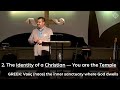
But Paul doesn't leave us here in this tension. He takes us deeper. And he he takes us to the root saying that if you belong to Christ, then your life is defined by a new identity. The identity of a Christian. In verse 16, Paul writes, we are the temple of the living god. He uses the word Niles. That's a Greek word for temple. The definition is the inner sanctuary, the place where god dwells. The inner sanctuary, the place where god dwells.
[00:10:40]
(49 seconds)
#TempleIdentity
The Corinthians were surrounded by pagan temples, idol worship, and constant pressure to blend their faith and their faith in Christ with the culture around them. Corinth was full of pagan feasts, temple trade guilds, idol sacrifices. The temptation was always there to mix devotion to Christ with the beliefs and practices of the world around them. Think of it as like in a hybrid religion. And Paul's concern here was really simple. Alliances like this, the hybrid, will pull believers away from Christ. So he drives the point home with several questions.
[00:05:50]
(59 seconds)
#FaithNotHybrid
Now, here's something important to understand about Corinth. At the time, temples were everywhere. You look at the skyline, you can see temples, all kinds of temples everywhere. There were temples to Apollo, Aphrodite, and many other gods, small g. They all had their own religious rituals, sacrifices, feasts, and many with immoral practices. That's what was happening in those temples. So when people in Corinth heard that word temple, their first image in their head wasn't about a nice, quiet church building.
[00:11:28]
(41 seconds)
#TemplesEverywhere
I'm an AI bot trained specifically on the sermon from Mar 23, 2026. Do you have any questions about it?
Add this chatbot onto your site with the embed code below
<iframe frameborder="0" src="https://pastors.ai/sermonWidget/sermon/cleanse-gods-grace-2-corinthians" width="100%" height="100%" style="height:100vh;"></iframe>Copy