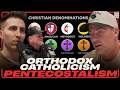
The continents–nations–states analogy sets the frame. The continent is everyone who can confess with the ancient creeds that Jesus is the Christ, the Son of the living God, crucified, risen, and returning. The nations are Protestant, Catholic, and Orthodox. The state lines mark the many denominational families. The continent draws hard edges: those who deny biblical Christology are not on the same landmass. The Nicene line holds the room together; Mormonism and Islam don’t confess that line, so they don’t share the continent.
The theological triage then sets the stakes. First tier truths are where it is more important to be right than to be together: salvation by grace alone, through faith alone, in Christ alone, with repentance and the basics of Christian ethics. Galatians-level clarity applies here; a different gospel is accursed. Second tier issues are where it is more important to be together than to be right, but it may be uncomfortable: think mode and timing of baptism or structures of church governance. Third tier stuff shouldn’t even be uncomfortable: end times timelines, age of the earth, and the like.
The state-lines tour sketches quick contrasts. Baptist life majors on credo-baptism and congregational polity, with strong local church autonomy. Episcopal and Anglican life runs episcopal, bishops “over-watching” groups of churches, with rich liturgy and the Book of Common Prayer. Methodism carries Wesley’s discipling genius and the old flame for a lived experience of the Spirit; yet in 2024 the United Methodist Church in the U.S. officially went affirming and so slid into apostasy. Wesley’s impulse toward an experiential faith also seeded holiness and Pentecostal streams that speak of a subsequent filling of the Spirit; the modern charismatic movement has exploded across the Global South, often as an experience in search of a theology.
Lutheran bones hold the law/gospel distinction tight and insist on a real presence in the Supper. Presbyterian and broader Reformed instincts prize God’s sovereign grace and covenant, and tend to guard worship by Scripture. All of that lives inside the Protestant nation, whose common heartbeat is simple: Scripture outranks the church. By contrast, Catholic and Orthodox bodies place Scripture alongside tradition and magisterial authority. Matthew 16 becomes a hinge: is the rock Peter, or Peter’s confession? The argument lands on the confession, which uniquely unites every true Christian.
Denominations then show up as a gift, not a curse. State lines keep second-tier tensions from blowing up the mission. The gospel stays central, the conscience stays clear, and different churches reach different people, all under the same King.
Key Takeaways
- 1. One confession defines the continent Every true Christian body stands or falls on the Nicene Christ: Jesus is the Christ, the Son of the living God, crucified and risen. That line keeps Christianity distinct from religions and cults that redefine Jesus. Agreement on Christ creates real unity; disagreement on Christ creates a different continent entirely. [03:39]
- 2. First-tier truth outranks togetherness Gospel essentials and core ethics are worth dividing over, because eternity is at stake. The apostles could both warn against sinful division and pronounce a curse on any “different gospel.” Unity without truth is a counterfeit peace; truth without love is a clanging cymbal, but still non‑negotiable. [05:35]
- 3. Second-tier differences need state lines Baptism modes, church polity, and other secondary convictions are significant enough to shape local practice but not central enough to redraw the continent. Denominations work like state borders that lower needless infighting while keeping everyone on the same national mission. That structure protects unity where it can and clarity where it must. [49:15]
- 4. Scripture outranks the church in Protestantism The five solas aim at one practical center: the Bible carries higher authority than any council, tradition, or office. That shared conviction explains the variety within Protestant “states” and also marks the nation off from Rome and the East. When Scripture leads, reform stays possible and mission stays nimble. [44:19]
- 5. Ethical drift exposes a false gospel When a body officially affirms what Scripture forbids, the problem is not style but substance. Doctrinal statements about grace and faith cannot outrun practiced ethics that deny repentance. Drift here reveals a different gospel at work, and fidelity requires a clean break. [25:10]
Youtube Chapters
- [00:00] - Welcome
- [02:01] - Continents, nations, states
- [03:39] - Who’s off the continent
- [05:35] - Triage: first, second, third
- [08:57] - Second-tier examples: baptism, polity
- [12:54] - Stereotype preface
- [14:02] - Baptists in 60 seconds
- [17:50] - Episcopal and Anglican lane
- [25:10] - Methodists and UMC turning point
- [28:13] - Wesley to holiness and Pentecostal
- [33:56] - Charismatic growth worldwide
- [35:41] - Lutherans: law, gospel, presence
- [42:49] - What makes a Protestant
- [45:17] - Matthew 16: the rock
- [49:15] - Denominations as unity, not division