The kingship of Jesus turns our understanding of power upside down. Instead of ruling with force or demanding allegiance through fear, Jesus reigns from a place of humility and suffering. His throne is a cross, and his crown is made of thorns. In the world’s eyes, this looks like defeat, but in God’s kingdom, it is the ultimate display of love and strength. Jesus shows us that true power is found in self-giving, in the willingness to be vulnerable for the sake of others, and in the courage to love even when it costs everything.
As followers of Christ, we are invited to let go of our own ideas of success and strength. We are called to trust that God’s power is made perfect in weakness, and that the way of the cross—though it may seem foolish or risky—leads to real life. This challenges us to examine where we seek control or recognition, and to ask whether we are willing to follow a King whose greatest victory was won through sacrifice.
“But he said to me, ‘My grace is sufficient for you, for my power is made perfect in weakness.’ Therefore I will boast all the more gladly of my weaknesses, so that the power of Christ may rest upon me.” (2 Corinthians 12:9, ESV)
Reflection: Where in your life do you feel pressure to appear strong or in control? How might you invite Jesus to show his strength through your vulnerability today?
The second criminal on the cross offers a powerful example of honest faith. He does not pretend to be innocent or worthy; instead, he admits his guilt and recognizes Jesus’ innocence. In a moment of desperation, he simply asks, “Jesus, remember me when you come into your kingdom.” This humble request is not about having the right words or impressive deeds—it is about trusting in who Jesus is, even when hope seems lost.
True faith is not about perfection or performance. It is about coming to Jesus as we are, with all our failures and fears, and daring to believe that his mercy is greater than our mistakes. When we confess our need and trust in Christ’s promise, we open ourselves to receive the gift of grace that only he can give.
“For thus says the One who is high and lifted up, who inhabits eternity, whose name is Holy: ‘I dwell in the high and holy place, and also with him who is of a contrite and lowly spirit, to revive the spirit of the lowly, and to revive the heart of the contrite.’” (Isaiah 57:15, ESV)
Reflection: What is one area of your life where you need to honestly admit your need for Jesus’ mercy today? Can you bring this to him in prayer, trusting in his compassion?
At the foot of the cross, the crowd stands silent. They are not openly mocking Jesus, but neither are they defending him or expressing faith. Their silence is a powerful reminder of how easy it is to remain on the sidelines—unwilling to risk discomfort or rejection for the sake of Christ.
There are moments in our lives when we are tempted to blend in, to avoid speaking up or taking a stand for what we believe. Yet, following Jesus means moving beyond passive observation. It means being willing to bear witness to his love, even when it is unpopular or costly. The invitation is to examine where we might be choosing comfort over courage, and to ask God for the strength to be faithful in both word and action.
“Have I not commanded you? Be strong and courageous. Do not be frightened, and do not be dismayed, for the Lord your God is with you wherever you go.” (Joshua 1:9, ESV)
Reflection: Think of a situation where you have been silent about your faith or values. What would it look like to speak or act with gentle courage in that place this week?
Many people long for a king who will fix their problems, defeat their enemies, or let them admire from a safe distance. But Jesus refuses to be the kind of king we can control or use for our own purposes. He calls us into a relationship that is marked by intimacy, vulnerability, and transformation.
Accepting Jesus as King means surrendering our desire for control and allowing him to shape our lives in ways that may be uncomfortable. It means trusting that his way—even when it challenges us or leads us through difficulty—is the way to true life. This surrender is not about giving up hope, but about opening ourselves to the deeper work God wants to do in us and through us.
“And he said to all, ‘If anyone would come after me, let him deny himself and take up his cross daily and follow me. For whoever would save his life will lose it, but whoever loses his life for my sake will save it.’” (Luke 9:23-24, ESV)
Reflection: In what area of your life are you tempted to want Jesus to simply “fix things” or meet your expectations? How might you open yourself to his transforming presence instead?
Making Jesus King is not a one-time event, but a daily journey of surrender. As one season ends and another begins, we are invited to let go of empty resolutions and instead commit, each day, to crown Jesus as Lord of our lives. This daily surrender is both simple and profound—it is the path that leads us to the promise of life with Christ, now and forever.
Each morning brings a new opportunity to choose Jesus, to trust his love, and to follow where he leads. This is not about perfection, but about faithfulness—about returning again and again to the One who gave everything for us. As we surrender, we discover the freedom and joy that come from living under the reign of a King whose power is love.
“Let us test and examine our ways, and return to the Lord! Let us lift up our hearts and hands to God in heaven.” (Lamentations 3:40-41, ESV)
Reflection: What is one practical way you can surrender to Jesus’ kingship today—whether in your thoughts, your words, or your actions? Invite him to reign in that area as you begin this new day.
On Christ the King Sunday, we are invited to reflect on what kind of king Jesus truly is, and what it means for us to call him our King. Instead of a triumphant, majestic ruler, the gospel reading from Luke places Jesus on the cross, humiliated and suffering, surrounded by mockery and misunderstanding. The story centers on the two criminals crucified with him—one who joins in the ridicule, and another who recognizes Jesus’ innocence, calls him by name, and asks simply to be remembered in his kingdom. This moment reveals the upside-down nature of Christ’s kingship: a king whose throne is a cross, whose crown is made of thorns, and whose power is shown in vulnerability, forgiveness, and love. The sermon challenges us to consider where we find ourselves in this story, and whether we are truly ready to make Jesus our King—not just in word, but in the daily reality of our lives.
When God breaks into our world in the person of Jesus Christ, everything gets flipped. We have come to expect that our expectations are upside down.
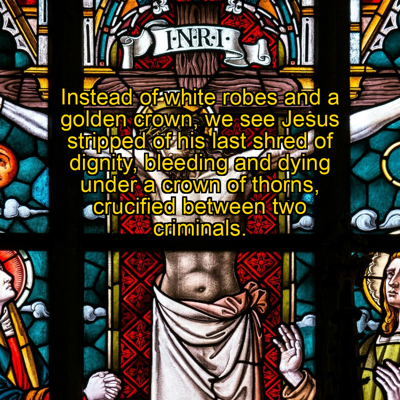
Instead of white robes and a golden crown, we see Jesus stripped of his last shred of dignity, bleeding and dying under a crown of thorns, crucified between two criminals.
The second criminal knows that even death cannot prevent Jesus, the Son of God, from coming into his kingdom. He is not fooled by appearances; he knows Christ’s kingdom is not of this world.
Announcing that Jesus is King of Heaven and Earth is a lot easier than boldly proclaiming that Jesus is King of my life, or asking Jesus to remember me in his Kingdom.
It is easier to celebrate Christ the King of all creation than it is to submit to Christ the King of me.

Where we find ourselves in this story – God’s story – depends a lot on what kind of King we want.
Jesus is not the kind of king who puts on a great show of majesty and pomp, so we can admire from afar and not get too close. Jesus is the king of weakness and vulnerability.
Jesus is the king whose throne is a cross, and whose crown is made of thorns—two symbols of suffering that remind us he loves us so much, he was willing to be made fun of, to be tortured, to die for our sake.
King Jesus and Saving Jesus and Suffering Jesus are all the same Jesus. His royalty and his saving power depend on his death, even death on a cross.
You don’t need to make a long list of resolutions to prepare for the new church year. You only need one. This year, every day, make Jesus your King.
Add this chatbot onto your site with the embed code below
<iframe frameborder="0" src="https://pastors.ai/sermonWidget/sermon/christ-king-sermon" width="100%" height="100%" style="height:100vh;"></iframe>Copy