
Choosing Faith: The Challenge of Discipleship
Dec 15, 2023
Devotional
Sermon Summary
Bible Study Guide
Sermon Clips
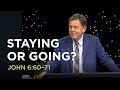
When many of his disciples heard it, they said, "This is a hard saying; who can listen to it?" But Jesus, knowing in himself that his disciples were grumbling about this, said to them, "Do you take offense at this? Then what if you were to see the Son of Man ascending to where he was before?" [00:00:35]
It is the Spirit who gives life; the flesh is no help at all. The words that I have spoken to you are spirit and life. But there are some of you who do not believe. For Jesus knew from the beginning who those were who did not believe, and who it was who would betray him. [00:01:02]
After this many of his disciples turned back and no longer walked with him. So Jesus said to the Twelve, "Do you want to go away as well?" Simon Peter answered him, "Lord, to whom shall we go? You have the words of eternal life, and we have believed, and have come to know, that you are the Holy One of God." [00:01:32]
The crowd either have to take him at his word, look, believe, come to him, find eternal life in him, or continue in life without him. And Jesus actually confronts not only the crowd on that day but he confronts everyone every day with the very same decision. [00:03:16]
It shows us that it's possible to be part of a crowd attracted to what Jesus can give and yet opposed to what Jesus demands. It makes perfectly clear that not all who are apparently disciples are actually disciples. And of course, classically and chillingly, as the chapter ends, we're reminded of the fact that the one who betrayed him for 30 pieces of silver was one who is listening to this dialogue as it unfolds. [00:04:58]
It is the Spirit who gives life. The words that I have spoken to you are spirit and life. That's a dramatic statement, isn't it? We sang about it a moment ago. The word of God is light in our darkness. What does that possibly mean? Who else can say the words that I speak not only display life but give life? [00:09:53]
To believe Jesus is to trust Jesus. To believe somebody is to trust that what they tell you is true. To believe someone is to say that when they make a promise, they will keep a promise. So what he's saying is this: some of you just don't trust me. You don't trust me. You're not prepared to trust me with your entire life. [00:11:28]
What Jesus is saying is that when a person actually comes to trust in Jesus, the initiative lies outside of them. The initiative actually lies with God. You could think about it in terms of interpersonal relationships. Perhaps there's a lady listening to me now, and she realizes that if that fellow that she knew very little about had not approached her on that day in that coffee shop or in that place, there's no saying where her life would have gone. [00:13:11]
Is there a decision to be made? Absolutely there is. We're called to it. Is our will engaged in coming to saving faith? Definitely. But the determinative cause of saving faith lies in the divine side and not in the human side. That's why, you see, when someone calls you to a decision, it's not a call to your emotion; it's a call to the totality of your being. [00:15:22]
Peter, who gets it right sometimes and wrong other times, comes in strong here. And in response to the question of verse 67, there is the answer which comes in 68 and 69. You can tell we're nearing the end, and it is a declaration. We sang it, didn't we? Really, Lord, to whom shall we go? [00:20:35]
Here's an illustration of what it means to be unreservedly committed to Jesus. Number one, you know that there is no other alternative. There is no other alternative. You have reached the point now where you say, "I cannot go on into life without you, Jesus." That's it. Where else would we go? To whom? To what? [00:21:28]
What Peter is declaring here is that he is unreservedly committed to the Lord Jesus Christ. And what that means is being prepared to say, "I'm no longer going to live my life in my own way, rejecting Jesus, spoiled by my indifference or my rebellion, living my life without hope. I'm not going to do that anymore." [00:25:05]
Ask a question about this sermon
It is the Spirit who gives life; the flesh is no help at all. The words that I have spoken to you are spirit and life. But there are some of you who do not believe. For Jesus knew from the beginning who those were who did not believe, and who it was who would betray him. [00:01:02]
After this many of his disciples turned back and no longer walked with him. So Jesus said to the Twelve, "Do you want to go away as well?" Simon Peter answered him, "Lord, to whom shall we go? You have the words of eternal life, and we have believed, and have come to know, that you are the Holy One of God." [00:01:32]
The crowd either have to take him at his word, look, believe, come to him, find eternal life in him, or continue in life without him. And Jesus actually confronts not only the crowd on that day but he confronts everyone every day with the very same decision. [00:03:16]
It shows us that it's possible to be part of a crowd attracted to what Jesus can give and yet opposed to what Jesus demands. It makes perfectly clear that not all who are apparently disciples are actually disciples. And of course, classically and chillingly, as the chapter ends, we're reminded of the fact that the one who betrayed him for 30 pieces of silver was one who is listening to this dialogue as it unfolds. [00:04:58]
It is the Spirit who gives life. The words that I have spoken to you are spirit and life. That's a dramatic statement, isn't it? We sang about it a moment ago. The word of God is light in our darkness. What does that possibly mean? Who else can say the words that I speak not only display life but give life? [00:09:53]
To believe Jesus is to trust Jesus. To believe somebody is to trust that what they tell you is true. To believe someone is to say that when they make a promise, they will keep a promise. So what he's saying is this: some of you just don't trust me. You don't trust me. You're not prepared to trust me with your entire life. [00:11:28]
What Jesus is saying is that when a person actually comes to trust in Jesus, the initiative lies outside of them. The initiative actually lies with God. You could think about it in terms of interpersonal relationships. Perhaps there's a lady listening to me now, and she realizes that if that fellow that she knew very little about had not approached her on that day in that coffee shop or in that place, there's no saying where her life would have gone. [00:13:11]
Is there a decision to be made? Absolutely there is. We're called to it. Is our will engaged in coming to saving faith? Definitely. But the determinative cause of saving faith lies in the divine side and not in the human side. That's why, you see, when someone calls you to a decision, it's not a call to your emotion; it's a call to the totality of your being. [00:15:22]
Peter, who gets it right sometimes and wrong other times, comes in strong here. And in response to the question of verse 67, there is the answer which comes in 68 and 69. You can tell we're nearing the end, and it is a declaration. We sang it, didn't we? Really, Lord, to whom shall we go? [00:20:35]
Here's an illustration of what it means to be unreservedly committed to Jesus. Number one, you know that there is no other alternative. There is no other alternative. You have reached the point now where you say, "I cannot go on into life without you, Jesus." That's it. Where else would we go? To whom? To what? [00:21:28]
What Peter is declaring here is that he is unreservedly committed to the Lord Jesus Christ. And what that means is being prepared to say, "I'm no longer going to live my life in my own way, rejecting Jesus, spoiled by my indifference or my rebellion, living my life without hope. I'm not going to do that anymore." [00:25:05]
Alistair Begg
This sermon · AI assistant

-
I'm an AI bot trained specifically on the sermon from Dec 15, 2023. Do you have any questions about it?