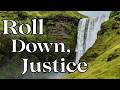
God is not interested in worship that stands alone, disconnected from how we live. The prophets remind us that true faith is expressed through a life of holiness and justice. It is about allowing God's character to shape our decisions and actions in the world. This call moves us beyond the walls of a building and into our daily interactions with others. It is an invitation to let our faith be made visible through fairness and righteousness. [05:00]
He has told you, O man, what is good; and what does the LORD require of you but to do justice, and to love kindness, and to walk humbly with your God? (Micah 6:8, ESV)
Reflection: Where is there a gap between your worship on Sunday and your pursuit of justice and kindness toward others throughout the week?
Justice is fundamentally about the decisions we make on how to live together with our neighbors. It is the practical outworking of fairness in our communities, even when these conversations feel challenging or uncomfortable. This is not a peripheral issue but is central to God's message and character. Engaging with justice is an essential part of walking with God and loving our neighbor as ourselves. [06:26]
Learn to do good; seek justice, correct oppression; bring justice to the fatherless, plead the widow's cause. (Isaiah 1:17, ESV)
Reflection: In your immediate community—your neighborhood, workplace, or family—what is one relationship or situation that could benefit from a more intentional pursuit of fairness?
From a very young age, human beings possess an innate sense of what is fair and what is not. We recognize injustice when it is done to us, and we are often aware when we are acting unfairly toward others. This internal compass points to a deeper truth about how God has created us. It reveals that the desire for justice is woven into the very fabric of our being. [08:18]
For when Gentiles, who do not have the law, by nature do what the law requires, they are a law to themselves, even though they do not have the law. They show that the work of the law is written on their hearts. (Romans 2:14-15a, ESV)
Reflection: When have you recently felt that inner sense of knowing something was unfair, either for you or for someone else? How did you respond to that feeling?
In a world full of injustice and unfairness, we are anchored by a hope that cannot be taken from us. No power, no circumstance, and no injustice can separate us from the love of God found in Christ Jesus. This hope is not a naive wish but a confident assurance in God’s faithful character. It is the foundation that allows us to work for justice without succumbing to despair. [15:59]
For I am sure that neither death nor life, nor angels nor rulers, nor things present nor things to come, nor powers, nor height nor depth, nor anything else in all creation, will be able to separate us from the love of God in Christ Jesus our Lord. (Romans 8:38-39, ESV)
Reflection: When the problems of the world feel overwhelming, how can you actively remind yourself of this promise that nothing can separate you from God’s love?
Our primary identity is not found in the flags we fly or the groups we belong to, but in our status as named and beloved children of God. Baptism is the radical ritual where we are claimed by God and welcomed into a family that transcends every human division. This identity calls us to see every other person as a child of God, worthy of dignity and justice. From this place of belovedness, God’s love and justice can flow through us. [19:36]
For in Christ Jesus you are all sons of God, through faith. There is neither Jew nor Greek, there is neither slave nor free, there is no male and female, for you are all one in Christ Jesus. (Galatians 3:26, 28 ESV)
Reflection: How might embracing your identity as a beloved child of God free you to extend more grace and work more earnestly for the good of others?
This Lent collection listens to Amos, Micah, and Paul to insist that faithful worship must yield lives shaped by justice. Amos leaves his farm to deliver a hard word: God rejects worship that does not lead to holiness and justice. Micah cuts through ritual piety with the blunt refusal of “perfectly burnt offerings,” calling instead for mercy, justice, and humble walking with God. Justice appears not as partisan noise but as the concrete rules by which communities live together; politics simply names the means by which neighbors arrange fairness.
Fairness shows up in small human instincts and large public systems. Children instinctively know right from wrong when toys are taken; athletes accept rules designed to level uneven conditions; Olympic officials check wind and sometimes end events to preserve agreed fairness even when outcomes disappoint. Paul’s letters deepen the claim: nothing in creation can separate anyone from God’s just, steadfast love. Equality before God erases status markers—gender, ethnicity, citizenship—and calls the baptized to make that equality visible in the world.
Hope becomes the engine for pursuing justice. Hope moves beyond despair and cynicism to hold that injustice does not have the final word. Bishops and church leaders confront real injustices—stops, marginalization, and structures that exclude—and yet baptismal ritual insists on naming each person as a child of God. Ritual naming rejects barriers that sort people into insiders and outsiders and points toward a future when flags fall away and all walk together as children of the world.
The season invites renewed attention to how God’s love fills and flows through people so justice can happen. Practical rules, honest humility, and sustained hope form the path: recognize when worship becomes empty, insist on fair and public structures, refuse despair, and let baptismal identity propel action. The call asks for steady courage to live hope into messy political life and to make fairness visible in homes, courts, and congregations until justice floods the land.
Our baptized baptism reminds us that we are each a child of God no matter what the world calls us or what people do to us. We receive God's love in baptism and we then have the opportunity to let God's love flow through us so that everyone can know they are a child of God.
[00:19:20]
(26 seconds)
#ChildOfGod

Now Paul's reading that Julie read for us today reminds us of God's fairness. There is nothing on earth that can separate us from God's love, and only God will be judging us. The judgment of the world does not matter. God will always be with us. Swords and powers can't separate us from God's distress and storms, persecution, illness, nothing can separate us from the love of God, the just love of God.
[00:12:25]
(36 seconds)
#UnbreakableGodsLove
Just as each of us has our special name on our shirts today, thank you care team for having all of us put our names on today, but these names are special. And in baptism, we name each person who comes before God to receive God's gift of hope and love and peace and grace. We name them. Our rituals have nothing to do with who's right and wrong or good and bad or in and out or on this side or that side.
[00:18:04]
(32 seconds)
#BaptismalWelcome
And fundamentally, when we're thinking about justice at church, I think it's about fairness, about treating each other equally, not changing the rules in the middle of the game. The jumpers knew the wind would be checked. They knew that they may not get all of their jumps in. So what does this mean for us?
[00:11:45]
(22 seconds)
#FairnessMatters
Because if you're jumping into a headwind, you've got a huge advantage. Just like with an airplane, if you've got a headwind, it help gives you lift, and it makes you go higher and further. If you've got a tailwind, it's just pushing you right down to the hill, and a tailwind is not good in ski jumping. So I'm watching ski jumping at one point, and they're talking about this and they're checking the wind between every jumper and all of sudden they stopped. They're like the wind just turned directions.
[00:10:05]
(26 seconds)
#WindAndFairness
and they're talking about this and they're checking the wind between every jumper and all of sudden they stopped. They're like the wind just turned directions. 180 degrees in the middle of the event. How is that fair? And so they stopped, and they gave it ten or fifteen minutes to see if the wind would switch back. It did not switch back, and they have a set of rules of what to do in this situation. And everyone knows the rules ahead of time, but the rule was we end the event.
[00:10:24]
(32 seconds)
#RulesForFairPlay
So it's not like someone complained and said, oh, you changed the rules in the middle of the game. They knew they came up with a fair set of rules to deal with the wind because it's always a problem. Now I am guessing it didn't feel fair to the athletes who still had jumps that they were trying to do, but they came up with rules and they were trying to make it as fair as possible.
[00:11:19]
(26 seconds)
#FairnessThroughRules
But I think the Olympics has one more thing for us to see and take away from, and I saw a lot of this over the last two weeks. And the Olympics is a great place to see hope in action. All these athletes, they've been working since they were little kids, most of them, hoping to get good at their sport, national team, hoping to be an Olympian, and a small number of them hopes to get a medal.
[00:14:45]
(35 seconds)
#OlympicHope
I'm an AI bot trained specifically on the sermon from Feb 22, 2026. Do you have any questions about it?
Add this chatbot onto your site with the embed code below
<iframe frameborder="0" src="https://pastors.ai/sermonWidget/sermon/child-of-god-roll-down-justice-2026" width="100%" height="100%" style="height:100vh;"></iframe>Copy