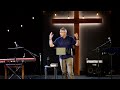
This passage speaks to the intentional commitment of joining a church community. It's about more than just attending; it's about formalizing your relationship, your responsibilities, and your sense of belonging. This partnership is rooted in a shared confession of faith in Jesus and a desire to live out God's work in your life within the context of the church. It's a way to officially plug in, to be part of the team, and to contribute to the collective witness of God's goodness. [21:49]
Ephesians 2:19-22 (ESV)
So then you are no longer strangers and aliens, but you are fellow citizens with the saints and members of the household of God, built on the foundation of the apostles and prophets, Christ Jesus himself being the cornerstone, in whom the whole structure, being joined together, grows into a holy temple in the Lord. In him you also are being built together into a dwelling place for God by the Spirit.
Reflection: In what specific ways do you feel called to "plug in" and contribute your gifts and talents to the community of faith you belong to?
Communion is a sacred practice instituted by Jesus himself, a central act of worship that anchors our faith. It serves as a powerful reminder of the historic events of Jesus' life, death, and resurrection, and how these events have profoundly impacted our present reality and future hope. This meal connects us to the past, grounds us in the present, and points us toward the eternal promises of God, reminding us of His transformative grace and the new life found in Him. [34:03]
1 Corinthians 11:23-26 (ESV)
For I received from the Lord what I also delivered to you, that the Lord Jesus on the night when he was betrayed took bread, and when he had given thanks, broke it, and said, “This is my body, which is for you. Do this in remembrance of me.” In the same way he took the cup, after they had eaten, saying, “This cup is the new covenant in my blood. Do this, as often as you drink it, in remembrance of me.” For as often as you eat this bread and drink the cup, you proclaim the Lord’s death until he comes.
Reflection: When you participate in communion, what specific aspect of Jesus' sacrifice and its impact on your life do you find yourself reflecting on most deeply?
Life's difficulties and injustices can leave us feeling aggrieved and overwhelmed, prompting the question of how to pray when life hurts the most. Scripture reveals a practice called lament, which is a way to express deep grief and sorrow directly to God. This is not about murmuring or victimhood, but about engaging God with our anxieties, despair, and even our protests, trusting that He hears, sees, and knows our pain. [54:14]
Psalm 142:1-3 (ESV)
I cry aloud to the Lord; I lift up my voice to the Lord for mercy. I pour out before him my complaint; before him I tell my trouble. When my spirit faints within me, you know my way! In the path where I walk they have hidden a trap for me.
Reflection: Think of a specific situation in your life where you've felt overwhelmed or that "this is just not right." How might you begin to articulate that feeling to God, as David did in Psalm 142?
Even in our darkest moments, when we feel trapped and alone, scripture assures us that God intimately knows our circumstances. David, in his distress, recognized that God's understanding of his path was not generalized but deeply personal. This knowledge offers comfort, reminding us that we are not merely numbers but individuals known and cared for by God, who has an informed care for our souls. [01:10:41]
Psalm 142:3 (ESV)
When my spirit faints within me, you know my way! In the path where I walk they have hidden a trap for me.
Reflection: Where in your life do you feel most unseen or misunderstood, and how might the knowledge of God's intimate understanding of your path bring you comfort today?
When life's challenges feel overwhelming and we are at the end of our personal resources, faith in God becomes our ultimate refuge. David's lament in Psalm 142 shifts from despair to confidence, recognizing God as his portion and his hope. This is not a passive resignation but an active engagement with God, a purposeful taking of refuge in Him, knowing that He is our ongoing security and the source of our greatest hope, even when we feel trapped. [01:15:28]
Psalm 142:5 (ESV)
I cry to you, O Lord; I say, “You are my refuge and my portion in the land of the living.”
Reflection: In what specific area of your life are you currently feeling the need for refuge, and how can you intentionally choose to see God as your refuge and portion in that situation?
The teaching moves through three clear concerns: the shape of local church life, the meaning of the Lord’s Supper, and the practice of lament as a faithful form of prayer. Partnership is presented not as a bureaucratic formality but as a covenantal naming of where people belong—a public and relational commitment that preserves unity and accountability within the local body while rooting members in the universal church. The Lord’s Supper is argued to be the one worship act explicitly instituted by Christ, a ritual that looks backward to the historical events of Christ’s death, forward to the promised banquet with him, and inward to the ongoing application of grace in believers’ lives; the bread and cup embody the exchange and the new covenant of grace. Lament is recovered as a biblical, honest, and robust posture before God: raw complaint, grief, and protest addressed directly to a God who hears, knows intimate pathways, and acts. Drawing on Psalm 142 and David’s time in the cave of Adullam, the address demonstrates how lament refuses stoic denial, instead bringing despair into the light of divine presence so that lament can move—through wrestling and hope—into trust.
The teaching refuses quick sentimentality: lament is not fatalism nor is it a mere venting of emotion; it is a disciplined language for calling God to account and for reminding oneself of God’s character and promises. Faith, in this frame, is dependency—an intentional orientation toward a God who is both near and sovereign, who knows individual paths and whose ultimate action is revealed in Christ. Jesus is presented as the culmination of the Psalms’ longings: his suffering validates the vocabulary of lament and makes God’s throne accessible. The result is pastoral direction: congregational rhythms (partnership, shared table, corporate prayer) and personal practices (honest lament, remembrance at the table) that cultivate resilience, communal care, and a hope that endures beyond present darkness.
``When the edges of life fray, when the ground beneath us crumbles, when trap after trap, disappointment after disappointment, robs you of your strength, you you you are not lost. You are not unseen. You are not unsheltered. God is the refuge of the soul there in that space, and he's a warm blanket for us in the cold night of despair.
[01:14:32]
(24 seconds)
#GodIsRefuge

When life hurts the most, when we don't we don't find God hiding or ducking and weaving like a politician trying to avoid the question, trying to avoid the reality of our experience and our loss. We find God as one who acknowledges and legitimizes our pain and provides us with a means to actually address him, to actually come to him, to speak to him.
[00:52:37]
(24 seconds)
#GodMeetsOurPain
I'm an AI bot trained specifically on the sermon from Feb 01, 2026. Do you have any questions about it?
Add this chatbot onto your site with the embed code below
<iframe frameborder="0" src="https://pastors.ai/sermonWidget/sermon/cave-lament-hope" width="100%" height="100%" style="height:100vh;"></iframe>Copy