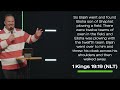
Elijah’s cloak lands on Elisha in the middle of a workday, and the text refuses to make that moment small. The ordinary scene holds an ox team, a plow, and a man who knows his route by heart, but God steps in and divinely disrupts the schedule. Elisha’s life has been formed by monotony and responsibility, yet the call insists that the miraculous often manifests on the other side of the monotonous. The oxen’s backs and the furrows in the ground become the backdrop where God says, there is more beyond ordinary.
Elisha does not stall. The cloak speaks louder than details, and the call outruns calculation. “He left the oxen,” he runs, and the yes comes before the how, the why, and the what. Faith here refuses to wait for a spreadsheet. It looks like immediate, simple obedience. The text places weight on timing: the moment opens, and Elisha steps. The biblical pattern agrees. Abraham moves without a map, Moses goes on a single word, Peter walks on one command, come. Faith does not demand a forecast.
But the call is not only immediate, it is costly. Verse 21 sets the plow on the altar. Elisha slaughters the oxen and burns the equipment. No storage, no installment plan, no plan b. The farm is not transferred to a cousin to keep options open. The plow is wood for the fire. The very tools that funded the old life become the sacrifice that funds the new one. This is what following sacrificially looks like. Easy and significant are not compatible. The path of least resistance often becomes the path of least reward.
The contrast between fear and faith sharpens the choice. Fear demands details and protects comfort; faith surrenders control and steps into calling. The cross and the plow cannot be carried together. Jesus’ word frames the moment: give up your own way, take up your cross, and follow. A contemporary testimony echoes the text’s cadence: obedience is the job, outcomes are God’s job. The call may not make sense to the mind, but it makes faith. Rhema moments break into rigid calendars when a disciple lays down plan b, burns the plow, and chooses immediate, sacrificial yes.
Key Takeaways
- 1. The miraculous follows faithful monotony The text shows God locating Elisha at the plow, not on a platform. Ordinary stewardship becomes the runway for extraordinary grace. Faithfulness in obscurity readies a life for interruptions of glory. Hidden obedience tills the soil where God plants a bigger assignment. [11:10]
- 2. Plow-burning faith responds immediately Elisha leaves the oxen and runs; the yes outruns analysis. Some calls do not wait for a pro-con list, they ask for trust in real time. Delayed obedience often disguises disbelief. When God speaks clearly, timing is part of obedience. [14:30]
- 3. Sacrifice eliminates plan b Burned plows and slaughtered oxen close the exit door, turning commitment into conviction. Tools of yesterday’s success become today’s offering, so the heart cannot drift back. Cost clarifies calling by removing comfortable alternatives. No storage means no split allegiance. [21:05]
- 4. Choose faith over fear’s details Scripture keeps handing out one-word summons: go, come, stay, trust. Faith lives on the word of God, not on perfect conditions. Fear counts risks; faith counts God faithful. Direction belongs to faith when outcomes belong to God. [17:55]
- 5. Trade the plow for the cross The cross asks for the surrender comfort protects. A disciple cannot clutch convenience and carry Christ at the same time. Kingdom reward lands on the other side of relinquishing control. Letting go of plan b makes room for God’s better. [26:04]
Youtube Chapters
- [00:00] - Welcome
- [00:44] - Liberty CI celebration and invitation
- [01:42] - Life in a tight rhythm
- [04:39] - Is there more than ordinary
- [05:50] - Meet Elisha in the field
- [06:06] - Reading 1 Kings 19
- [07:34] - The cloak and the call
- [09:04] - Why this moment matters
- [11:10] - Miraculous after monotonous faithfulness
- [13:58] - Respond immediately without details
- [17:55] - Faith not fear directs steps
- [20:22] - Follow sacrificially, burn the plow
- [23:44] - Easy vs significant
- [25:31] - Cross over comfort
- [28:11] - Salvation and bold next steps