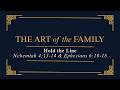
Families thrive when their boundaries reflect God’s truth, not mere tradition. Just as Nehemiah rebuilt Jerusalem’s broken walls to restore Israel’s spiritual identity, believers must fortify their homes with Scripture’s unchanging foundation. Walls crumble when priorities shift or convictions weaken, leaving hearts exposed to compromise. Vigilance begins by recognizing that spiritual protection isn’t about rigid rules but anchoring to Christ’s redemptive purpose. What remains unguarded becomes vulnerable. [33:24]
“So in the lowest parts of the space behind the wall, in open places, I stationed the people by their clans with their swords, their spears, and their bows. And I looked and arose and said to the nobles and to the officials and to the rest of the people, ‘Do not be afraid of them. Remember the Lord, who is great and awesome, and fight for your brothers, your sons, your daughters, your wives, and your homes.’”
(Nehemiah 4:13–14, ESV)
Reflection: Where has your family’s spiritual “wall” grown weak? What daily habit could reinforce your identity in Christ’s truth?
Generations inherit either ruins or redemption. Sin’s damage ripples beyond individuals, shaping legacies of dysfunction or grace. Like Nehemiah’s exhausted workers, rebuilding requires confronting exhaustion, ridicule, and the weight of past failures. Yet God specializes in restoring broken altars. Spiritual renewal starts when one generation says, “By God’s grace, it stops here.” The choice to rebuild begins with humility, not perfection. [40:32]
“He established a testimony in Jacob and appointed a law in Israel, which he commanded our fathers to teach to their children, that the next generation might know them, the children yet unborn, and arise and tell them to their children, so that they should set their hope in God.”
(Psalm 78:5–7, ESV)
Reflection: What unhealthy pattern in your family line are you called to interrupt? How can you actively “tell the next generation” God’s faithfulness?
Spiritual warfare demands simultaneous construction and combat. Nehemiah’s workers held tools and weapons, mirroring families who nurture while resisting cultural lies. Ephesians’ armor—truth, faith, Scripture—equips parents to guard digital gates and ideological battlegrounds. Protection isn’t control but teaching discernment through shared engagement. Victory comes not by isolation but by wielding God’s Word amid daily chaos. [47:17]
“Put on the whole armor of God, that you may be able to stand against the schemes of the devil. For we do not wrestle against flesh and blood, but against the rulers, against the authorities, against the cosmic powers over this present darkness.”
(Ephesians 6:11–12, ESV)
Reflection: What specific “scheme” threatens your family’s peace? How can you model spiritual alertness without fostering fear?
Legacies form in repetitive acts—prayers muttered over dishes, forgiveness offered again, Scripture read through yawns. Like Paul’s endurance in prison, families thrive through mundane obedience, not dramatic moments. Cortez burning ships symbolizes total commitment, but Christ calls deeper: daily dying to retreat options. Spiritual stamina grows when small choices align with God’s marathon vision. [01:05:38]
“And let us not grow weary of doing good, for in due season we will reap, if we do not give up. So then, as we have opportunity, let us do good to everyone, and especially to those who are of the household of faith.”
(Galatians 6:9–10, ESV)
Reflection: What ordinary act of faithfulness feels exhausting? How might Jesus’ presence transform it into worship?
Partial commitment guarantees spiritual drift. Cortez’s burned ships forced forward movement, just as families flourish when they abandon “plan B” compromises. Surrender means praying with kids despite fatigue, or turning off screens to seek faces. Revival begins when homes become sanctuaries—no exit strategies, just relentless pursuit of Christ’s presence. [01:03:00]
“No one who puts his hand to the plow and looks back is fit for the kingdom of God.”
(Luke 9:62, ESV)
Reflection: What “retreat option” have you secretly kept? What step today could burn that bridge in trust?
Nehemiah sets the scene after exile with burned gates and broken walls, and the charge lands like a bell: “fight for your brothers, your sons, your daughters, your wives, and your homes.” The walls, Nehemiah shows, are not about bricks but identity. City walls mean protection, stability, and belonging, and when those crumble the people live exposed and scattered. Family life mirrors that picture. When priorities shift, convictions thin out, and spiritual disciplines erode, homes resemble Jerusalem’s gaps. What is left unguarded eventually becomes vulnerable, so every generation must rebuild what neglect has broken.
The people in Nehemiah do hard, exhausting work. They build with one hand and hold a weapon with the other, which paints a clear picture for spiritual leadership at home. God’s word is both tool and sword. The charge is not just to provide but to nurture and protect, to know the gates that need guarding, especially in a digital world that catechizes kids before parents notice. Sin, Scripture reminds, does not just bruise individuals, it bruises generations. But grace can stop the cycle. Spiritual maturity owns that it may not have started with someone, and by God’s grace it can stop with them.
Paul writes from prison with comfort far from his mind. He calls the church to be strong in the Lord and to put on the whole armor of God, every piece, because the battle is spiritual and the threats are often invisible at first. Drift looks small, then becomes a road. Psalm 78 still stands as a banner over the home, pressing the obligation to pass down the works and truth of God to the next generation. The greatest legacies are spiritual. Money fades, but what is left in Christ remains.
A vivid picture from history underscores the call. When retreat remains an option, commitment stays partial. Families often try to follow Christ while keeping a back door open. Biblical homes are not built on occasional conviction but on surrendered lives. Holding the line requires endurance. Family life is repetitive, so faithfulness must be steady. Most strong families are not forged in big moments but in ordinary obedience, repeated consistently. The simple rhythms of prayer, Scripture, conversation, correction, showing up, and forgiving again build a wall brick by brick. One honest area of drift named, one shared discipline restored, and one united step in the same direction start pulling the rope the right way.
``Just as we should in our family. See, a healthy family doesn't happen accidentally but it requires rather, it requires vigilance, it requires intentionality, sacrifice, and get this, endurance. It takes a marathon of life to go through because we're never going to be perfect until we are complete in heaven with Christ. Those that are in the body of Christ professed and confessed their life to Christ and so eventually, listen, every family reaches moments where they must decide this, that they will preserve what god has built or that they will slowly surrender it to compromise, distraction, and spiritual drift
[00:30:38]
(42 seconds)
And then, why would you even place your trust and faith within that? To then, let the line go and never hold it with what god has already done and held the victory all along. So, don't be exposed because here's the deal, what is left unguarded will eventually become vulnerable. If you let yourself be exposed, if you let yourself continuously be out there and you don't hold yourself within the right relation to god, you're going to be vulnerable. Because every generation must rebuild what neglect has broken.
[00:37:36]
(39 seconds)
The greatest threat to a family are often not visible at first because you and I are real good at playing things off. We can compromise on things when really we don't want to compromise. We can drift spiritually. Yeah, it's just, you know, it's just one song. If two songs, you know what? I'll get back to worship later. Now, all of a sudden, we're way down a different road and we're down a path that has been instilled in our lives we formally knew. Here's the deal. I'm not telling you to not listen music that you enjoy. What I'm saying is this, is that you've gotta be cognizant aware of everything that we do. How does it lead you back to Christ? How does it lead you closer to being a relationship with god? Because otherwise, it's going to cause bitterness. It's going to cause you to isolate and you're going to neglect not only yourself but others as well.
[00:57:37]
(59 seconds)
and so as we get in this, I want us to know this. Here's the first point. The walls were not about bricks. They were about identity. They weren't about walls of bricks. They were about identity because we can build, right? I can build walls of bricks and they could just be put up but really do they mean anything if I don't have them there and it's kind of again as we take a look at these scriptures, you're going be like, well, this is kind of contradictory. Let's see why. So, the book of Nehemiah takes place after Israel's exile. In Babylon and then in Jerusalem, they were devastated. See, here's why. The walls were destroyed.
[00:33:09]
(43 seconds)
Add this chatbot onto your site with the embed code below
<iframe frameborder="0" src="https://pastors.ai/sermonWidget/sermon/art-family-hold-the-line" width="100%" height="100%" style="height:100vh;"></iframe>Copy