True salvation comes not through human effort but through God’s unmerited grace. We are called to release the illusion of control and receive the gift of Christ’s cleansing work. Just as Jesus humbled Himself to wash His disciples’ feet, we must humbly accept that our righteousness flows from His sacrifice alone. Attempts to earn God’s favor only distance us from the freedom He offers. Rest in the truth that His grace is sufficient. [04:32]
“For by grace you have been saved through faith. And this is not your own doing; it is the gift of God, not a result of works, so that no one may boast.” (Ephesians 2:8–9, ESV)
Reflection: Where do you subtly rely on your own “goodness” or achievements to feel secure before God? How might embracing grace in that area deepen your dependence on Christ’s finished work?
Jesus’ act of washing feet reveals a profound paradox: to be cleansed, we must surrender our pride. Peter’s resistance mirrors our own struggle to admit our need. True discipleship begins not in serving God on our terms but in allowing Him to meet us in our brokenness. The basin of grace requires humility—acknowledging that even our best efforts cannot purify what only Christ’s love can heal. [07:04]
“Peter said to Him, ‘You shall never wash my feet.’ Jesus answered him, ‘If I do not wash you, you have no share with me.’” (John 13:8, ESV)
Reflection: In what relationships or circumstances do you resist vulnerability, fearing others might see your “dirt”? How could inviting Christ into those areas transform your sense of worth?
Pilate’s basin symbolizes the temptation to prioritize comfort over conviction. When we silence our witness to avoid conflict, we trade eternal purpose for temporary peace. Yet neutrality toward Christ is impossible—every choice either deepens our allegiance to Him or aligns us with the crowd. True freedom lies not in avoiding the cost of discipleship but in embracing it. [17:17]
“So when Pilate saw that he was gaining nothing, but rather that a riot was beginning, he took water and washed his hands before the crowd, saying, ‘I am innocent of this man’s blood; see to it yourselves.’” (Matthew 27:24, ESV)
Reflection: When have you minimized your faith to fit in, and what fear drove that choice? What step could you take this week to courageously honor Christ in a relationship or setting where it feels risky?
Jesus redefined love not as a feeling but as sacrificial action. His command to “wash one another’s feet” calls us to serve others not out of obligation but from the overflow of being cleansed by Him. This love transcends preferences and comfort—it enters the messiness of others’ lives, just as Christ entered ours. Such love becomes the world’s clearest glimpse of the Gospel. [40:30]
“A new commandment I give to you, that you love one another: just as I have loved you, you also are to love one another.” (John 13:34, ESV)
Reflection: Who in your life is hardest to love sacrificially? What practical act of service or kindness could you offer them this week to reflect Christ’s love?
Salvation by grace does not negate action—it redirects it. We are God’s masterpieces, designed to walk in the good works He ordained. Like Jesus’ basin, our calling may seem ordinary, but obedience transforms daily tasks into eternal significance. Surrendered lives become living testimonies, proving that faith without works is lifeless, and works without faith are futile. [22:56]
“For we are His workmanship, created in Christ Jesus for good works, which God prepared beforehand, that we should walk in them.” (Ephesians 2:10, ESV)
Reflection: What mundane responsibility or relationship feels disconnected from your faith? How might God be inviting you to see it as part of His purposeful design for your growth and others’ good?
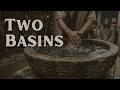
Ephesians 2’s declaration of salvation by grace frames a stark moral choice between two symbolic basins: one that humbles and cleanses, and one that excuses and abandons. The first basin, modeled by Jesus in John 13, is a simple bowl and a towel—an act of service that both meets physical need and points to a deeper spiritual cleansing only Christ can accomplish. Kneeling to wash dirty feet illustrates that no human effort earns reconciliation; receiving that cleansing requires humility, surrender, and trust in Christ’s unique authority to purify. Peter’s resistance exposes the human instinct to refuse dependence on divine grace and to insist on self-sufficiency until confronted with the cost of exclusion from Christ.
The second basin, used by Pilate, looks elegant and convenient but carries moral surrender. Washing his hands before the crowd, Pilate declares himself innocent while deflecting responsibility, choosing public approval over truth. That gesture dramatizes a worldly posture that knows the right answer in private yet abandons it in public to preserve status, safety, or reputation. Such self-justifying gestures produce no lasting gain; they leave a conscience unsettled and a soul unchanged.
Scripture offers a counterexample in David, whose exposure to guilt led him not to handwashing but to penitence. Psalm 51 models the posture the Pilate-basin cannot produce: raw confession, plea for cleansing, and a desire for inward renewal. The true bowl of cleansing works inwardly—creating a clean heart and restoring the joy of salvation—because it rests on the atoning work that only Christ provides.
Finally, the basin of Jesus carries a commissioning: sacrificial love toward others. The footwashing becomes an enacted gospel and a new standard for relationships—love one another as Christ loved—calling disciples to costly service that reflects the cross. Communion serves as the tangible reminder of that love: the same grace that cleanses also compels a community to humbly serve, to confess, and to love sacrificially in ways that reveal Christ to the world.
And so then we can show god, say, look at what I've chosen. Look at what I've done. Look at this basin. Look at this gate. Isn't this amazing, god? With this gate, with this basin, lord, I've done so many things for you. I've cast out demons. I've prophesied. I've done good works. And how does the story go? God says, but I never knew you. I never knew you. We picked this basin because it was so attractive.
[00:21:37]
(28 seconds)
#RelationshipOverReligion
As Pilate washed his hands in the basin, he said, I am innocent. He declared himself innocent. I can cleanse myself. I've got this. All I have to do is wash my hands and I'm gonna be good to go. I could do this myself. I'm innocent. Nobody look at me. I'm fine. He declares himself innocent. I don't know how much Pottett thought of that decision or that situation. I wonder what it must have been like trying to go to bed at that night knowing he just ordered an innocent man to be crucified.
[00:29:22]
(42 seconds)
#WashMyHandsOfIt
You will eventually understand it. Instead of that being the period, sometimes we are still insisting, No, I need to understand this. We become stubborn ourselves. I'm gonna figure this out. And sometimes we get so much stubborn like Peter. We get so stubborn about this. I'm not gonna cooperate, Lord, till I understand this. I need to know this now. If you want me to keep moving forward, then explain this to me. And Jesus said, I already had the end of the sentence a while back.
[00:15:48]
(30 seconds)
#TrustBeforeUnderstanding
We cannot earn our salvation. We cannot work for it. We can't do these things. Only Jesus can do this. He's trying to show us that, teach us that. And this was humbling for the disciples. One of if if you remember the disciples, they didn't get along all the time. They had their fair share of disagreements. The last disagreement that they had before this took place was, which one of us is the greatest? I mean, Jesus, I know that we're all good. In fact, we're all great. But but which one's the greatest? That was their argument. That was their mindset.
[00:08:35]
(46 seconds)
#GraceNotWorks
And we start adjusting our answer for the crowd. That's washing our hands of him. We cannot have that attitude. We ask ourselves, if I make a stand for Jesus, what will it cost me? What will it mean for me? And this is why Pilate's Basin is so attractive. It doesn't cost us anything. Just wash your hands and move on. No big deal. But we choose Jesus' basin. We humble ourselves.
[00:27:07]
(40 seconds)
#CostOfFollowingJesus
Here's what happens when we come to Jesus' basin. When we come to his basin, the greatest, no matter how great we think or we are in our own mind, we are humbled. We're brought low because he brought himself low. Amen. And Peter struggled because, listen, if you've ever been part of a foot washing service or anything like that, you know that it is humbling to wash someone else's feet, but you also know it is humbling to have your own feet washed.
[00:10:05]
(32 seconds)
#HumilityThroughService
And all that we did, everything that we worked for, we find out just like Pilate, we gained nothing. At the end of the line, we get a god who tells us, but I never knew you. And all that's left for us to do is just wash our hands of it and say, well, I tried. That's all I can do. Remember I told you last week, we make a decision to follow Christ, but then we make a decision which basin do we want.
[00:22:05]
(29 seconds)
#WorksDontSave
If we live for him, we're obedient to him. We allow him to be our lord, our savior. We allow him to be everything to us. He's the one who calls the shots. It's all about him and what he wants, not about what I want. It's about his standard, not my standard. His desires, not my desires. That's what happens when we choose his basin. But that requires us to be humbled. It requires us to go to his basin. But this other basin looks so good over here. Live for myself. Do it my own way.
[00:23:02]
(34 seconds)
#ChooseHimNotSelf
I'm an AI bot trained specifically on the sermon from Apr 14, 2026. Do you have any questions about it?
Add this chatbot onto your site with the embed code below
<iframe frameborder="0" src="https://pastors.ai/sermonWidget/sermon/2026-04-12-two-basins" width="100%" height="100%" style="height:100vh;"></iframe>Copy