When Jesus encountered the bent-over woman in the synagogue, his first act was not to immediately heal her body, but to call her forward and restore her place among the people. This act of seeing and welcoming her was itself a form of healing, affirming her dignity and belonging before any physical change took place. In a world where so many are overlooked or pushed to the margins—because of difference, disability, or quiet suffering—Jesus models a love that notices, calls by name, and makes space for each person.
We are invited to consider how true healing often begins with being seen, valued, and included. When we overlook or sideline others, we not only diminish their sense of worth but also weaken the fabric of our community. The call is to become people who notice those waiting to be welcomed, to extend the invitation that Christ first offered to us, and to recognize that belonging is the soil in which all other healing can grow.
Luke 13:12-13 (ESV): “When Jesus saw her, he called her over and said to her, ‘Woman, you are freed from your disability.’ And he laid his hands on her, and immediately she was made straight, and she glorified God.”
Reflection: Who in your daily life or church community might be waiting for you to notice them and invite them in? What is one practical step you can take today to help someone feel seen and included?
Many of the things that weigh us down are invisible to others—grief, shame, anxiety, or the feeling that we don’t measure up. These burdens can bend us over just as surely as any physical ailment, making it hard to look up or move forward. Yet Christ sees what others cannot. He knows the silent struggles, the private pain, and the stories we carry in our hearts.
In our own moments of heaviness, we are invited to be still and let God hold us close. There is deep comfort in knowing that our pain is not hidden from him, and that sometimes the most profound healing is simply being seen and loved in our suffering. We are not alone in our burdens; Christ’s compassion meets us right where we are, offering rest and hope even before circumstances change.
Psalm 38:9-10 (ESV): “O Lord, all my longing is before you; my sighing is not hidden from you. My heart throbs; my strength fails me, and the light of my eyes—it also has gone from me.”
Reflection: What is one invisible burden you are carrying right now? Take a moment to bring it honestly before God, trusting that He sees and cares for you in your pain.
Jesus often challenged the religious leaders of his day when their rules and traditions became barriers to grace. He reminded them—and us—that the heart of God’s law is always compassion and inclusion. Even well-intentioned systems can end up excluding or hurting those they were meant to serve if we lose sight of their true purpose.
We are called to examine our own practices, both personally and as a community. Are there ways we have allowed customs, routines, or unspoken rules to keep people at a distance? The invitation is to let compassion lead, to ensure that our actions and institutions uplift the vulnerable and make room for all, just as Jesus did.
Micah 6:6, 8 (ESV): “With what shall I come before the Lord, and bow myself before God on high?... He has told you, O man, what is good; and what does the Lord require of you but to do justice, and to love kindness, and to walk humbly with your God?”
Reflection: Is there a tradition, habit, or “rule” in your life or community that might be excluding someone? What would it look like to let compassion take priority in that area?
Change rarely comes without someone being willing to speak up, even when it is difficult or costly. Throughout history and in our own lives, justice has moved forward because people have refused to accept exclusion or injustice as the final word. Whether advocating for the disabled, the poor, or those who have been marginalized for any reason, it takes courage, persistence, and the support of others to make a difference.
If you feel unable to speak out right now, know that receiving support and care is also a holy act. When you are able, your voice—no matter how small it seems—can help tip the balance toward justice and belonging. We are called to stand in solidarity, to support one another in our burdens, and to trust that Christ’s love empowers us to speak and act for what is right.
Proverbs 31:8-9 (ESV): “Open your mouth for the mute, for the rights of all who are destitute. Open your mouth, judge righteously, defend the rights of the poor and needy.”
Reflection: Who is someone in your life or community whose voice is not being heard? What is one way you can support them or help amplify their story this week?
Jesus’ healing is never just about the individual; it is about restoring the whole community. When the bent-over woman stood tall, she did so not only for herself but as a sign of what God desires for all people—to be seen, loved, and able to stand with confidence. We are invited to stand tall, not in pride, but in the assurance that we are beloved and called to help others do the same.
In times of transition or uncertainty, we can trust the Spirit to guide us. By listening deeply to one another, bearing each other’s burdens, and making space for every voice, we become a community where all can flourish. Christ’s love enables us to move forward together, stronger and more whole than we could ever be alone.
Isaiah 35:3-4 (ESV): “Strengthen the weak hands, and make firm the feeble knees. Say to those who have an anxious heart, ‘Be strong; fear not! Behold, your God will come with vengeance, with the recompense of God. He will come and save you.’”
Reflection: In what area of your life or community do you need to “stand tall” today? Who around you might need encouragement to stand tall as well, and how can you offer it?
of the Sermon:**
In this sermon, we reflected on the story of the bent-over woman whom Jesus healed in the synagogue, exploring how Christ’s compassion restores not only individuals but entire communities. We considered the ways people are marginalized—by disability, difference, or internal burdens—and how Jesus’ first act of healing is to see, call forward, and restore belonging. The sermon challenged us to examine our own community’s inclusivity, recognizing that even with good intentions, we may overlook barriers others face. We were reminded that Jesus’ compassion is deeply personal, that he sees each of us in our pain, and that true healing often begins with being seen and welcomed. The message then turned to justice, urging us to not only welcome those on the margins but also to challenge systems and rules that perpetuate exclusion, following Jesus’ example of prioritizing compassion over rigid legalism. Through stories both personal and societal, we were encouraged to speak out for justice, support one another in our burdens, and trust that Christ’s love enables us to stand tall and help others do the same.
**K
Jesus doesn’t just heal the woman’s body; he brings her back into the community. The first part of healing is belonging. When we set people aside, we all lose. Everyone is a child of God and has a rightful place among us.
Many things can weigh us down—shame, grief, poverty, or a sense of brokenness. Christ sees us in our pain and invites us to stand tall, reminding us that we are never alone or forgotten.
Sometimes, the soul needs a different kind of miracle—it needs to know it’s not alone. Jesus chooses proximity, reaching out to those who are burdened, showing us that connection and belonging are holy.
Broken systems need to be called out. A rule or law is only good if it works towards protection and compassion for all. The holocaust was entirely legal. Justice means seeing and protecting everyone, not just the powerful.
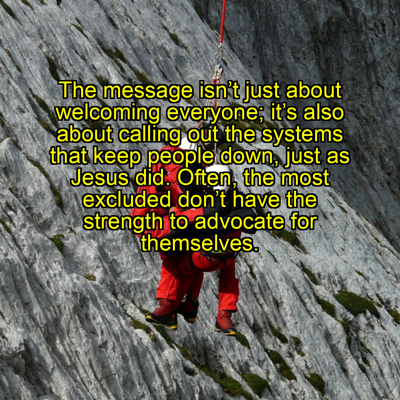
The message isn’t just about welcoming everyone; it’s also about calling out the systems that keep people down, just as Jesus did. Often, the most excluded don’t have the strength to advocate for themselves.
Speaking out makes a difference. Change is possible if we follow Christ and lift our voices. History shows that when people refuse to hide and keep speaking up, hope and justice can prevail.
Sometimes the cost of doing the right thing is extreme, but it’s what Christ calls us towards. The cost is easier to bear if we take it on together, supporting each other as a community.
Remember, you are blessed and seen by Christ. You belong here. If you don’t have the strength to speak out against injustice right now, that’s okay. Offer the gifts you have, and know that receiving is good too.
When you are stressed or weighed down by anything, remember, Jesus sees you. He always sees us when we are most burdened, drawing us close and holding us in our pain.
We stand tall, so others can stand tall too. Together, we shoulder each other’s burdens and create a community where everyone is seen, valued, and loved.
Hi, I'm an AI assistant for the pastor that gave this sermon. What would you like to make from it?
Add this chatbot onto your site with the embed code below
<iframe frameborder="0" src="https://pastors.ai/sermonWidget/sermon/20250824_sermon_on_the_bent_over_woman_-_stand_talldocx" width="100%" height="100%" style="height:100vh;"></iframe>Copy